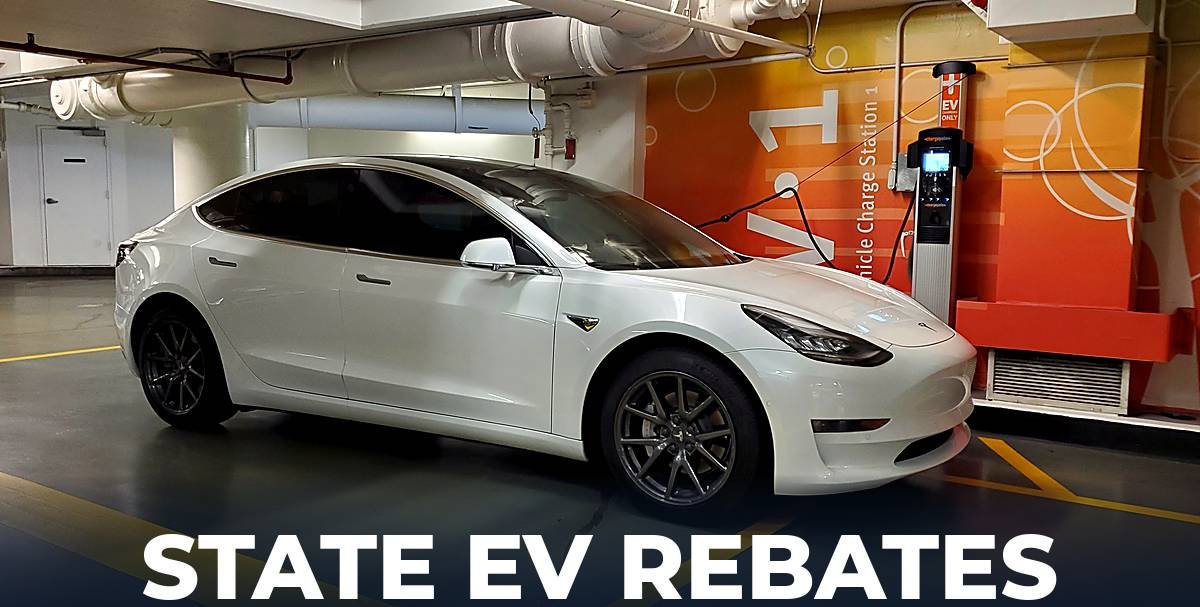
Yes — California will still hand you $3,500 toward a new electric car in November 2026. Not as a tax credit you claim next spring, but as an instant discount at the dealership counter. Illinois will send you $2,000 if you buy before December 31. New York knocks up to $2,000 off at the dealer, Massachusetts pays $3,500, and Colorado offers up to $3,250.
What nobody will hand you anymore is the federal $7,500 credit. That ended for vehicles bought after September 30, 2025 — more than a year ago. Since then, the EV discount map has turned into a patchwork: a few states pay real money, most pay nothing, and one — Minnesota — has the rebate on paper but an empty account in practice.
Here is every state program we could verify as active this month, with the amounts, the catches, and the official pages to check before you sign anything.
| State | What you get | How it arrives | Deadline |
|---|---|---|---|
| California | $3,500 new / $1,750 used | Instant, at the dealer | While funds last |
| Illinois | $2,000 ($4,000 low-income) / $1,500 e-motorcycle | Rebate check by mail | Buy by Dec 31, 2026 |
| New York | $500–$2,000 | Off the price at the dealer | Ongoing |
| Massachusetts | $3,500 (up to $6,000 with adders) | At the dealer or online | Ongoing |
| Colorado | Up to $3,250 | State tax credit, assignable at sale | Tax year 2026 |
| Minnesota | $2,500 new / $600 used — funds exhausted | — | No new applications |
The federal $7,500 credit is gone — and it is not coming back soon
The clean-vehicle credit of up to $7,500 for new EVs (and $4,000 for used ones) ended for vehicles acquired after September 30, 2025, when Congress repealed it in Public Law 119-21. The commercial “lease workaround” credit went away the same day. The 30% home-charger credit (up to $1,000) held on a little longer, then expired for equipment put in service after June 30, 2026. EV Digest’s 2026 guide tracks the full phaseout.
One narrow exception survived: if you signed a binding written contract and paid for the car on or before September 30, 2025, you can still claim the credit even if the car showed up later. That is an IRS transition rule — not something anyone can still use.
The market felt the cutoff right away. Americans bought a record 438,487 EVs in the third quarter of 2025 — 10.5% of all new cars — rushing to beat the deadline, then sales crashed to roughly 234,000 (5.8%) in the fourth quarter. The good news is that the slide has stopped. Kelley Blue Book reports Americans bought more EVs in the third quarter of 2026 than in any quarter since the credit ended — about 6.5% of the market, up 7.7% from the second quarter, the first real growth in a year.
“What we’re seeing now is a market finding its footing again,” said Stephanie Valdez Streaty, director of Industry Insights at Cox Automotive, KBB’s parent company. “The third quarter was the best result in a year, and improvement through 2026 suggests the reset phase is largely behind us.” She added that pump prices are helping the case: “With gas prices well above $4 a gallon, electric vehicles look better than ever.” KBB’s full sales breakdown has the brand-by-brand numbers.
California: $3,500 off at the counter for first-time EV buyers
California’s MyFirstEV program is the closest thing America has to a replacement for the federal credit. It takes $3,500 off a new zero-emission vehicle with an MSRP up to $50,000 — or $1,750 off a used one sold for up to $25,000 through a manufacturer’s pre-owned program — right at the point of sale. No tax forms, no waiting until April.
The catch is in the name: it is for first-time ZEV buyers only. The state says the program is open to any Californian buying their first zero-emission vehicle, and each person gets one incentive. Battery electrics and hydrogen fuel-cell vehicles count; plug-in hybrids do not. Used cars have to be at least two model years older than the year you buy.
The program started as Senate Bill 168, signed on July 13, 2026, and opened on August 7 with Hyundai, Lucid, and Tesla first in line. Ford, Rivian, Chevrolet, and Kia joined in August; Toyota, Lexus, Honda, and Subaru came aboard in September, with more brands scheduled through the fall. The state put up $135.5 million and participating automakers matched it dollar for dollar — roughly $271 million in total point-of-sale savings.
Demand was instant. Governor Gavin Newsom’s office said nearly 12,000 Californians had used the rebate in its first two months, and zero-emission vehicles held 19.1% of new-car sales in California in the third quarter of 2026. Tesla’s slice of the money lasted about five days — its allocation covered inventory orders placed August 3 through 7 and then ran dry. The lesson: each brand’s funding is separate, so “the program has money” and “your brand has money” are two different statements. Confirm with the dealer before you count on it.
Two more things worth knowing. First, the discount stacks with other California programs such as the Driving Clean Assistance Program and Clean Cars 4 All. Second, Toyota noticed the first-timer rule was leaving money on the table and launched its own privately funded answer: MyNextEV and MyLexusEV give Californians who already owned an EV an instant $2,500 off an eligible Toyota or Lexus electric car. The CARB program page has the official rules, and the governor’s October 16 update confirms which brands still have money.
“California is putting its foot on the accelerator,” Newsom said when the program launched in July — and two months and 12,000 rebates later, the numbers suggest buyers agree. One caution from EVXL’s tracking of the rollout: when a single brand’s allocation runs out, its cars lose the discount even while other brands keep theirs.
Illinois: $2,000 back — but the clock runs out December 31
The Illinois EPA’s Electric Vehicle Rebate Program pays $2,000 for a new or used EV, $4,000 for qualifying low-income buyers, and $1,500 for an electric motorcycle. The current application window opened August 1, 2026 and closes December 31, 2026 — and Illinois counts postmark dates, so a form mailed on New Year’s Eve does not count.
The rules that matter: you have 180 days from the purchase date to apply, the vehicle’s price cannot top $80,000, and applications go in by mail only. Lawmakers appropriated $14 million for the program in the fiscal year ending June 30, 2027, and rebates are paid only while the money lasts. If you are shopping in Illinois, the Illinois EPA’s official FAQ is the page to bookmark.
New York: $500 to $2,000 off at the dealer
New York’s Drive Clean Rebate comes straight off the price at participating dealers — no paperwork chase. The amount tracks electric range: more than 200 miles of range gets you $2,000, 40 to 199 miles gets $1,000, and under 40 miles gets $500. Cars with an MSRP above $42,000 drop to $500 no matter the range.
The state added $30 million to the program in April 2026, and NYSERDA says more than 228,000 rebates have gone out since 2017. “NYSERDA is proud to partner with dealerships statewide on the Drive Clean Rebate to lower EV costs for New York drivers and their families,” said Doreen M. Harris, NYSERDA’s president and CEO, in the state’s April 2026 announcement. Check NYSERDA’s program page for the current eligible-model list.
Massachusetts: $3,500, and up to $6,000 if you stack the adders
Massachusetts’ MOR-EV program pays $3,500 for a new battery-electric or fuel-cell vehicle with a total MSRP of $55,000 or less — at participating dealers, or online within 90 days of purchase. Income-qualified buyers can add $1,500 through MOR-EV+, and trading in a gas or diesel car adds another $1,000. Stack all three and you are at $6,000.
One caution: the used-EV track was revised during 2026, so check mor-ev.org for the current used-vehicle rules before counting on a used-car rebate.
Colorado: up to $3,250 as a tax credit
Colorado’s Innovative Motor Vehicle credit works differently — it is a state income-tax credit, not a rebate check. For tax year 2026 the base credit is $750, plus another $2,500 if the vehicle’s MSRP is under $35,000, for a maximum of $3,250. The credit only applies to vehicles priced at $80,000 or less, and you can assign it to the dealer at purchase so it still feels like a point-of-sale discount. The Colorado Energy Office’s EV hub has the current forms.
Minnesota: the rebate exists — the money does not
Minnesota gets a section precisely because it is the trap. On paper, the state’s EV rebate law pays $2,500 for a new EV (MSRP under $55,000) and $600 for a used one, and the statute runs through June 30, 2027. In practice, the legislature’s $15 million was fully claimed by early 2025 — more than 6,600 rebates went out between February 2024 and January 2025 — and the Department of Commerce says plainly that it is no longer taking new applications.
The legislature could refund the program, but as of November 2026 it has not. Do not subtract $2,500 from any quote in Minnesota. Check the Commerce Department’s EV rebates page before you believe a dealer who says otherwise.
How the math actually changes
A point-of-sale rebate is not just a tax credit that arrives sooner — it changes what you finance. Take California: $3,500 off at signing on a $40,000 EV means you are borrowing $36,500 (plus tax and fees) instead of $40,000. At today’s auto-loan rates, that is real monthly-payment money, not a refund you wait a year to see.
Two warnings from this month’s data. First, per-brand funding runs out: Tesla’s California allocation lasted five days, so “the program has money” and “your brand has money” are different statements — confirm with the dealer before you count it. Second, stack carefully: California lets MyFirstEV combine with other state programs, but every state writes its own combination rules, and the official program page always beats a dealer’s memory of last year’s rules.
And if your state is not on this list? The federal map is mostly blank now — but check your utility company too. Many utilities still offer EV charger rebates or time-of-use rates that cut what you pay to charge, and those do not depend on Congress or the statehouse.
EV rebate questions, answered
Is there still a federal EV tax credit in November 2026?
No. The $7,500 new-vehicle credit (and the $4,000 used-vehicle credit) ended for vehicles acquired after September 30, 2025. The only surviving path is a binding written contract signed and paid on or before that date.
Which state pays the most for a new EV right now?
California and Massachusetts both pay $3,500 at the point of sale; Colorado offers up to $3,250 as a state tax credit. Illinois pays $2,000 through the end of 2026.
Do I have to be a first-time EV buyer to get California’s $3,500?
Yes — MyFirstEV is limited to Californians buying their first zero-emission vehicle. Toyota’s own MyNextEV and MyLexusEV programs pay $2,500 to repeat buyers of eligible Toyota and Lexus EVs.
Can I get an EV rebate in Minnesota?
Not right now. The program’s $15 million was fully claimed by early 2025 and the state is not taking new applications, though the underlying law runs through June 30, 2027 and could be refunded.
Does Illinois’ rebate cover used EVs?
Yes — $2,000 for a new or used EV, $4,000 for qualifying low-income buyers. You must apply within 180 days of purchase, and the current window closes December 31, 2026.
Are plug-in hybrids eligible for California’s MyFirstEV?
No. Only battery-electric and hydrogen fuel-cell vehicles qualify — plug-in hybrids are excluded.