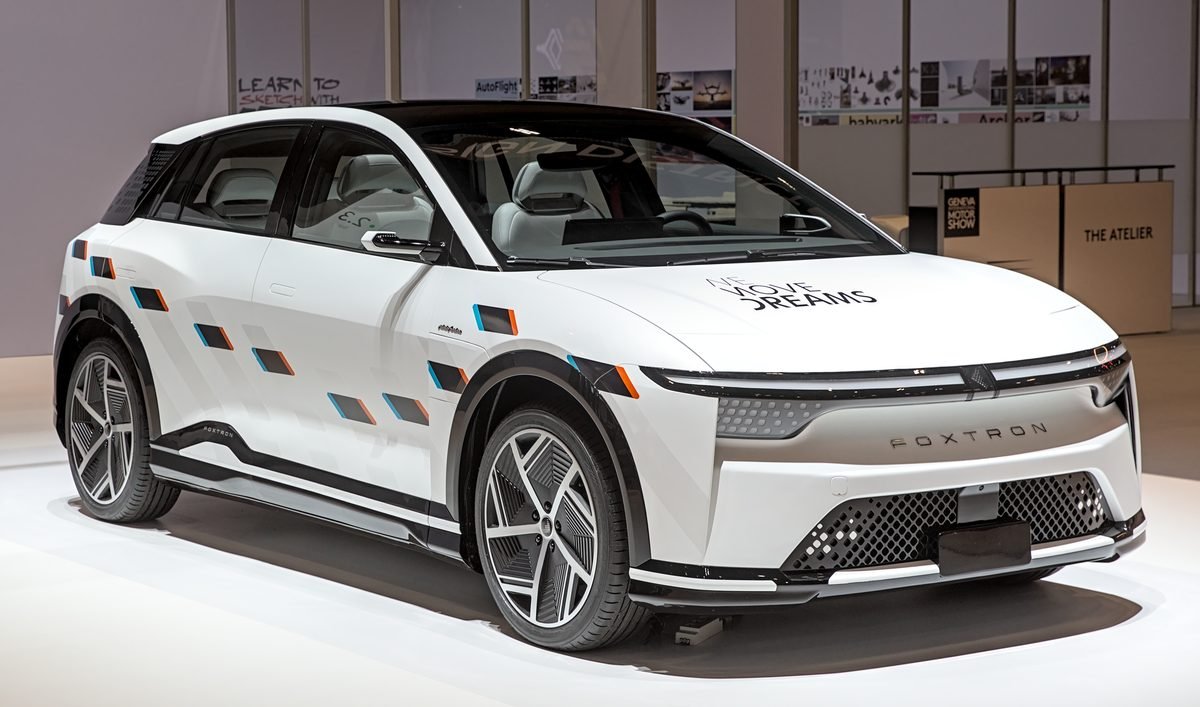
Foxconn — the Taiwanese giant that assembles iPhones for Apple — just added three more electric vehicles to a lineup you will never see in a showroom. On Friday, October 30, Foxconn unveiled three new electric vehicles at Hon Hai Tech Day 2026 in Taipei: the MODEL A+ B-segment SUV, the MODEL K+ lifestyle SUV, and the MODEL K kei-class commercial truck. The trio takes the company's catalog of reference EVs to 12 models — and every one of them exists so that some other company can put its own badge on it and start selling cars without spending billions on development.
If that sounds strange, it shouldn't. It is exactly how your phone got made. And Foxconn is betting the car business is about to work the same way.
The three new EVs, one by one
All three models broke cover at HHTD26, Foxconn's flagship annual tech conference, now in its seventh year. Here's what each one is — and who it's for.
MODEL A+: the B-segment SUV with in-wheel motors
The MODEL A+ is Foxconn's play for the fastest-growing slice of the SUV market: the B-segment, the small crossovers that now dominate sales charts from Europe to Southeast Asia. Foxconn describes it as an "expressive luxury style yet authentic SUV for affluent drivers," which is marketing-speak for a small SUV that looks expensive without costing it.
The interesting bit is underneath. The MODEL A+ uses in-wheel motor technology and a selectable electrical/electronic architecture (EEA) — meaning the motors sit inside the wheels themselves, freeing up cabin space, and buyers can pick the electronic backbone that suits them. Foxconn pitches it for a very specific set of uses: flood capability for emergencies, temporary living space, and backup power for glamping and camping. That last one is telling — Foxconn isn't just designing transportation, it's designing for the outdoor-lifestyle market where a car doubles as a power source.
MODEL K+: Japan's city pop era, electrified
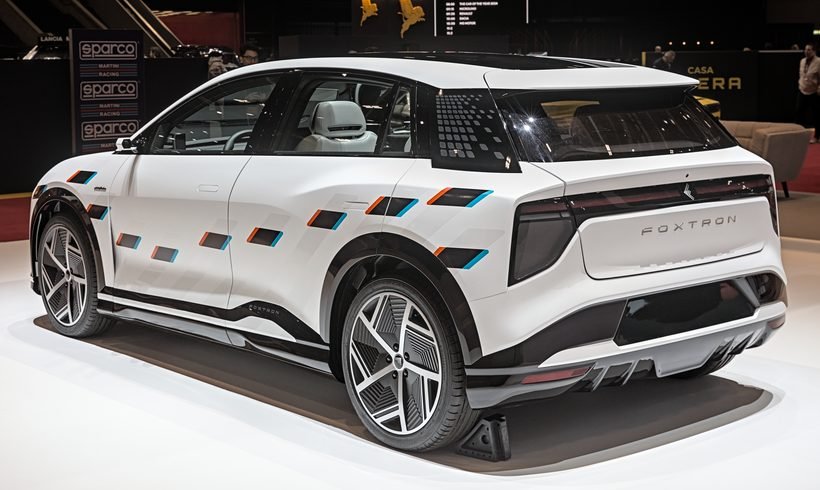
The MODEL K+ might be the most fun of the three. It's an affordable SUV aimed at young buyers, with styling Foxconn says nods to Japan's city pop music era of the '70s and '80s — think neon-soaked Tokyo nightlife — reinterpreted as "neo city pop" for today. Like the A+, it runs in-wheel motors, and Foxconn stresses how customizable it is: exterior, interior, driving range, and electronic architecture can all be tailored.
The target customer here isn't a driver at all — it's a business. Foxconn says the K+ is for B2B clients that want to build their own lifestyle SUV brand, and for established automakers hunting for an affordable, distinctive EV to sell to younger buyers. In other words: here's a finished youth SUV, add your logo, start selling.
MODEL K: the kei truck
The MODEL K goes after one of the most specialized — and most loyal — vehicle markets on earth: Japan's kei trucks. These tiny commercial trucks are the backbone of last-mile delivery and small business across Japan, and the MODEL K is Foxconn's electric take on the formula: functional, futuristic, and aimed squarely at fleet buyers.
Foxconn says the truck borrows its design language from the award-winning MODEL T electric bus, comes canopy-ready, and stretches the formula with a lower bed height and longer bed length than a typical kei truck. The pitch to buyers is pure business math: lower total cost of ownership through cheaper energy and less maintenance, plus compliance with tightening environmental rules — catnip for decarbonization-focused entrepreneurs, municipalities, and government agencies.
Wait — what does "reference EV" actually mean?
This is the part most coverage skips, and it's the whole story. A "reference EV" is not a car you can buy. It's a finished design that Foxconn will build for you. The company's pitch is called CDMS — contract design and manufacturing service — and it works exactly like the iPhone business: Apple designs the experience and the brand, Foxconn handles the engineering and the factories.
"The new reference EVs join Foxconn's emerging ecosystem in electromobility that is accelerating time-to-market, time-to-cost and time-to-technology for our customers and partners," said Jun Seki, Foxconn's Chief Strategy Officer for EV, at the unveiling.
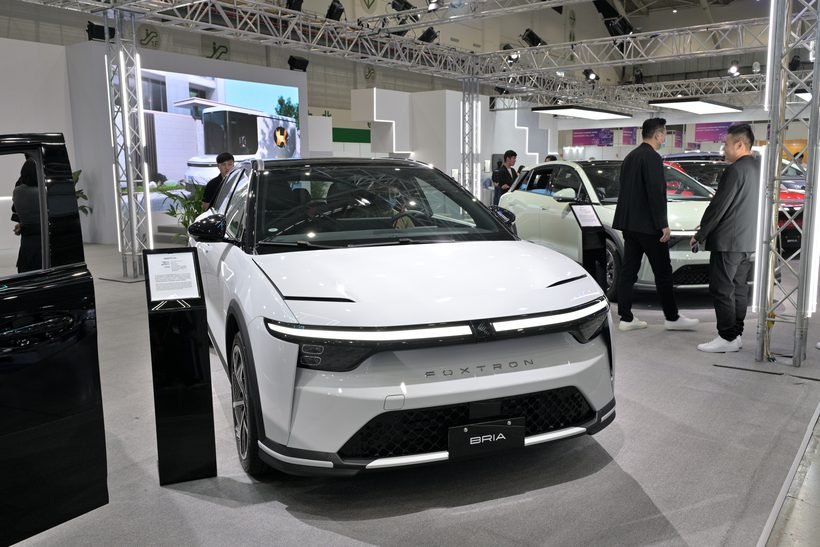
The catalog now runs to 12: the large MODEL T bus, the MODEL C passenger SUV, the MODEL E luxury sedan, the MODEL B crossover SUV, the MODEL V truck, the MODEL N cargo van, the MODEL D LMUV, the MODEL U midi-bus, the modular MODEL A — and now the A+, K+, and K. And this isn't just a shelf of concepts. Foxconn's joint venture Foxtron already has a production car on the road: the Luxgen n7, based on the Model C, is on sale in Taiwan. At HHTD26, a right-hand-drive MODEL B sat on the exhibition floor as a live example of what a CDMS collaboration looks like when it rolls off the line.
Why this matters: Foxconn wants to be the TSMC of EVs
Here's the bet, in one sentence: building cars is about to become like building phones and PCs — too expensive and cutthroat to do in-house, so everyone outsources it to a specialist. Foxconn wants to be that specialist.
Chairman Young Liu said it outright at the event: "Foxconn is transforming into a technology manufacturing platform service provider. From testing to the tangible, our vertical integration and precision manufacturing makes the impossible possible. We are building this kind of strength across ecosystems of smart consumer electronics to AI and EV, as well as in space and robotics."
He's made the comparison explicit before. Speaking to Reuters ahead of this year's Tech Day, Liu said the EV business could follow the path of the early personal computer industry, where brutal competition made in-house manufacturing unsustainable and pushed everyone toward outsourcing. He also predicted a shakeout in China's crowded EV market "soon" — and in that kind of shakeout, the company selling shovels usually does just fine.
Now the honest caveat, because the gap between ambition and reality matters. Foxconn quietly pushed back its once-ambitious target of grabbing 5% of the global EV market late last year as demand cooled. And for American readers, there's a dollars-and-cents angle: with US tariffs now pushing some EVs out of the American market entirely, cost pressure is exactly what makes an outsourced, cost-competitive EV platform attractive to automakers. Foxconn's pitch lands harder when building your own EV just got more expensive.
The Japan push is the real story
Look past the three reveals and notice where Foxconn is pointing them: Japan. The MODEL K kei truck is built for Japanese commercial buyers. The MODEL K+ wears Japanese pop culture on its sleeve. And the guest list at HHTD26 told the same story — Honda R&D and Mitsubishi Electric Mobility both took the stage in Taipei to discuss their electromobility work with Foxconn, and Liu has been openly calling for a Taiwan-Japan EV alliance, arguing Taiwan's fast-moving electronics industry and Japan's automotive precision are a natural fit.
There are also live talks behind the pageantry: Reuters reports Foxconn is in discussions with Japan's government about potential AI and EV investments, and Asian press has reported for months on negotiations for Foxconn to build EVs for Mitsubishi Motors. None of that is a signed deal — treat the Mitsubishi production talks as reported, not confirmed — but the direction is unmistakable. Japan's automakers, caught flat-footed on EVs, are exactly the kind of customers Foxconn's CDMS catalog was built for.
What to watch next
The question hanging over all 12 models is the same one that has followed Foxconn's car ambitions for five years: will a real automaker actually pick one up? The pieces are moving in the right direction. The Luxgen n7 proved the Foxtron formula can reach production. The right-hand-drive MODEL B on the HHTD26 floor showed what a finished CDMS collaboration looks like. And the HHTD26 exhibition went beyond cars entirely — full-stack, made-in-Taiwan batteries from raw materials to cells to packs and battery management, plus E/E architecture and powertrains for two- and three-wheelers. Foxconn isn't just selling car designs; it's selling the entire electric supply chain underneath them.
The broader market is moving Foxconn's way, too. The world just registered a record 11 million battery-electric vehicles in nine months — somebody has to build all of those, and fewer and fewer automakers want to do it alone. Years ago, Young Liu joked, "I hope one day we can do Tesla cars for Tesla." Nobody's laughing at the ambition anymore. The only question is which automaker's badge ends up on a Foxconn-designed EV first — and whether the MODEL A+, K+, or K will be the one.
The bottom line
Foxconn didn't unveil three cars this week. It unveiled three products — finished EV designs, ready for an automaker to buy, badge, and sell. The MODEL A+ chases the booming small-SUV segment with in-wheel motors, the MODEL K+ chases young Japanese buyers with city-pop style, and the MODEL K chases Japan's kei-truck fleets. Twelve reference models deep, with batteries, electronics, and factories to back them up, Foxconn's message to the car industry is getting harder to ignore: you don't have to build your EV. We'll build it for you.