The launch happened
: here is what is confirmed
So it is official. Hero MotoCorp did launch the updated Xtreme 160R 4V on Friday, October 16, 2026, in New Delhi, exactly as the teasers promised. The launch event also brought a refreshed Xtreme 250R, which tells you how serious Hero is about its premium lineup right now. The company has been talking about "premiumisation" for a couple of years, and this double launch is the clearest proof yet that it means business.
Let us get the housekeeping out of the way first, because there is always a bit of noise around Indian launches. Hero calls the bike "all-new," and that is marketing doing its job. The trade press is more measured, and frankly more accurate: this is a heavy update, not a clean-sheet motorcycle. The 163.2cc engine is carried over with a small power bump, the frame is familiar, and the real changes are in the styling, the variant lineup and the electronics. Autocar India calls it a refined design and electronics update on the same engine That does not make it boring. In the 160cc segment, where buyers obsess over feature checklists, this is the kind of update that moves metal.
The important thing for anyone shopping this bike: every price Hero announced is introductory. The Standard starts at Rs 1.27 lakh (about $1,450 at current exchange rates), the Pro at Rs 1.37 lakh (about $1,560), and the new top Carbon at Rs 1.41 lakh (about $1,600), all ex-showroom Delhi. USD figures are approximate and shift with the exchange rate.
Price and variants: three grades, clearly separated
Hero has split the Xtreme 160R 4V into three variants, and the separation between them is genuinely meaningful. This is not just paint and stickers.
The Standard, at Rs 1.27 lakh, is essentially the old base model carried forward with the new styling. It keeps a mechanical throttle cable, a conventional telescopic front fork, a color LCD console and single-channel ABS, with disc brakes at both ends. That price actually undercuts the old base model by about Rs 8,000, which is an interesting move. It gives Hero a sharp entry point while the fancy stuff lives higher up the range.
The Pro, at Rs 1.37 lakh, is where the bike gets interesting. This is basically last year's Combat Edition, reborn with the new design. You get ride-by-wire, three riding modes (Rain, Road and Sport), cruise control, a 37mm KYB upside-down front fork, dual-channel ABS, a seven-step adjustable rear monoshock and Panic Brake Alert. At this price, Autocar India notes the Pro is effectively Rs 1,000 cheaper than the Combat Edition it replaces, with a fresh design thrown in. That is aggressive pricing, and it is clearly aimed at the TVS Apache and Bajaj Pulsar crowd.
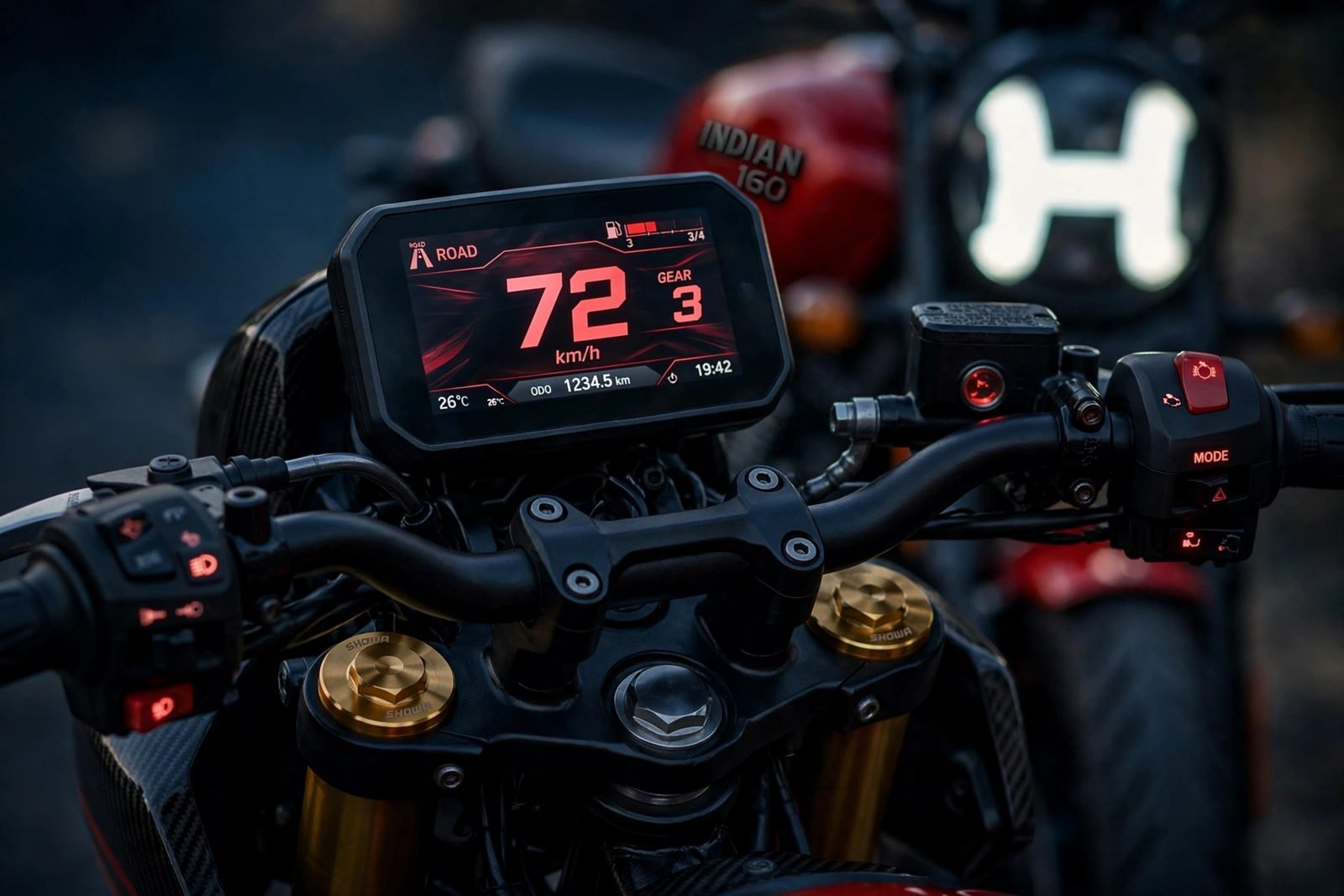
The Carbon, at Rs 1.41 lakh, is just Rs 4,000 above the Pro, which makes the jump nearly a no-brainer if you want the top spec. Over the Pro it adds the new TFT display, illuminated soft-touch switchgear, an adjustable clutch lever and a colored front alloy wheel. ZigWheels also lists the adjustable clutch lever as a Carbon exclusive, and Rushlane's breakdown agrees the Carbon is the one to have if you are spending this money. For Rs 4,000, the TFT alone settles the argument. ZigWheels' full launch breakdown lays out the variant-by-variant equipment split
There is one catch on timing. The Standard does not reach showrooms until January 2027, according to multiple outlets including Rushlane and ZigWheels. The Pro and Carbon are the ones you can actually buy soon.
Design: Hero's "Cybersharp" language, sharper everywhere
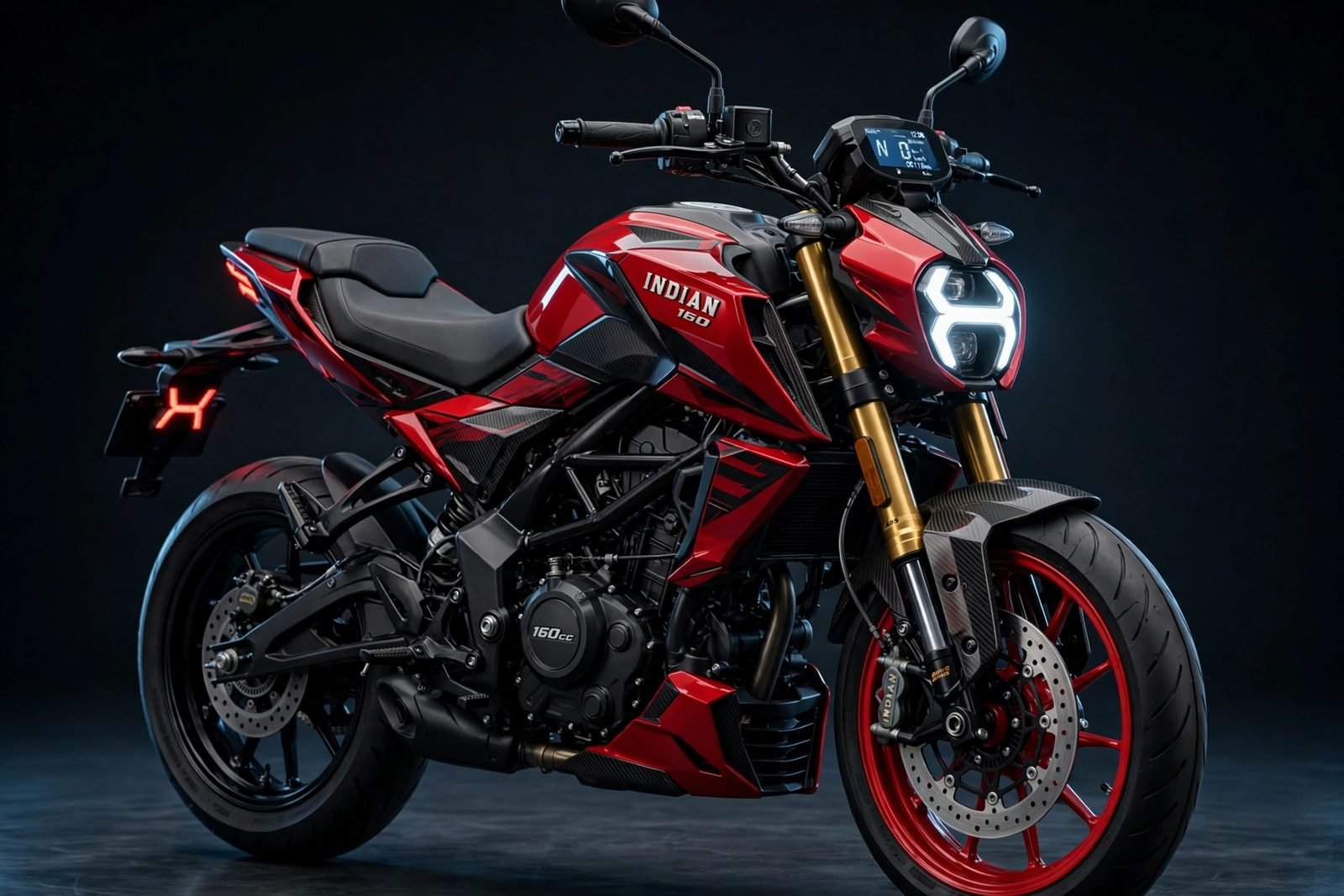
Hero calls the new design language "Cybersharp," and it is exactly what it sounds like: angular tank shrouds, a more muscular stance, reshaped body panels and prominent graphics. The fuel tank has been reworked with a focus on knee grip and rider comfort, which matters more than it sounds on a bike people will commute on daily. The rider triangle has been tweaked, the seat is now 16mm longer at 642.9mm per BikeWale, and buyers can pick between single and split-seat layouts.
The lighting is fully modern now. There is an auto-illuminating Class D LED headlamp with a projector high beam and an ambient light sensor, H-shaped daytime running lights up front, an H-shaped LED tail lamp and full-LED turn indicators. The H signature is Hero's family face, and it ties the 160R visually to the rest of the range.
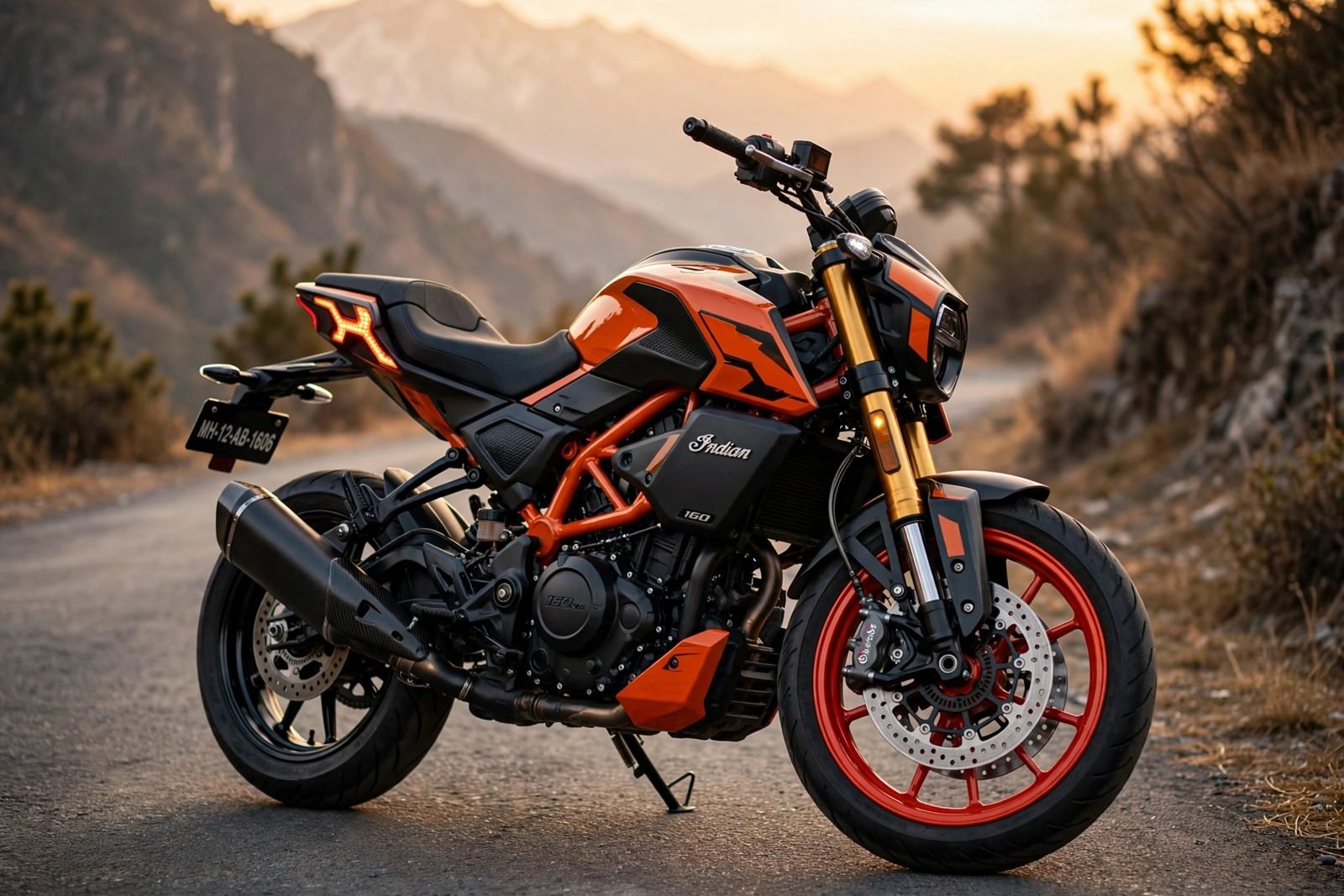
Colors are spread across the variants. Standard comes in Firestorm Red and Pearl Black. The Pro gets Pro Red and Pro Black. The Carbon gets four choices: Carbon Red, Carbon Black, Carbon Grey and Abrax Orange, that last one being the loud one. Rushlane has the full color and styling breakdown with launch imagery Hero has also rolled out an accessories range with a headlight cowl, lever guards, tank grips, engine guards, winglets and a seat cover, per ZigWheels, which is a nice touch for a segment where personalization sells.
Engine and performance: familiar motor, slightly sharper
Under the bodywork, the story is continuity. The 163.2cc four-valve, air-and-oil-cooled single-cylinder engine carries over, mated to a five-speed gearbox. Peak power is up marginally to 17.1 PS at 8,750 rpm, compared to 16.9 PS before, and it arrives 250 rpm later in the rev range. Torque is unchanged at 14.6 Nm at 6,500 rpm.
Is 0.2 PS meaningful? Not really, and Hero does not pretend it is a revolution. What Hero does claim is that the bike does 0 to 60 km/h in 4.4 seconds, calling it the fastest motorcycle in its segment. That is a manufacturer claim, and it should be read as one, but it sets the tone: Hero wants the Xtreme to be seen as the quick one in this class. BikeWale's launch report covers the performance claims and the longer service intervals
One practical ownership change deserves a mention. Neither an oil change nor a tappet adjustment is required until 6,000 km now, per BikeWale's report. On a commuter-sport bike that will rack up miles in Indian traffic, fewer early service visits is a real quality-of-life improvement, and it trims running costs.
Electronics: the real story of this update
This is where the 2026 bike justifies its existence. The ride-by-wire throttle on the Pro and Carbon unlocks three riding modes, Rain, Road and Sport, which adjust throttle response for commuting, wet roads and spirited riding. Cruise control, which debuted on last year's Combat Edition, continues here, and it can be activated above 30 km/h. It remains a segment-first feature at this price, and it is the kind of thing that makes long highway stints genuinely easier.
The Carbon's TFT display is the headline gadget. It is shared with the Xpulse 210, but Hero has changed the layout to suit the Xtreme's sportier character. Rushlane reports it offers day and night modes, connectivity and more than 60 features. Bluetooth brings call and message alerts, music controls, phone battery status and turn-by-turn navigation. BikeWale adds that the console shows riding modes, gear position, shift advisory, cruise-control status, distance to empty and real-time fuel economy. There is also a drag timer: D1 records your 0-60 km/h run, D2 measures a quarter-mile over 402 meters. Pre-launch reports from Latestly had suggested Google Maps mirroring on the TFT; the launch specification describes Bluetooth-based turn-by-turn navigation, so treat the Google Maps specifics as unconfirmed for now.
Elsewhere in the cockpit, there is illuminated soft-touch switchgear with a dedicated mode selector, an integrated kill-start switch, hazard lights and cruise control switches, a Type-C fast charging port, and Panic Brake Alert, which flashes a warning to traffic behind you during hard braking. Five-step adjustable levers are listed by BikeWale and Rushlane, though outlets disagree on whether both levers or just the clutch are adjustable and on which variants, so confirm with the dealer before you sign.
Chassis and hardware: solid, mostly unchanged
The chassis is a tubular underbone diamond-type frame. Suspension on the Pro and Carbon is a 37mm KYB upside-down fork up front with a seven-step preload-adjustable monoshock at the rear; the Standard makes do with a conventional telescopic fork. Braking hardware is a 276mm front petal disc and a 220mm rear disc, with dual-channel ABS on the Pro and Carbon and single-channel ABS on the Standard. Wheels are 17-inch alloys wearing 100/80 front and 130/70 rear tubeless tires.
The dimensions tell a familiar story. Autocar India reports the seat height is now 805mm, up a negligible 2mm, and kerb weight is 149kg, up 1.5kg. The fuel tank holds 12 liters, ground clearance is 165mm and the wheelbase is 1,329mm per Rushlane. A 149kg kerb weight keeps the Xtreme among the lighter bikes in this class, which pays off in city traffic and tight corners. Autocar Professional's launch coverage has the full technical rundown for both the 160R 4V and the 250R
Rivals: the 160cc war is hotter than ever
The Xtreme does not exist in a vacuum. The 160cc segment in India is one of the most fiercely contested two-wheeler categories on the planet, and both of the Xtreme's main rivals have been updated too.
The TVS Apache RTR 160 4V just got its own 2026 update. Prices run Rs 1,25,440 to Rs 1,37,440 ex-showroom Delhi across three variants. Its 159.7cc air-and-oil-cooled engine makes 17.55 PS at 9,250 rpm and 14.73 Nm at 7,250 rpm, paired with a five-speed gearbox and a slip-and-assist clutch. BikeDekho has the full details of the 2026 Apache RTR 160 4V lineup On paper, the Apache is the most powerful bike in the segment, and its top variant now packs a TFT display, traction control, USD forks and three ride modes (Sport, Urban and Rain). Kerb weight is 143kg, which undercuts the Hero by a useful margin. If outright spec-sheet power matters to you, the Apache is still the benchmark.
Then there is Bajaj. The Pulsar N160 story has gotten complicated, in a good way for buyers. The regular 2V N160 starts around Rs 1.22 lakh with a 160.3cc engine making 16 PS and 14.65 Nm. But Bajaj has also launched the N160 S (Rs 1,33,511) and N160 SS (Rs 1,42,585), which get a 164.9cc four-valve oil-cooled engine producing a hefty 18.5 PS, electronic throttle, traction control, four riding modes and a color TFT with navigation. BikeWale's weekly roundup covers the new Pulsar N160 S and SS launch That 18.5 PS figure is the biggest number in the class right now, and the SS at Rs 1,42,585 sits almost exactly on top of the Xtreme Carbon's Rs 1.41 lakh. If you are cross-shopping, that comparison is unavoidable.
So where does that leave the Hero? It is not the most powerful, and it is not the cheapest. Its argument is the package: cruise control remains unique in this class, the Pro at Rs 1.37 lakh undercuts the Apache's top variant by a whisker while matching its features, and the Carbon at Rs 1.41 lakh gives you a TFT, ride modes and cruise control for Rs 4,000 more than the Pro. 91bikes put it well in its launch assessment: "Cruise control, a feature rarely seen in this segment, makes the Xtreme 160R 4V one of the best-equipped 160cc bikes on sale." The honest advice is the same as always in this segment: test ride all three. The numbers only tell you so much; how the bike feels at 40 km/h in traffic tells you the rest.
What Hero is saying, and what it means
Anuj Dua, Hero MotoCorp's Chief Business Officer for the Premium Segment, framed the launch as part of a bigger strategy. Speaking at the launch, he said: "Premiumisation remains one of the biggest growth opportunities ahead of us and we continue to strengthen our position in this segment through sharper product differentiation and enhanced riding experiences. The Xtreme family is a key pillar of this strategy." He went on to call the 160R 4V "the fastest motorcycle in its segment, with a complete redesign and segment-first cruise control and Panic Brake Alert," while noting that both new launches are backed by Hero's Premia network of more than 130 stores.
That Premia detail is worth pausing on. Hero has been building Premia as its premium retail channel, separate from the regular Hero dealerships that sell Splendors and Passions by the truckload. The Xtreme twins being sold through both regular outlets and Premia stores shows Hero trying to have it both ways: mass-market reach with a premium buying experience. Whether that works depends on execution, but the intent is clear. Hero is the world's largest two-wheeler maker by volume, and it has decided the next phase of growth is moving upmarket, not just selling more commuters.
Bookings and deliveries
Bookings opened on October 17, 2026, the day after the launch, across Hero's showrooms and the Premia network. Deliveries of the Pro and Carbon begin November 1, 2026, which times things nicely for India's festive season, traditionally the biggest buying period of the year. The Standard follows later, with deliveries expected from January 2027. If you want the bike this year, in other words, you are buying a Pro or a Carbon, and at these prices, that is probably the right call anyway.
Why US riders should care
Let us be straight about this: the Xtreme 160R 4V is not coming to the United States, and it was never designed for American roads. It is an India-market motorcycle built for Indian traffic, Indian fuel prices and Indian budgets. But there are real reasons for US riders and industry watchers to pay attention.
First, the technology trickle. Cruise control, ride-by-wire and multiple riding modes on a $1,600 motorcycle is genuinely remarkable. Features that were superbike-only a decade ago are now standard equipment on a 160cc commuter-sport bike in India. That cost curve is what eventually brings affordable rider aids to small-displacement bikes everywhere, including the sub-400cc segment that is growing in the US with bikes like the Kawasaki Ninja 500 and the Honda CB300R. When Hero can put electronic throttle control on a bike this cheap, the economics of rider aids shift globally.
Second, Hero itself is a company Americans should know. It is the world's largest motorcycle manufacturer by volume, operates in 53 countries, and has a strategic alliance with Harley-Davidson that produced the X440. Its premiumisation push, with dedicated Premia retail stores and a growing lineup of feature-packed small bikes, is a case study in how emerging-market giants move upmarket. If you follow the motorcycle industry, Hero's moves today are a preview of the competitive pressure global brands will face tomorrow.
Third, the segment itself is instructive. The 160cc class in India is where brutal competition forces innovation at razor-thin margins. Three major manufacturers updating their 160s within weeks of each other, each trying to out-feature the others at under $2,000, is a pace of product development the US market rarely sees. The lessons about packaging, cost control and feature prioritization from this segment eventually show up in global products.
So no, you cannot buy one in Ohio. But the next time you see cruise control or riding modes on an affordable small bike in a US showroom, remember where the volume economics that made it possible were worked out.