The federal EV fee would charge every electric car $130 a year and every plug-in hybrid $35 a year, on top of your state fee. In Michigan, the total would reach $397 a year. The fee is not law yet — the House committee approved it 62–2 in May 2026, but it has not passed the House or Senate. If Congress passes it before Dec. 11, 2026, it could start in December.
What the federal EV fee adds to your state fee
| State | State fee now | Total with the $130 federal fee |
|---|---|---|
| California | $121 | $251 |
| Michigan | $267 | $397 |
| New Jersey | $270 | $400 |
The $130 federal fee sits in Section 1129 of the BUILD America 250 Act (H.R. 8870), as per govinfo.gov. The $7,500 federal EV tax credit ended for vehicles acquired after Sept. 30, 2025, according to the IRS. California’s $121 fee is as per the SF Inquirer; Michigan’s $267 and New Jersey’s $270 are as per SooperArticles.
The federal EV fee would charge every electric car $130 a year and every plug-in hybrid $35 a year. That is on top of your state fee. In Michigan, the total reaches $397 a year. The fee is not law yet. The fee sits in Section 1129 of the BUILD America 250 Act (H.R. 8870), as per govinfo.gov. The House Transportation and Infrastructure Committee approved the bill 62–2 in May 2026, but it has not passed the House or Senate. The $7,500 federal EV tax credit ended for vehicles acquired after Sept. 30, 2025, according to the IRS. As per USA Today, EV owners could face the $130 fee as soon as December.
How much is the federal EV fee?
The federal EV fee is $130 a year for every electric car and $35 a year for every plug-in hybrid. The fee sits in Section 1129 of the BUILD America 250 Act (H.R. 8870), as per govinfo.gov.
The fee is a flat annual charge. You pay it when you register your car. It does not change with how far you drive. A car that covers 5,000 miles a year pays the same $130 as a car that covers 25,000 miles.
The fee is meant to replace the gas tax that EV drivers do not pay. The federal gas tax is 18.4 cents a gallon, as per USA Today. It has not changed since 1993. The federal gas tax brings in about $40 billion a year. That figure comes from the Tax Policy Center, as per USA Today. Electric cars buy no gas, so they pay nothing into the Highway Trust Fund. The fee is meant to change that.
The states would collect it. That is how the bill is written, as per the SF Inquirer. There is no tracking and no mileage report, as per USA Today.
Do not trust the old numbers. An earlier draft set the fee at $135 a year. The current figure is $130, as per the SF Inquirer and USA Today.
Is the federal EV fee law yet?
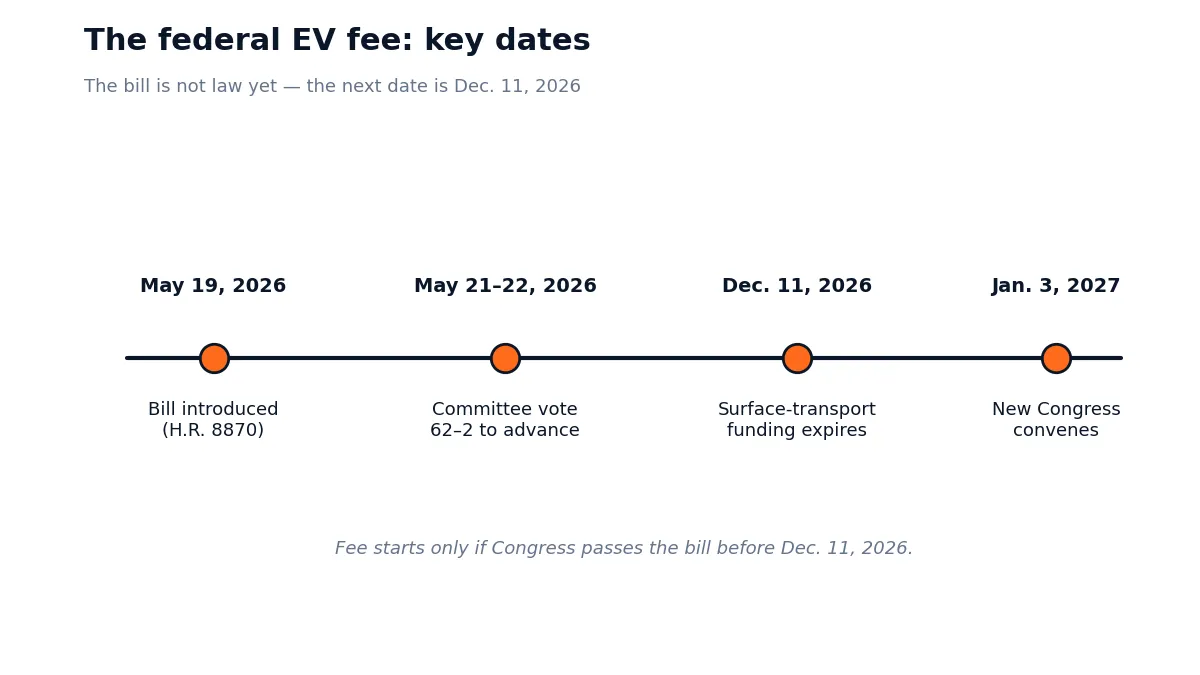
No. The federal EV fee is not law yet. The House Transportation and Infrastructure Committee approved the BUILD America 250 Act 62–2 in May 2026, as per the SF Inquirer. The bill has not passed the full House or Senate, as per USA Today.
A committee vote is an early step. A bill becomes law only after both chambers pass it and the president signs it. The BUILD America 250 Act has not reached the House floor, as per the SF Inquirer.
This matters because the December headlines can read as if the fee is certain. It is not. Until the House and Senate pass the bill, no EV driver owes the fee.
The bill is a five-year highway bill. It authorizes $474 billion for roads, mass transit, and other surface transportation programs from the Highway Trust Fund for fiscal years 2027 through 2031, as per the CBO’s July 9 score, reported by the Cato Institute. The House committee approved it. The full House has not voted.
When would the fee start?
The fee could start in December 2026 — but only if Congress passes the bill first. As per USA Today, EV owners could face the $130 fee as soon as December.
Surface-transportation funding runs out on Dec. 11, 2026. Congress extended the current funding to that date, as per USA Today. The BUILD America 250 Act is the bill that would replace it. If Congress passes the bill before Dec. 11, the fee could start in December.
The Dec. 11 deadline forces a choice. Congress must pass a new bill or extend the funding again. The fee only starts if the bill passes.
No start date is set, as per SooperArticles. If the bill does not pass by Dec. 11, the fee stays a proposal. The new Congress convenes on Jan. 3, 2027, as per CNBC.
Does the fee replace your state fee?
No. The federal EV fee sits on top of your state fee. It does not replace it.
The states would collect the federal fee. But the bill does not credit your state fee against the federal one, as per the SF Inquirer. You pay both.
This is the part that surprises most drivers. The federal fee is new money. Your state fee stays.
California charges $121 a year for a zero-emission vehicle from model year 2020 or later, as per the SF Inquirer. A California driver would owe about $251 a year in combined road fees. That is $121 to the state plus $130 to the federal government.
How much would you pay in total?
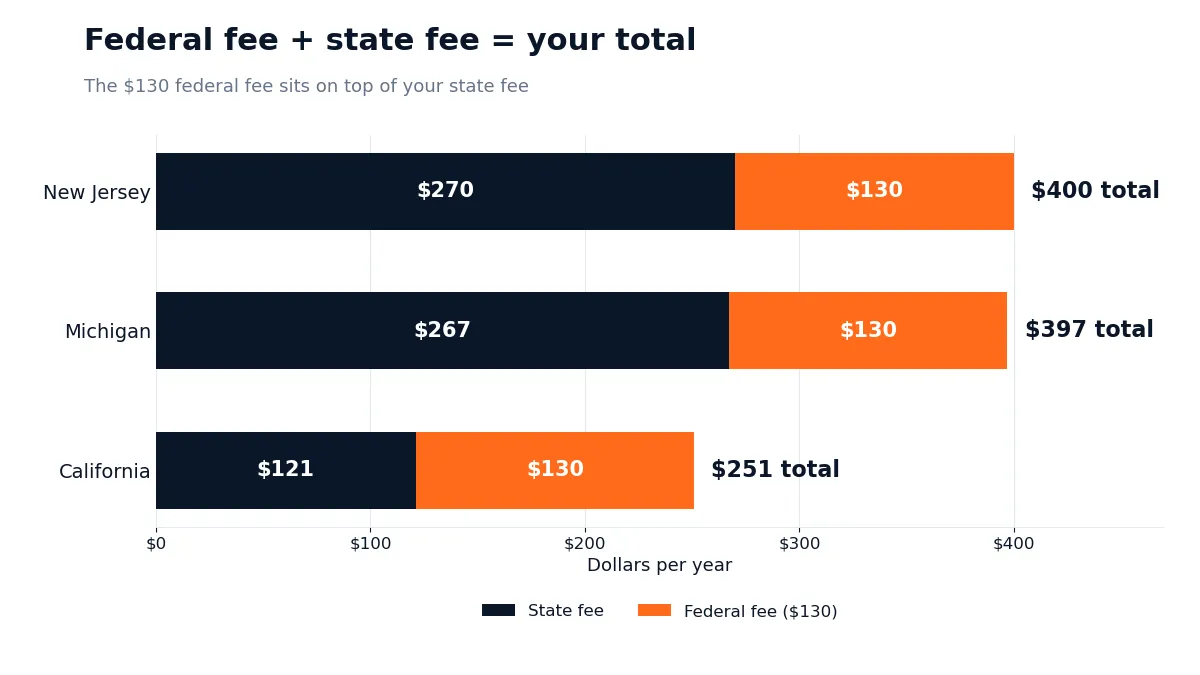
It depends on your state. In California, $251 a year. In Michigan, $397 a year. In New Jersey, $400 a year.
The combined total is the number that matters for your budget. The $130 alone does not tell the full story.
Michigan charges $267 a year, as per SooperArticles. Add the $130 federal fee and the total is $397. New Jersey charges $270, as per SooperArticles. Add the $130 and the total is $400. California charges $121, as per the SF Inquirer. Add the $130 and the total is $251.
The fee joins a longer list of EV ownership costs. Our Tesla Cybercab Autonomy Subscription Terms explainer covers the Cybercab subscription, and our Tesla Model Y RWD report covers the Model Y. Tesla Q3 2026 Results give the sales backdrop for the market the fee would hit.
How does $130 compare to what gas drivers pay?
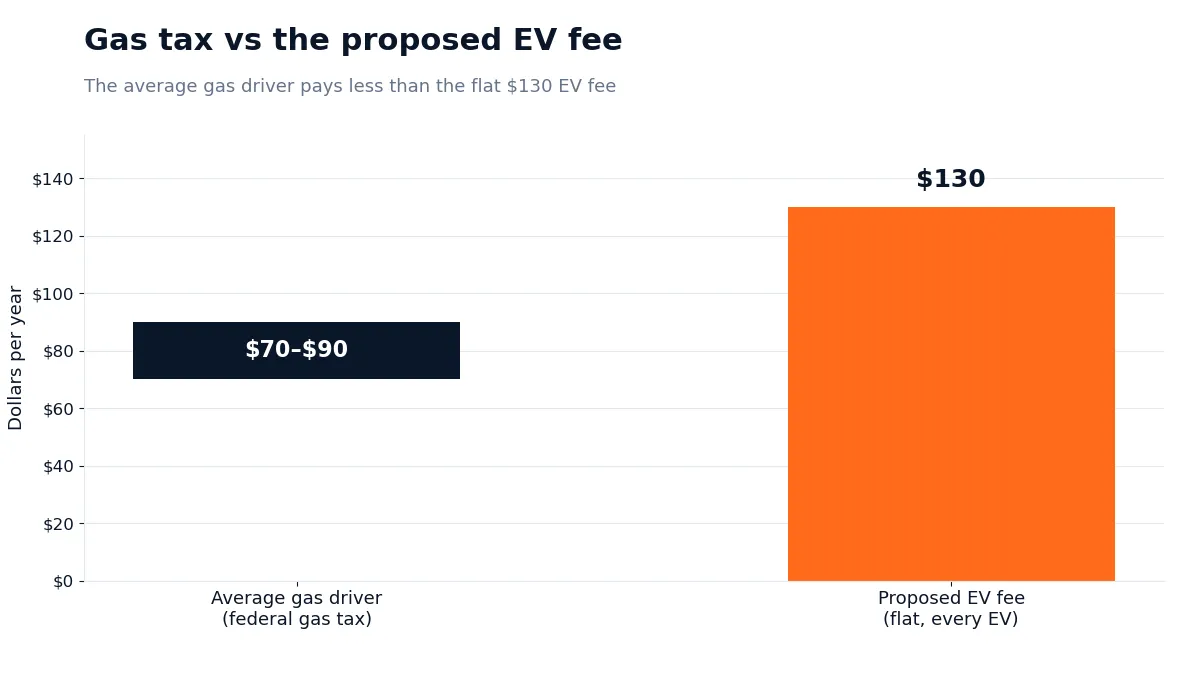
The average gas driver pays $70 to $90 a year in federal gas tax, as per SooperArticles. The proposed EV fee is $130. That is more than the average gas driver pays.
The gas tax works like a toll paid by the gallon. The more you drive, the more you pay. The EV fee is a flat annual pass. It costs the same for a car that rarely leaves the garage as for one on the road every day.
This is the fairness question at the heart of the bill. A flat fee charges light drivers more than they would pay in gas tax.
The break-even is about 15,000 miles a year, as per SooperArticles. A gas car driven less than that pays less federal tax than the proposed EV fee. A gas car driven more pays more.
The gap is widest for light drivers. The proposed fee is $130 whatever the distance, with no lower rate for a car that is driven little.
Will the fee go up?
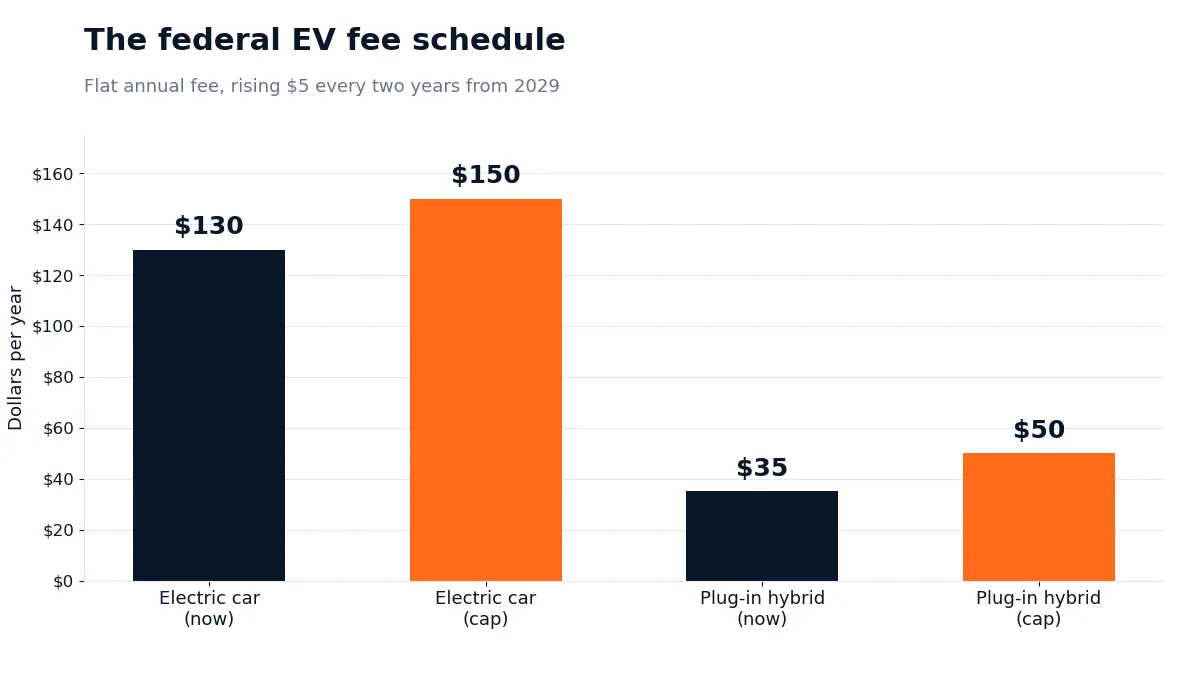
Yes. The fee rises by $5 every two years from 2029, as per USA Today. The EV fee would reach a cap of $150. The plug-in hybrid fee would reach a cap of $50.
The EV fee starts at $130. From 2029, it goes up by $5 every two years until it reaches $150. The plug-in hybrid fee starts at $35 and rises the same way until it reaches $50.
The bill runs from fiscal year 2027 through fiscal year 2031, as per the CBO’s July 9 score, reported by the Cato Institute.
Where does the money go?
The bill does not require the money to go to the Highway Trust Fund. That is the surprise in the text.
The fee is pitched as road funding. The BUILD America 250 Act is a highway bill. But the Congressional Budget Office found in its July 9 cost estimate that Section 1129 would not require the money to be deposited in the Highway Trust Fund, as per the SF Inquirer. Money that lands in the general Treasury can be spent on anything Congress chooses.
This matters because the whole pitch is that EV drivers should pay for the roads they use. If the money does not go to roads, the pitch breaks.
As per the CBO’s July 9 score, reported by the Cato Institute, the fees would raise a net $12.4 billion over nine years. The same score says the bill would add more than $147 billion to the debt over five years. That is about $1,100 per household.
What the other pages miss
We read the top pages for this question. Four things stood out. This section is what we found that the other pages miss.
First, the old numbers. An earlier draft set the fee at $135 a year. The current figure is $130, as per the SF Inquirer and USA Today.
Second, the combined total. No top page gives the federal fee plus the state fee in one table. We did. California $251, Michigan $397, New Jersey $400. Those totals come from the SF Inquirer and SooperArticles.
Third, the money trail. The fee is pitched as road funding. But the CBO found the bill would not require the money to go to the Highway Trust Fund, as per the SF Inquirer. Most pages skip that finding. We put it in the open.
Fourth, the status. The fee is not law yet. The House and Senate have not passed the bill, as per USA Today. Until they do, no EV driver owes the fee.
For the price end of the EV market, see our Tesla Roadster Price guide.
Frequently asked questions
Is the federal EV fee law yet?
No. The House Transportation and Infrastructure Committee approved H.R. 8870 62–2 in May 2026, but the bill has not passed the House or Senate, as per USA Today and the SF Inquirer.
How much is the federal EV fee?
$130 a year for an electric car and $35 a year for a plug-in hybrid, on top of your state fee, as per USA Today and the SF Inquirer.
When does the federal EV fee start?
No start date is set. If Congress passes the bill before Dec. 11, 2026, the fee could start in December, as per USA Today.
Do I still pay my state EV fee?
Yes. The federal fee sits on top of your state fee. California charges $121, Michigan $267, and New Jersey $270 — all on top of the $130 federal fee, as per the SF Inquirer and SooperArticles.
This article explains a proposed fee. It is not tax or legal advice. For your own situation, talk to a qualified tax professional.
How We Verified This Data
We checked the fee against the bill itself — Section 1129 of H.R. 8870, the BUILD America 250 Act, on govinfo.gov — and the $7,500 credit cutoff against the IRS. We checked the $130 figure and the Dec. 11 deadline against USA Today (Nov. 11, 2026), the CBO finding and the California fee against the SF Inquirer (Oct. 26, 2026), and the gas-tax comparison and the Michigan and New Jersey fees against SooperArticles (Nov. 12, 2026). We also checked the CBO’s July 9 score — a net $12.4 billion over nine years — as reported by the Cato Institute. We did not use the total number of states with their own EV fee, because our sources disagreed on it (41 vs 42).
Sources
- govinfo.gov — H.R. 8870, BUILD America 250 Act, Section 1129 (Registration fee on motor vehicles)
- IRS — Credits for new clean vehicles purchased in 2023 or after ($7,500 credit ended for vehicles acquired after Sept. 30, 2025)
- USA Today, November 11, 2026 — EV owners could face a new $130 annual federal fee as soon as December
- SF Inquirer, October 26, 2026 — The House highway bill would add a $130 federal fee for electric cars
- SooperArticles, November 12, 2026 — The $130 federal EV fee is still a proposal, and gas drivers pay $70 to $90
- Cato Institute, August 10, 2026 — CBO: New Highway Bill Has More Spending, Taxes, and Deficits
- economy-media, November 15, 2026 — Rivian, Lucid, Scout CEOs Not Counting on Democrats to Revive EV Aid (new Congress convenes Jan. 3, 2027, as per CNBC)