Tesla is inviting select customers to buy a Cybercab for personal use at $29,990 before taxes. The car will not operate without a $299-a-month Autonomy Subscription, with the first month included. You also pay a $1,000 non-refundable deposit, and the car only works inside Tesla’s Robotaxi service areas in Texas and Florida.
That is the deal in one paragraph. The rest of it is in the fine print, and the fine print is the story. The subscription is mandatory, not optional. It is pre-checked on the order page. The car has no steering wheel or pedals, so there is no way to drive it yourself if the subscription lapses. Insurance, registration, parking, charging and cleaning are all on you. And you cannot sell the car or put it on the Robotaxi network without Tesla’s permission. Here is every term that matters, what it costs over time, and where the car can actually go.
What the $299 Tesla Cybercab autonomy subscription covers
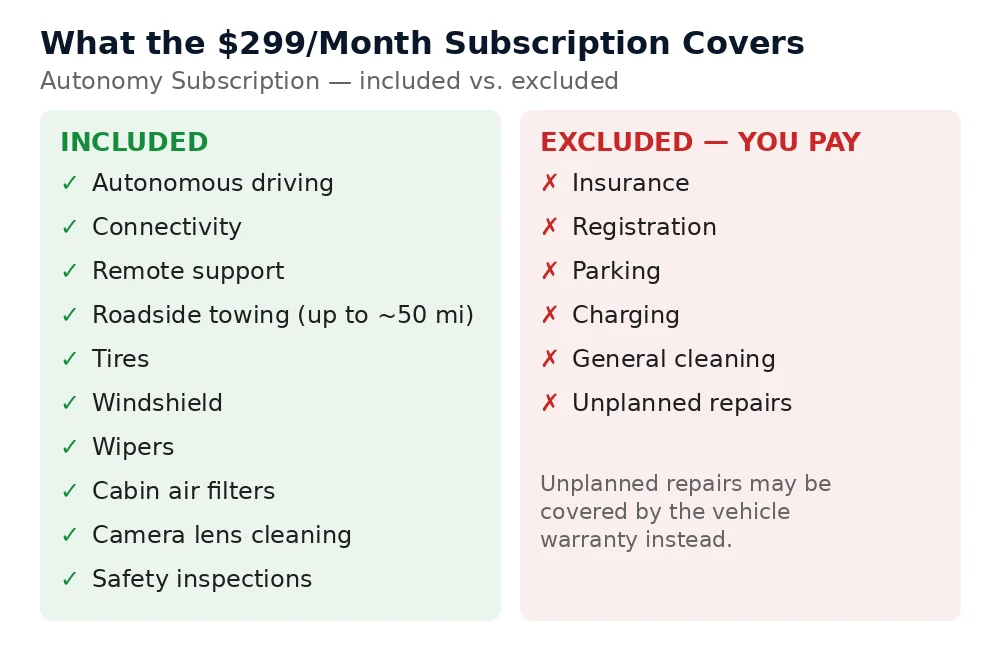
The Autonomy Subscription is what makes the car move. Under the agreement, the subscription covers autonomous driving, vehicle connectivity, remote support and roadside assistance, including towing of up to about 50 miles to a Tesla service centre or the owner’s home. It also covers a list of maintenance items the agreement calls Covered Services: front and rear tire replacements, windshield replacements, wiper service, cabin air filter replacements, exterior camera lens cleaning, hydrophobic coating upkeep and vehicle safety inspections.
The subscription renews every month and can be cancelled at any time, but payments are not prorated — cancel mid-month and you do not get the rest of the month back. Tesla says it will give one month’s notice before a price change. The $299 figure sits on the order screen, not in the agreement itself, so the agreement does not lock the price in.
What the subscription does not cover is just as important. Owners remain responsible for insurance, registration, parking, charging and general cleaning. Unplanned repairs are not included, though the vehicle warranty may cover them. Damage from misuse or intentional acts is excluded, and Tesla says it will ask for approval before doing work the owner will be billed for.
Does the Cybercab $299 subscription include insurance?
No. The $299 a month does not include liability insurance, and that is the question most buyers should settle before they order. Insurance, registration and maintenance are completely on the owner, and the car has no steering wheel — so a standard auto policy may not fit it cleanly. Insurers price risk on the driver, the car and how it is used, and a car with no driver at all does not sit in any of their usual boxes.
On liability, the picture is split. If a crash is caused by a software glitch, a sensor failure or a flaw in the driving system, Tesla may bear product liability as the manufacturer and software developer. If the registered owner puts the car into commercial use, their own insurance is typically the first source of recovery for injured third parties. Florida, where the Robotaxi service already runs, has no specific statute governing autonomous vehicle liability, so courts apply traditional motor-vehicle law alongside product liability principles. That means liability could fall on Tesla, on the owner, or on another driver, depending on the exact circumstances. Before ordering, talk to your insurer about what a policy for a steering-wheel-free car actually covers — and what it costs. That is not a detail to discover after delivery.
What happens if you cancel Cybercab subscription?
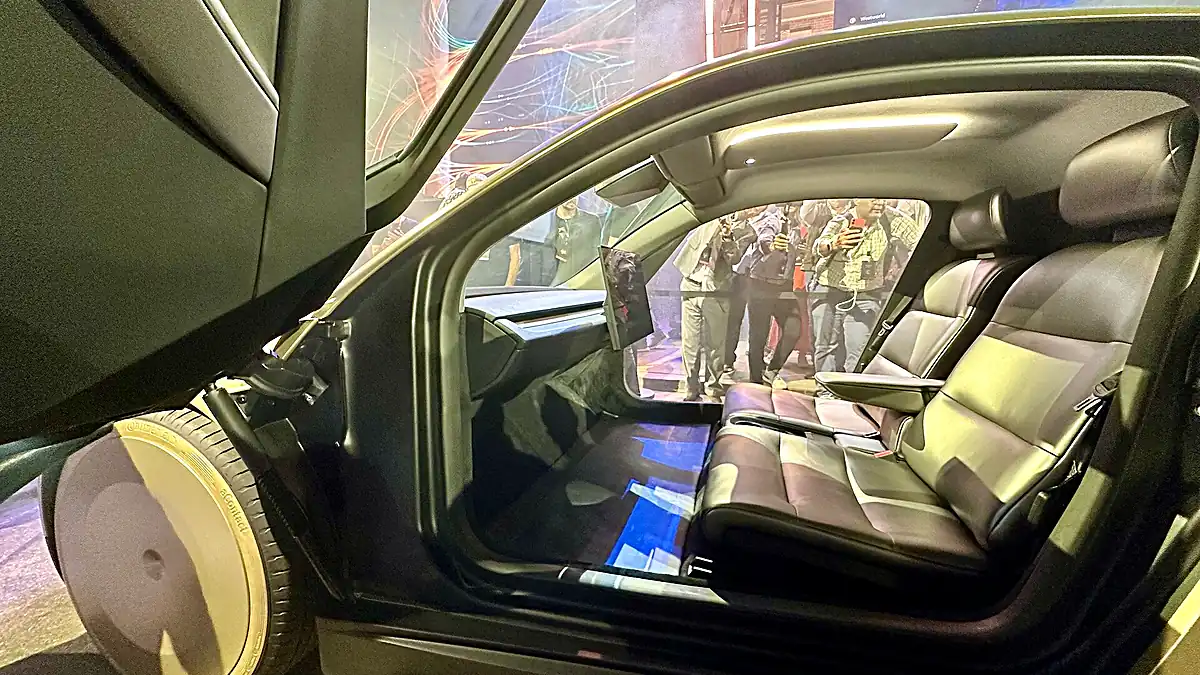
The car stops. The Autonomy Subscription Agreement states that a Cybercab “will not operate without an active Autonomy Subscription.” Cancel the subscription and the car becomes a $29,990 vehicle that cannot drive itself — and you cannot drive it either, because there is no steering wheel and no pedals. The only manual controls move the car at up to 2 mph for short-distance maneuvering, not on public roads, and they need a valid US driving licence.
That is the answer to the question Reddit keeps asking: yes, if you stop paying the $299 a month, the car becomes inoperable until you resume the subscription. There is no free tier, no manual fallback and no way to use the car as a normal vehicle. You can cancel at any time, but you do not get a refund for a part month, and the car will not run while the subscription is off.
There is also a suspension rule. Three or more “strikeouts” for improper or unsafe use trigger a one-week suspension of the autonomous driving features, during which the car may not operate and the monthly payment is not prorated. Tesla can also remotely restrict the car, limit it by geography, road type or weather, or put it in a safe state. The agreement says Tesla may change the terms from time to time.
How do you park or move a Cybercab without a steering wheel?
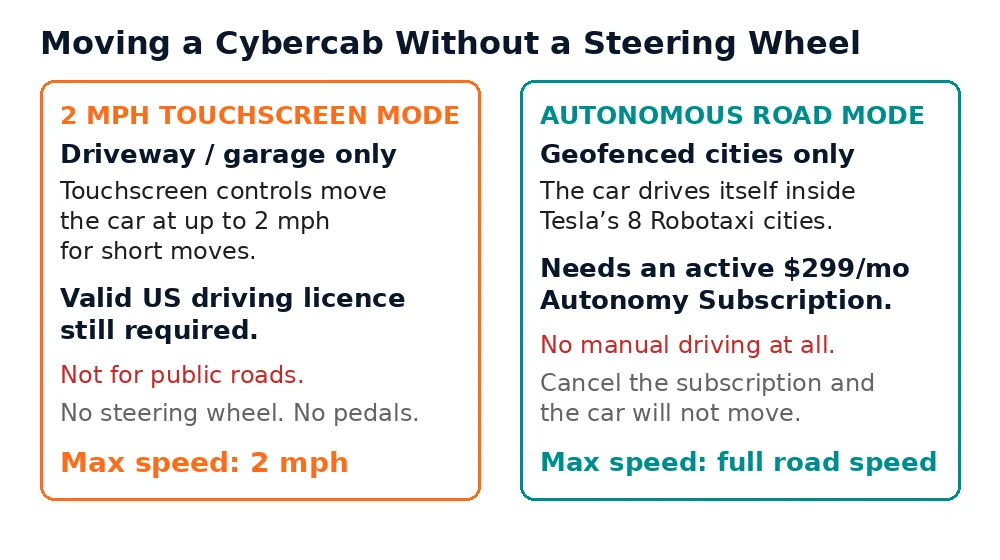
The Cybercab has no steering wheel and no pedals, so there is no way to drive it by hand. The only manual controls are on the centre touchscreen, and they move the car at up to 2 mph. That is enough to inch it into a driveway or shuffle it around a garage, but it is not driving. The touchscreen controls are for short-distance maneuvering only, not for public roads.
You still need a valid US driving licence to use them. Tesla requires a licence for the low-speed manual mode, even though you are not steering in the normal sense. The 2 mph cap is a hard limit, not a setting you can change. If the car needs to move further than a driveway, it has to do it itself, with an active subscription, inside a geofenced area.
Personal Cybercab geofence map: where you can drive it
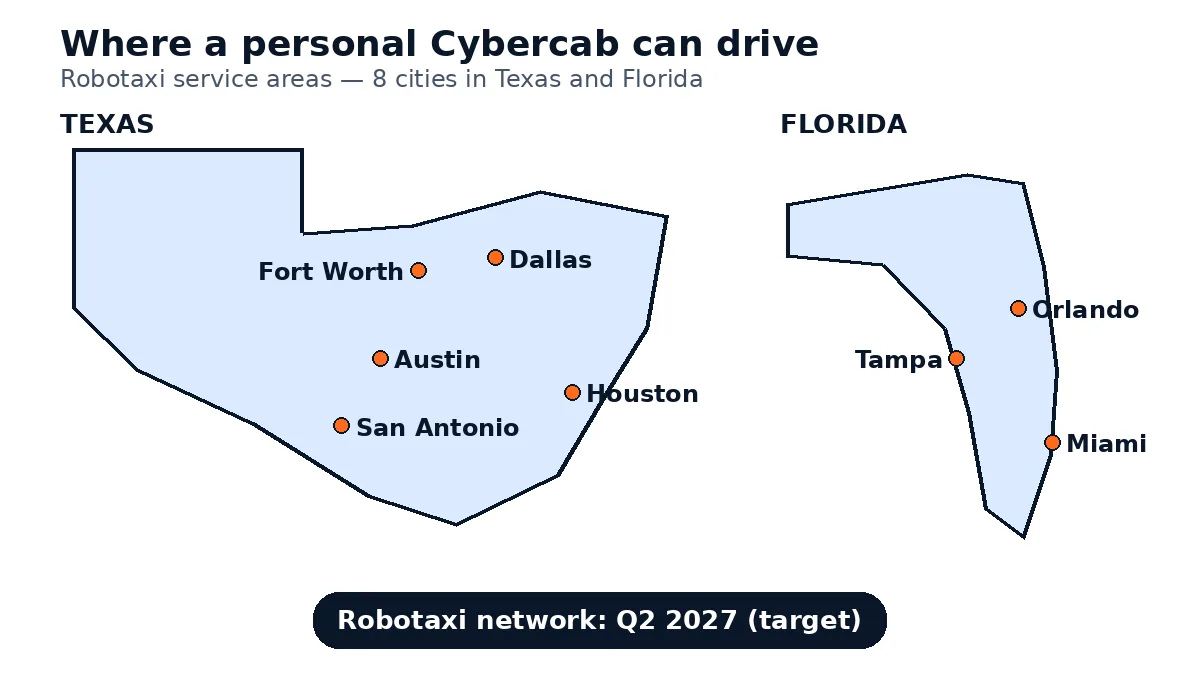
A personal Cybercab only works inside Tesla’s Robotaxi service areas. That is eight cities: Austin, Dallas, Houston, Fort Worth and San Antonio in Texas, and Miami, Orlando and Tampa in Florida. The invitation email is direct about it: “Only available in supported service areas. Subscription required for operation.” Operation outside the operating area is prohibited and may be technologically prevented, and Tesla can expand, shrink or move the area. Coverage may not match Tesla’s Robotaxi service exactly.
The real map is smaller than the advertised one. Independent tester Koby Pierce checked thousands of addresses in the Robotaxi app and found that the areas where Tesla actually accepts pickups and drop-offs are only 59% to 78% of the advertised geofences in the six cities he checked. In Austin — the city where Tesla is delivering these cars — it is about 59%. So a buyer in Austin should expect the car to work in roughly six-tenths of the area Tesla’s map shows.
Tesla’s vice president of AI software, Ashok Elluswamy, said on X that owners’ Cybercabs will drive unsupervised in all of the same areas as the Robotaxi service. For now, Cybercab rides are only offered in Austin, where more than 300 of them run alongside the Model Y robotaxis, with Dallas next. A personal Cybercab does not remove the geographic restriction — it inherits it.
Is the Tesla Cybercab approved by NHTSA for private buyers?
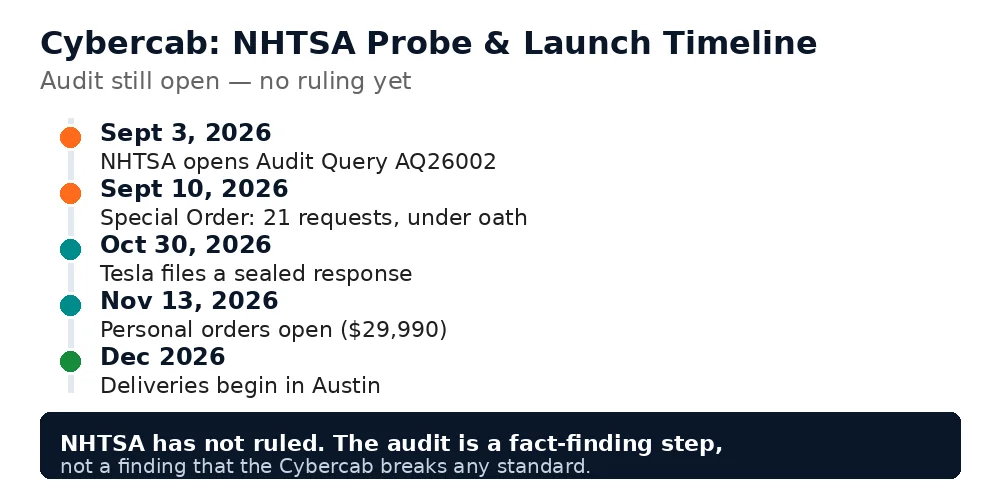
Not in the way a normal car is. The National Highway Traffic Safety Administration opened an audit query into the Cybercab on September 3, 2026, the same day Tesla started charging fares for Cybercab rides in Austin. The audit, numbered AQ26002, examines how Tesla certified a car with no steering wheel, pedals or mirrors as meeting federal safety standards written for cars that have all three. A week later, on September 10, NHTSA’s chief counsel signed a Special Order demanding Tesla explain under oath how the car complies with every standard it certified to, including the brake rule that says service brakes must be activated by a foot control. The order carries civil penalties of up to $27,874 a day, capped at about $139 million.
Tesla’s response was due October 30, 2026, after an extension. The public filing was a one-page letter saying the entire file is confidential business information. As of November 14, 2026, NHTSA has not issued a ruling, and the audit is still open. That does not mean the car is illegal to sell — Tesla certified it as compliant, and NHTSA has not found it out of compliance. But it does mean the legal basis for selling a car without a brake pedal is still being tested, and a buyer should know the question is unresolved before ordering.
True cost of owning a Tesla Cybercab
Note: the standalone $299-a-month cost breakdown now lives on this page — including the 5-year Cybercab vs Model Y comparison below.
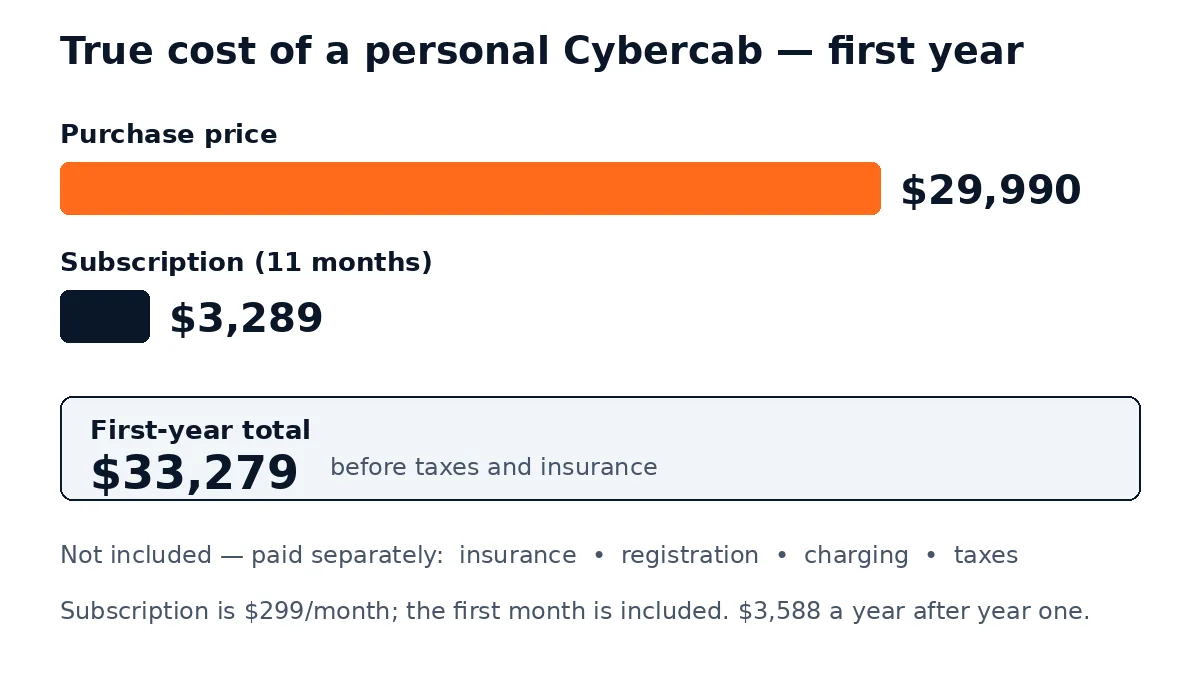
The $29,990 price is real, and it is also only the start. Here is the full math, using Tesla’s own figures: a $29,990 estimated purchase price before taxes, a $1,000 non-refundable deposit due at order (part of the purchase price), and a $299-a-month subscription with the first month included.
| Time owned | Purchase price | Subscription paid | Total before tax |
|---|---|---|---|
| 1 year | $29,990 | $3,289 (11 months) | $33,279 |
| 3 years | $29,990 | $10,465 (35 months) | $40,455 |
| 5 years | $29,990 | $17,641 (59 months) | $47,631 |
The formula is simple: $29,990 plus $299 for every month after the first free one. At five years that is $47,631 before sales tax, insurance, registration, charging and any maintenance outside the subscription. The subscription alone is $3,588 a year, which works out to about 30 cents a mile for a driver covering 12,000 miles a year — before a single kilowatt of electricity, an insurance premium or a registration fee. For comparison, Tesla’s Full Self-Driving subscription for its other cars is $99 a month. The Cybercab’s $299 is three times that.
That math is the honest answer to the “cheapest Tesla ever” headline. The sticker price is the lowest Tesla has ever charged. The cost of keeping the car running is higher than any other Tesla’s, because no other Tesla stops working when you cancel a subscription. If you drive a lot inside the geofence and value not driving, the numbers can work. If you drive rarely, or outside the eight cities, they do not.
Tesla Cybercab vs Model 3: 5-year cost with FSD
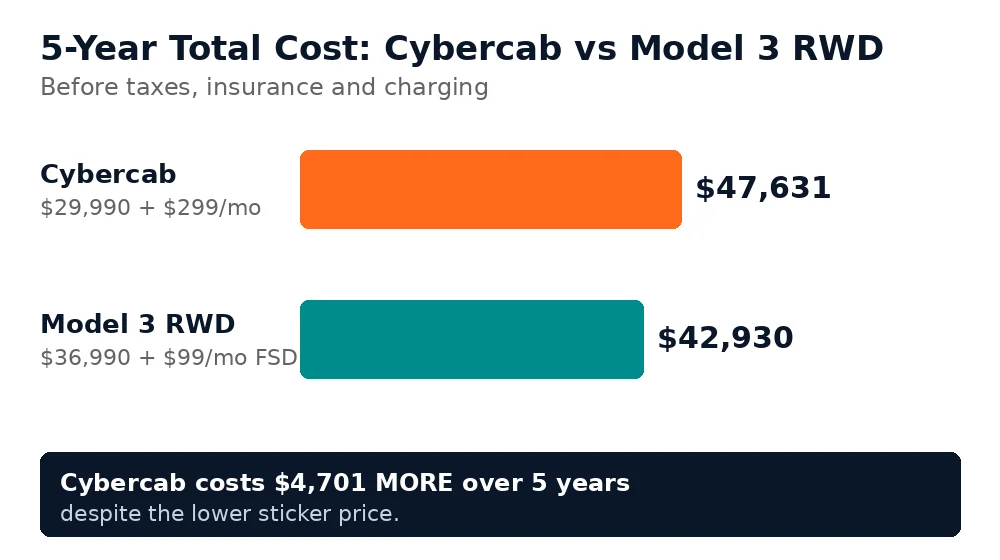
The Cybercab looks cheap next to a Model 3. The cheapest Model 3, the Standard rear-wheel-drive, costs $36,990 before taxes — $7,000 more than the Cybercab’s $29,990. But the Cybercab’s $299-a-month subscription is three times the $99-a-month Full Self-Driving subscription on a Model 3, and over five years that gap swallows the sticker-price advantage whole.
Here is the math. A Cybercab over five years costs $29,990 plus $17,641 in subscription fees (59 paid months after the first free one), for a total of $47,631. A Model 3 Standard RWD over five years costs $36,990 plus $5,940 in FSD subscription fees (60 months at $99), for a total of $42,930. The Cybercab costs $4,701 more over five years, despite the lower sticker price. And the Model 3 is a car you can drive yourself, anywhere, with no subscription required to keep it moving.
| Cybercab | Model 3 RWD + FSD | |
|---|---|---|
| Upfront price | $29,990 | $36,990 |
| Monthly software fee | $299 | $99 |
| 5-year software total | $17,641 | $5,940 |
| 5-year total | $47,631 | $42,930 |
Both totals are before taxes, insurance, registration and charging. The Model 3 also carries a $1,640 order and delivery fee on top of its $36,990 list price, which narrows the gap slightly, but does not close it. The point stands: the Cybercab is the cheapest Tesla to buy and one of the most expensive to keep.
When can personal Cybercab join Robotaxi network?
Not now, and not on any date Tesla has guaranteed. The subscription terms say a Cybercab cannot be used for Tesla Robotaxi, third-party ride-hailing, delivery or rental platforms unless Tesla authorizes that use in writing or enables it in the product. The vehicle is for personal, non-commercial use only.
Tesla has given a target, though. On its third-quarter 2026 earnings call on October 21, Ashok Elluswamy said the first customer vehicles could join the Robotaxi fleet “somewhere around Q2 next year,” meaning the second quarter of 2027. The software running the Cybercab and the Model Y robotaxis is the same, and Tesla plans to release it to customers as part of its V15 software. The remaining work is fitting customer cars into the geofences and the fleet management system.
Treat that date as a target, not a promise. Tesla has a long record of missing its own self-driving deadlines, and the company has not shared how revenue sharing would work, or how charging, cleaning and fleet management would be handled for owner-provided cars. There are also regulatory questions: in most places it is still not settled whether an individual can legally run their own car as a driverless taxi. Until Tesla enables the feature, a personal Cybercab earns nothing.
How to get Tesla Cybercab order invite
Orders are invite-only. Tesla’s official Robotaxi account announced on X on November 13, 2026 that “select customers are now being invited to purchase Cybercab for personal use,” sharing screenshots of the order page and the invitation email. The order page lists an estimated delivery of December 2026 in Austin, Texas.
Tesla has not said how it chooses who gets invited, or when general public orders will open. The first wave appears focused on Austin, where the cars are already running and where deliveries are scheduled. There is no public waitlist or application to join — you wait for Tesla to invite you. If you are not in a supported service area, an invitation would not help: the car only operates inside those areas, so Tesla is inviting customers where it can actually deliver a working car.
Tesla Cybercab home inductive charger cost
There is no price yet, because Tesla has not announced one. That is the honest answer to a question a lot of buyers are asking: how do you charge a Cybercab at home when it has no charge port?
Here is what is known. The Cybercab was designed for wireless inductive charging: the car parks over a ground pad and power transfers across the air gap, with no connector and no one plugging it in. Tesla demonstrated a pad at roughly 25 kW in 2024 and targets about 90% transfer efficiency, and the Federal Communications Commission granted Tesla a waiver in February 2026 for the ultra-wideband radios that align the car over the pad. The car’s EPA filing lists wireless induction as the primary charging method, from a 47.6 kWh battery with about 293 miles of adjusted range.
But the cars on the road today do not charge that way. The fleet Cybercabs in Austin charge DC only through a hidden NACS port behind a drop-down door in the rear bumper, and depot staff plug them in by hand. The car has no onboard AC charger, so it cannot use a home Level 2 wall connector at all. Tesla has not said whether personal buyers will get a home inductive pad, what it would cost, or whether the consumer version will add a conventional charge port. Until Tesla announces a home charging setup, the cost of charging a personal Cybercab at home is an open question — and it belongs in the budget alongside the $299 a month.
What this means for US readers
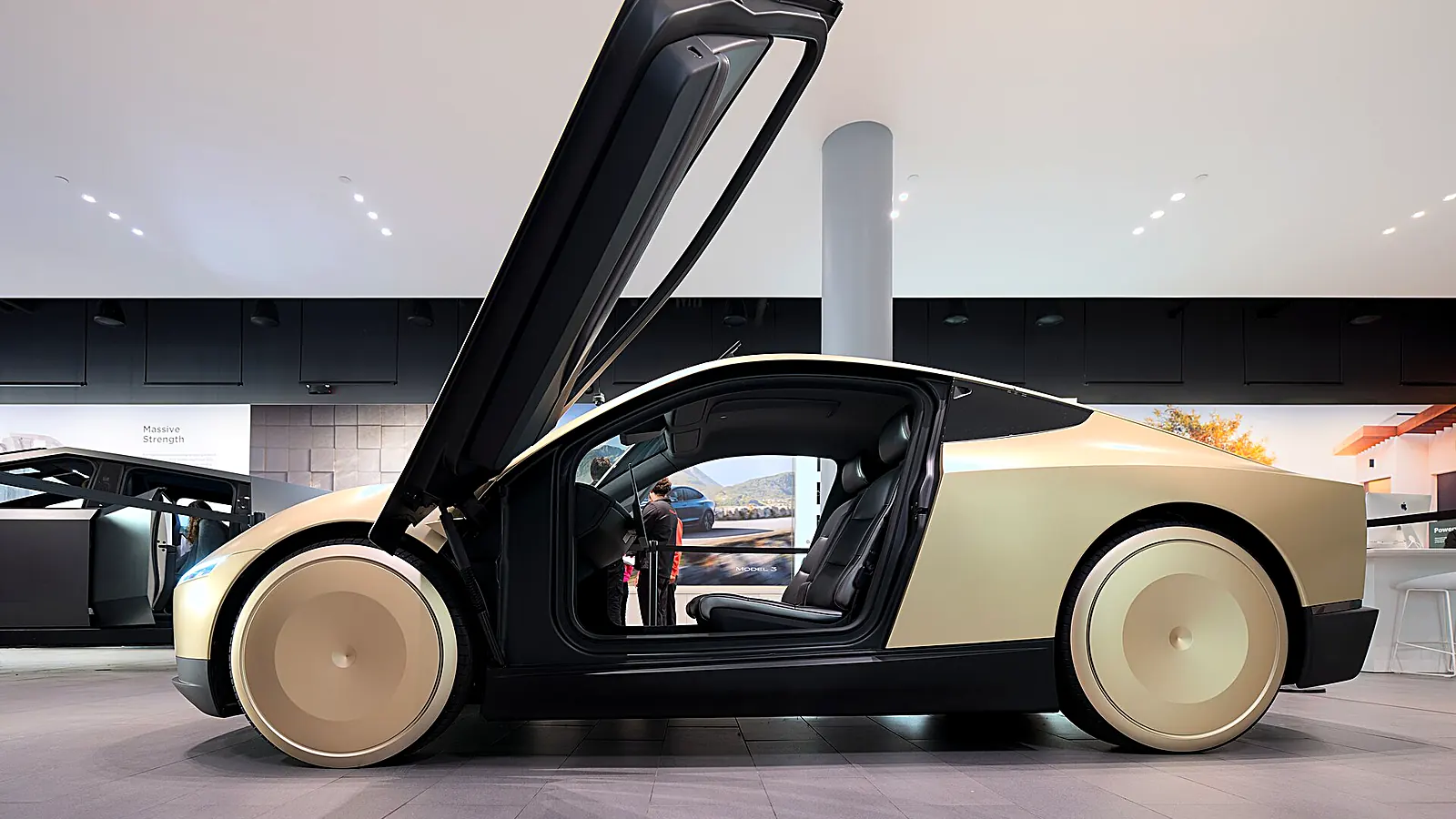
If you live in Austin and Tesla invites you, you can buy the cheapest Tesla ever built — a two-seat car with butterfly doors, a 21-inch touchscreen and 569 litres of cargo space, for $29,990. But you are not buying a normal car. You are buying a car that only works in eight cities, that stops working if you stop paying $299 a month, that you cannot sell without Tesla’s permission, that you cannot modify, and that you cannot use to earn money until Tesla says so. The $29,990 is the entry fee. The $299 a month is the real price of owning it.
For everyone outside the eight service areas, the Cybercab is not a car you can buy and use yet. It is a sign of where Tesla is heading: a car sold as hardware, run as a subscription, and confined to a map Tesla controls. Watch the December deliveries in Austin, watch whether the geofence grows, and watch Q2 2027 for the Robotaxi opening. Those three dates decide whether the Cybercab becomes a real product or stays a very expensive demo.
Cybercab or Model Y: which costs less over 5 years?
Here is the comparison that matters. The Model Y RWD starts at $39,990 — $10,000 more than the Cybercab. But its FSD (Supervised) subscription is $99 a month, a third of the Cybercab’s $299. Over five years, the cheaper subscription wins.
| Cybercab | Model Y RWD + FSD | |
|---|---|---|
| Purchase price | $29,990 | $39,990 |
| Subscription | $299 a month (required) | $99 a month (optional) |
| Paid months in 5 years | 59 (first month included) | 60 |
| Subscription cost, 5 years | $17,641 | $5,940 |
| 5-year total | $47,631 | $45,930 |
The Model Y RWD with FSD costs $1,701 less over five years than the Cybercab — $45,930 against $47,631. The Cybercab is cheaper to buy, but the subscription flips the result by year three.
Two things to keep in mind. First, FSD (Supervised) is not the same as the Cybercab’s driving. FSD (Supervised) is a driver-assistance feature: you still sit in the driver’s seat, hold the wheel, and stay alert. The Cybercab has no steering wheel, no pedals, and no driver at all. The $99 buys assistance; the $299 buys the whole drive. Second, the Model Y also carries a $1,640 destination and order fee on top of its $39,990 price. If you add that to the Model Y alone, the gap narrows to $61. But the Cybercab’s fee structure is not fully shown yet, so this comparison uses list prices for both.
The cars are not really comparable, either. The Cybercab is a two-seat car built for one purpose: driving itself inside a geofenced city. The Model Y RWD is a five-seat SUV with 321 miles of EPA range, a 0-to-60 time of 6.8 seconds, and no geographic limit — you can drive it anywhere, with or without FSD. If you want a car you can take on a road trip, the Model Y is the only one of the two that does it. If you want a car that drives itself while you sit in the back, only the Cybercab does that, and only inside eight cities.
There is also a simpler way to look at it. The Model Y works without FSD — you can buy it, drive it yourself, and pay nothing a month. The Cybercab does not work without its subscription. Cancel the $299, and the car stops. So the Cybercab’s real cost is not $29,990. It is $29,990 plus $299 a month, for as long as you own it.
Tesla Cybercab autonomy subscription: quick answers
Does the Cybercab $299 subscription include insurance? No. The subscription covers autonomous driving, connectivity, remote support, roadside assistance and selected maintenance. Insurance, registration, parking, charging and general cleaning are the owner’s responsibility.
What happens if you cancel Cybercab subscription? The car will not operate without an active Autonomy Subscription. You can cancel at any time, but payments are not prorated, and the Cybercab has no steering wheel or pedals for manual driving.
When can personal Cybercab join Robotaxi network? Not yet. Tesla has said it aims to let customer vehicles join the Robotaxi network around the second quarter of 2027, but that is a target, not a guarantee. For now the car is personal use only.
How do you charge a personal Cybercab at home? Tesla has not announced a home charging setup or a price for one. The car is designed for wireless inductive charging, but the fleet cars charge through a hidden NACS DC port, and there is no onboard AC charger for a home wallbox.
How do you get safety strikeouts in a car with no steering wheel? Tesla monitors cabin and trip behavior, and three or more strikeouts for improper or unsafe use trigger a one-week driving suspension without a subscription refund.
Can I resell my Cybercab if I change my mind? Not without Tesla’s written permission. Unauthorized transfers carry contractual damages of at least $50,000, and Tesla reserves the right to buy the car back at any time, at a fair market value it determines.
The verdict
The Cybercab is $29,990, the subscription is $299 a month, and the subscription is not optional. The car has no steering wheel, no pedals and no charge port. It works only in eight Texas and Florida cities, it cannot earn money yet, and you cannot sell it without Tesla’s written permission. If that still sounds like a good deal, it is because you drive a lot inside the geofence and you never want to drive again. For everyone else, the $29,990 is the cheapest way into a car you cannot fully use yet.