Ford finally gave the Mustang Mach-E the update it’s needed for two years. On October 22, Ford opened US dealer order books for the 2027 model with a headline move: the old standard-range battery is dead, and every single Mach-E now comes with the extended-range pack. The entry Select RWD starts at $39,995 before destination — $42,040 all-in — which means the cheapest Mach-E is now an extended-range Mach-E. And there’s a brand-new Trail package for buyers who want a little Rally flavor without the Rally bill.
Here’s why this matters more than a typical model-year refresh: the Mach-E is having a brutal year. Sales are down 59% through the third quarter, and the whole affordable-EV segment is getting squeezed. Ford’s answer isn’t a discount sticker — it’s better hardware at the same money. Let’s get into what’s actually new, what it costs, and whether it’s enough.
| Question | Answer |
|---|---|
| What changed for 2027? | The 73-kWh standard-range battery is gone. Select and Premium trims now get the 88-kWh usable pack standard; GT and Rally keep the 91-kWh pack. Plus a new $2,295 Trail package, a cheaper-to-build front motor, BlueCruise 1.5 updates, and standard connected services. |
| How much does it cost? | Select RWD starts at $39,995 MSRP, or $42,040 including the $2,045 destination fee — the first extended-range Mach-E ever to start under $40,000. |
| What’s the Trail package? | A $2,295 option on the Select eAWD ($47,335 with destination) adding a small suspension lift, Rally wheels and steering rack, Michelin CrossClimate 2 tires, and standard 400W Pro Power Onboard. |
| What’s the EPA range? | Ford hasn’t released 2027 EPA figures yet. For reference, the 2026 extended-range models were rated at 320 miles (RWD) and 300 miles (AWD); the discontinued standard-range pack was 260 miles RWD / 240 miles AWD. |
| Did prices go up or down vs 2026? | Both. The base Select RWD is up $2,200 (because it now includes the bigger battery), but nearly every other trim dropped $2,300–$3,050 — the GT fell $2,400 and the Rally $2,400 too. |
| When can I buy one? | Order books opened October 22, 2026 through Ford dealers. Trail deliveries start in Q1 2027. The online Build & Price tool opens early next year. |
| Any power changes? | Same outputs, new hardware: a redesigned front motor on eAWD models delivers identical performance at lower build cost — which is how Ford kept prices flat while adding the bigger battery. |
The headline: bigger battery standard, sticker barely moves
Let’s talk about the thing that actually affects every buyer. For 2027, there is no small battery. The 73-kWh standard-range pack that used to sit under the cheapest Mach-Es has been dropped from the lineup entirely, leaving the 88-kWh extended-range pack — 88 kWh of usable capacity, per Ford — as the default on Select and Premium trims. GT and Rally carry on with their 91-kWh packs, unchanged, as Ford Authority detailed.
That means the base car jumps from a 2026 EPA rating of 260 miles (RWD) to an extended-range figure that, on the 2026 car, was 320 miles. Ford hasn’t published the 2027 EPA numbers yet — they say those come closer to the on-sale date — but the company told the press the 2027 figures will be “comparable to the extended range offering in the same 2026 configuration,” the company told the Detroit Free Press. So pencil in roughly 320 miles for the RWD and 300 for the AWD until Ford certifies the exact numbers.
Now the money part. The 2027 Select RWD lists at $39,995 before destination, or $42,040 with the $2,045 destination fee included. Compare that to the 2026 Select RWD at $39,840 all-in, and yes — the sticker went up by $2,200. But you’re not buying the same car. A Ford spokesman, Jake Bley, put it plainly: “The 2027 pricing for Mustang Mach-E Select reflects the Extended Range Battery as standard (88 kilowatt-hour usable capacity), providing more value and range to our customers, compared to the extended range offering in same 2026 configuration.” In other words, you’re paying $2,200 more for what used to be a far more expensive upgrade — and the under-$40K MSRP is a first for an extended-range Mach-E.
And here’s the part that surprised us: while the base price crept up, nearly everything else got cheaper. That’s down to the other big 2027 change — a redesigned secondary drive unit (the front motor on AWD models) that, Ford says, matches the old unit’s performance at a lower build cost. That cost saving is what let Ford standardize the bigger battery without a big sticker shock, and it actually pushed most trim prices down, which brings us to the full price list.
Every trim, every price — 2027 vs 2026
Full lineup pricing with the $2,045 destination fee included, per Ford’s announcement as compiled by CarBuzz:
| Trim | 2027 price (incl. dest.) | Change vs 2026 |
|---|---|---|
| Select RWD | $42,040 | +$2,200 (now 88-kWh battery standard) |
| Select eAWD | $45,040 | −$3,050 |
| Premium RWD | $45,040 | −$2,350 |
| Trail eAWD (new) | $47,335 | New — $2,295 package on Select eAWD |
| Premium eAWD | $48,040 | −$2,300 |
| GT eAWD | $53,040 | −$2,400 (was $55,440) |
| Rally eAWD | $57,335 | −$2,400 (was $59,735) |
Read that table twice, because it tells the whole story of this update. The base car costs more because it now comes with the battery that used to be optional. Everything above it costs less — real, meaningful less: three grand off the Select AWD, $2,400 off the 480-hp GT. That’s not incentive money or a limited-time sale; it’s the new MSRP, enabled by the cheaper front motor.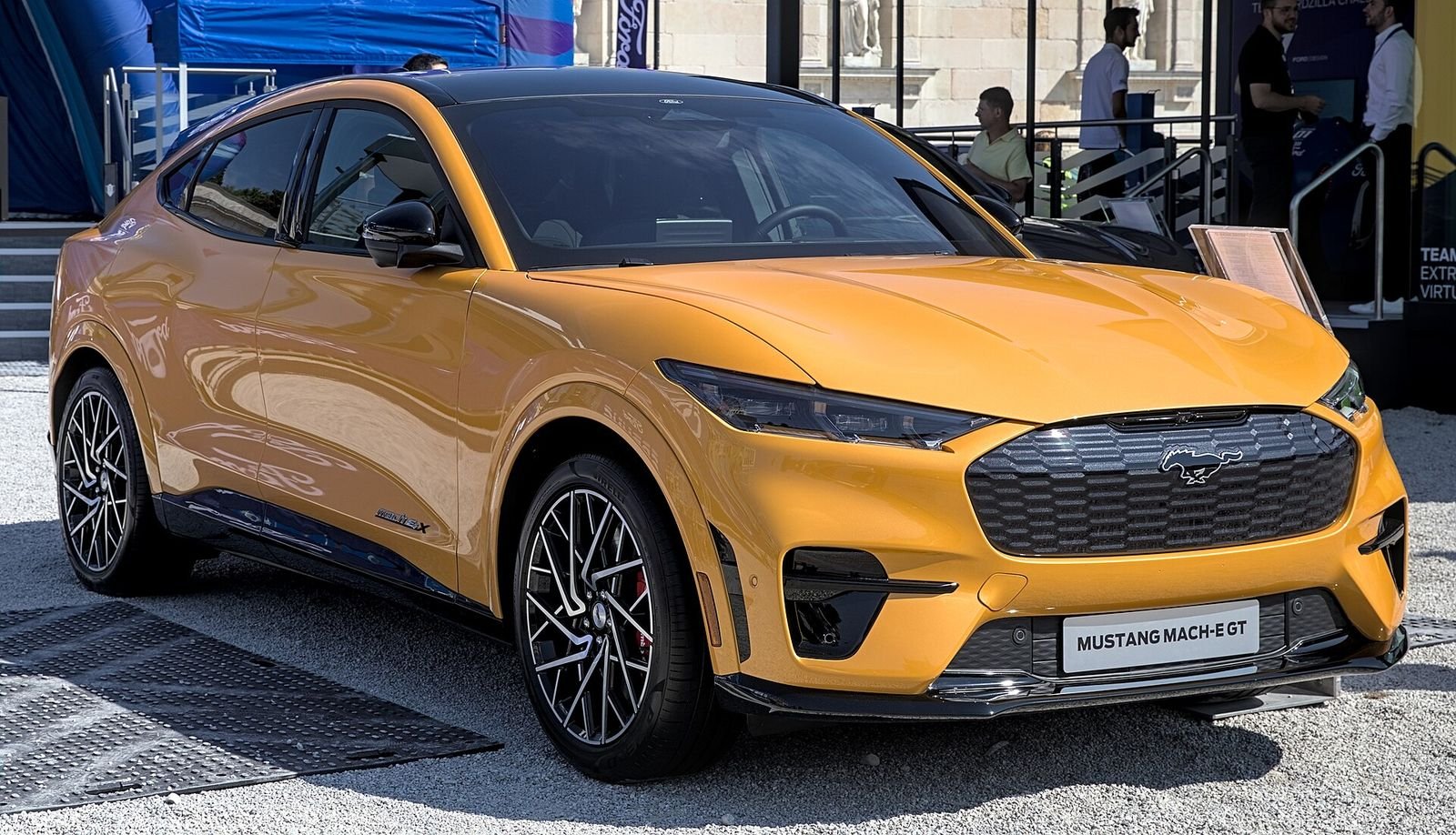
One footnote for the fine print crowd: those price cuts land even harder when you remember 2026 GT and Rally buyers were already paying for 91-kWh packs, so their battery story didn’t change — they’re just paying less for the same hardware. The Select and Premium are the opposite: different hardware (much bigger battery), modestly different money.
Meet the Trail: Rally flavor, Select budget
Okay, the fun part. The Trail is Ford’s answer to a question nobody realized they were asking: what if you want the Mach-E Rally’s attitude but not its $57,335 bill?
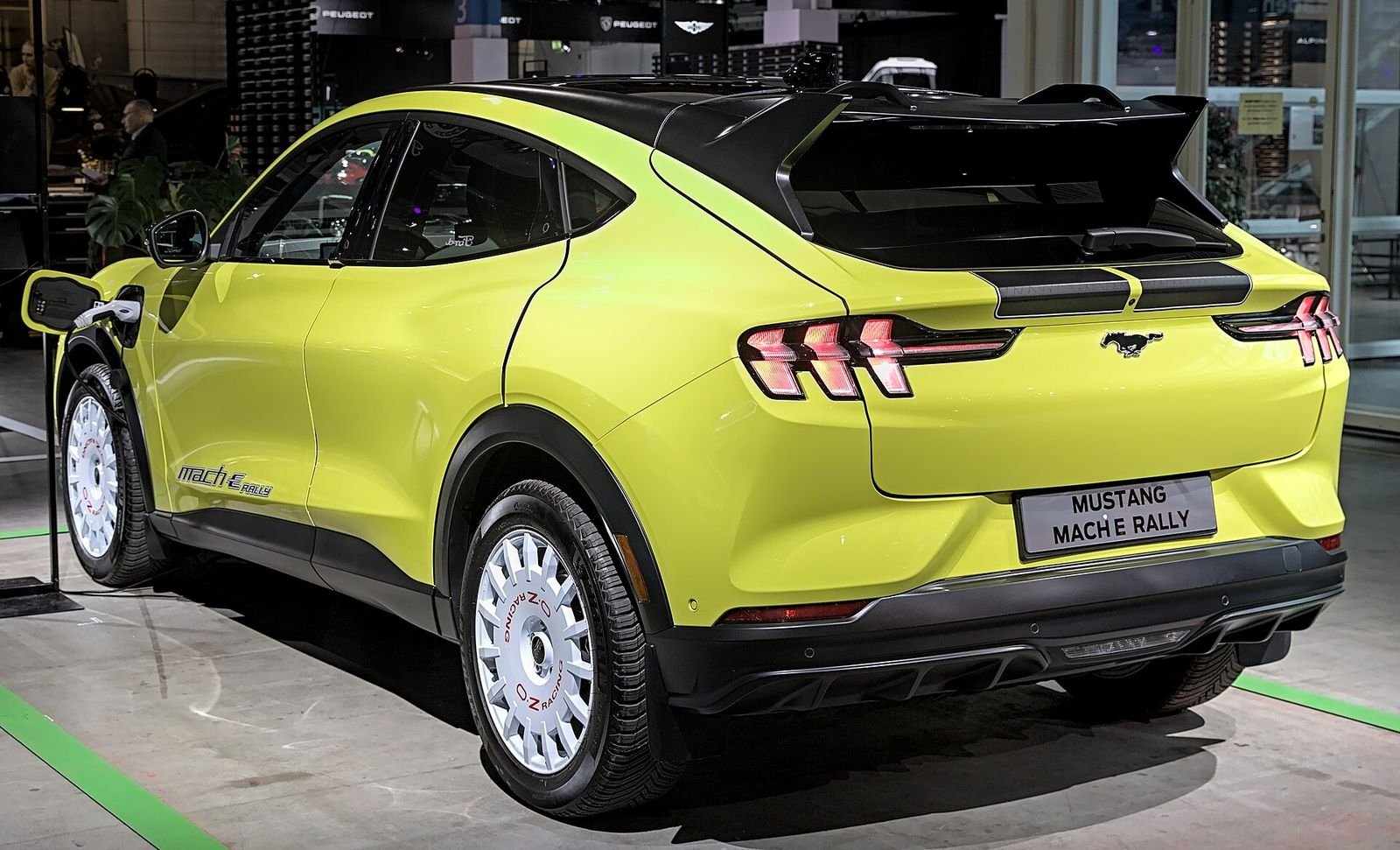
The Trail is a $2,295 package available only on the Select eAWD — so $47,335 with destination, a full ten grand under the Rally. What does that $2,295 buy? Ford starts with the Select eAWD’s dual-motor setup (370 hp and 500 lb-ft, per Ford’s figures as reported by TFLcar), then bolts on the Rally’s greatest hits: the same steering rack, the same 19-inch High Gloss Dark Carbonized Gray wheels with as-cast graphics, and 235/55 Michelin CrossClimate 2 tires. New passive struts and springs raise the ride height by 10 mm up front and 15 mm in the rear versus the standard car — actually a touch more rear lift than the Rally gets.
There’s more in the box than just the lift. Pro Power Onboard — a 400-watt, 120-volt inverter with outlets in the cargo area and behind the center console — comes standard on the Trail (it’s optional on Premium and GT). You get a blacked-out lower front fascia like the Rally’s, subtle Trail graphics low on the bodysides, and a Trail logo embossed on the center armrest. Thule offers an optional clamp-on cross-bar kit for bikes and kayaks, and Ford will sell you an Interior Protection Package with all-weather mats and a cargo-area protector.
Now let’s calibrate expectations, because Ford is being honest here and we should be too. The Trail is not an off-roader. No skid plates, no rock-crawl mode — Jalopnik’s take is blunt: it’s built for the road to the adventure, not the adventure itself. Ford’s own line, from the announcement, is that the Trail is designed to make “outdoor adventures across pavement, gravel, and dirt roads more accessible than ever.” Nick Rallis, Ford’s lead Mach-E vehicle integration engineer, added: “It is built for all-season, off-pavement excursions, so customers headed to a trailhead, a campsite, or everyday driving through changing weather get real added confidence.” Gravel roads, muddy trailheads, snowy driveways — that’s the brief. Moab is not.
Which, honestly, is exactly the right call. The Rally is a $57k toy; the Trail is a $47k daily driver that won’t panic on a fire road. Hyundai sells the same idea as the Ioniq 5 XRT, which MotorTrend pegs at $48,175 — so Ford has undercut its most direct rival by nearly a grand. And one more sweetener: Trail buyers get 100,000 Ford Rewards points on top of the 22,000 points every Mach-E buyer receives, good toward accessories, parts, and subscriptions.
Heads up on timing: the Trail isn’t shipping at launch. First Trail models reach dealers in Q1 2027, and Ford says it won’t limit production of the package — it’s factory-built, not a dealer add-on or a limited run. Order banks are already open.
Tech and fine print: BlueCruise 1.5, free connectivity, and two paint colors
Beyond the battery and the Trail, the 2027 Mach-E picks up the usual model-year tech shuffle — and one genuinely useful change for base-trim buyers.
BlueCruise 1.5, Ford’s hands-free highway driving system, is now standard on the GT and Rally, and — this is the new part — it’s available on the base Select through an optional Tech Pack Lite and on the Premium through the Premium Tech Pack. Every trim gets one year plus 90 days of service included, with a one-time-purchase option afterward. There’s a catch worth knowing before you spec your car: because the Trail is built on the Select, its BlueCruise hardware has to be selected at order time. Ford can’t add it later, per Electrek’s breakdown. Decide before you sign.
The Ford Connectivity Package (internet, navigation, entertainment) and the Security Package (anti-theft and vehicle recovery) are now standard across the whole lineup with one year of service included — again with one-time-purchase options if you’d rather not subscribe. Desert Sand and Shadow Black are the two no-cost paint colors; six more — including Adriatic Blue Metallic, Eruption Green Metallic, and Race Red — cost extra.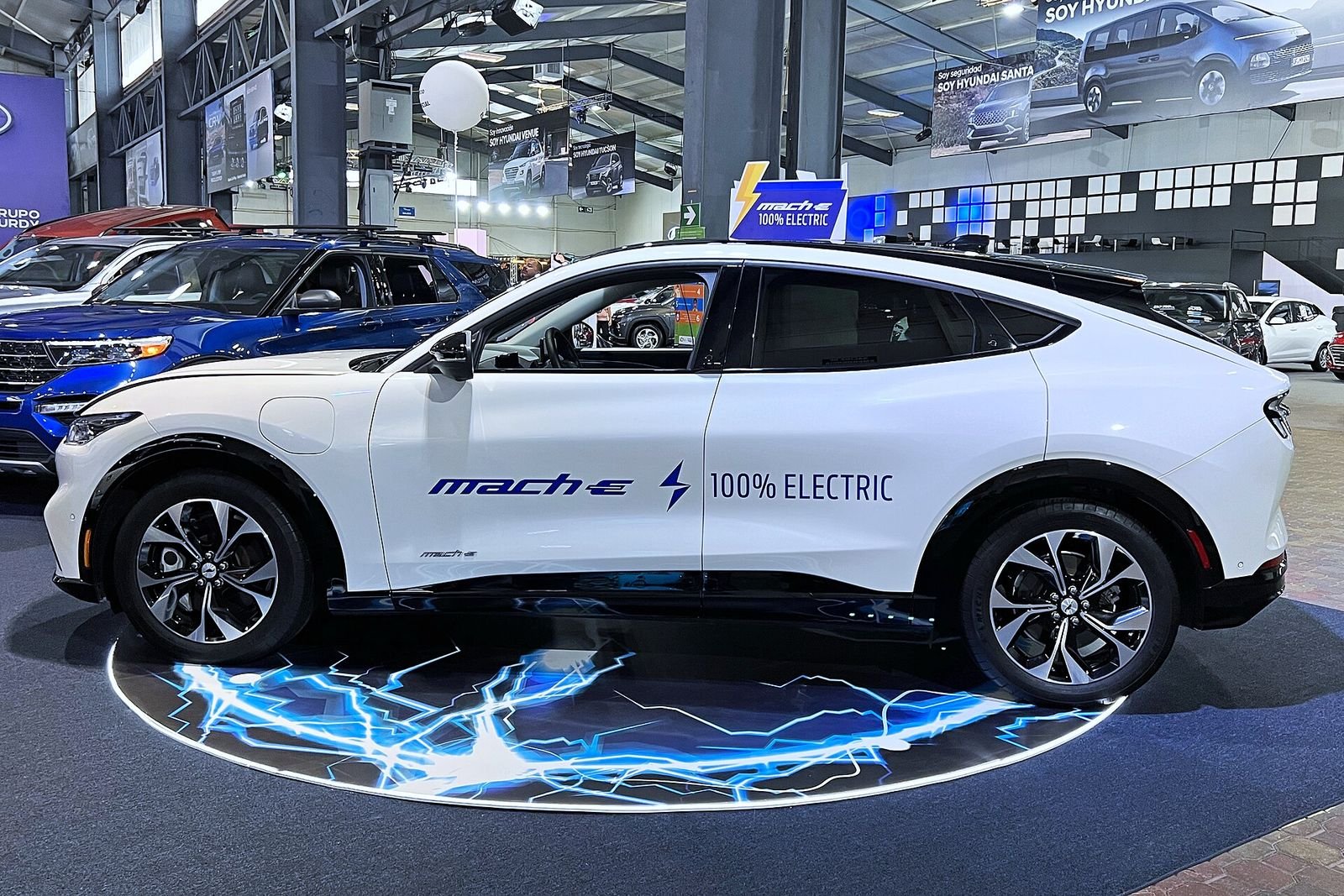
Why this update had to happen: a brutal year for the Mach-E
Real talk: this update isn’t happening from a position of strength. Let’s look at the scoreboard.
Through the first three quarters of 2026, the Mach-E ranks seventh among US EV sales with 17,206 units — down 59% year over year. In Q3 alone it managed just 5,574 sales, a 72% collapse, per Kelley Blue Book data reported by Electrek. For context, the Tesla Model Y — the car the Mach-E was built to fight — is still #1 at 262,491 units through Q3, down just 1%. The Hyundai Ioniq 5 holds third at 31,112. The Toyota bZ has doubled to 24,944 and now sits fourth. Even the Chevy Equinox EV, which had a catastrophic Q3 (down 92% to 1,905 units), is still ahead of the Mach-E on the year at 18,154.
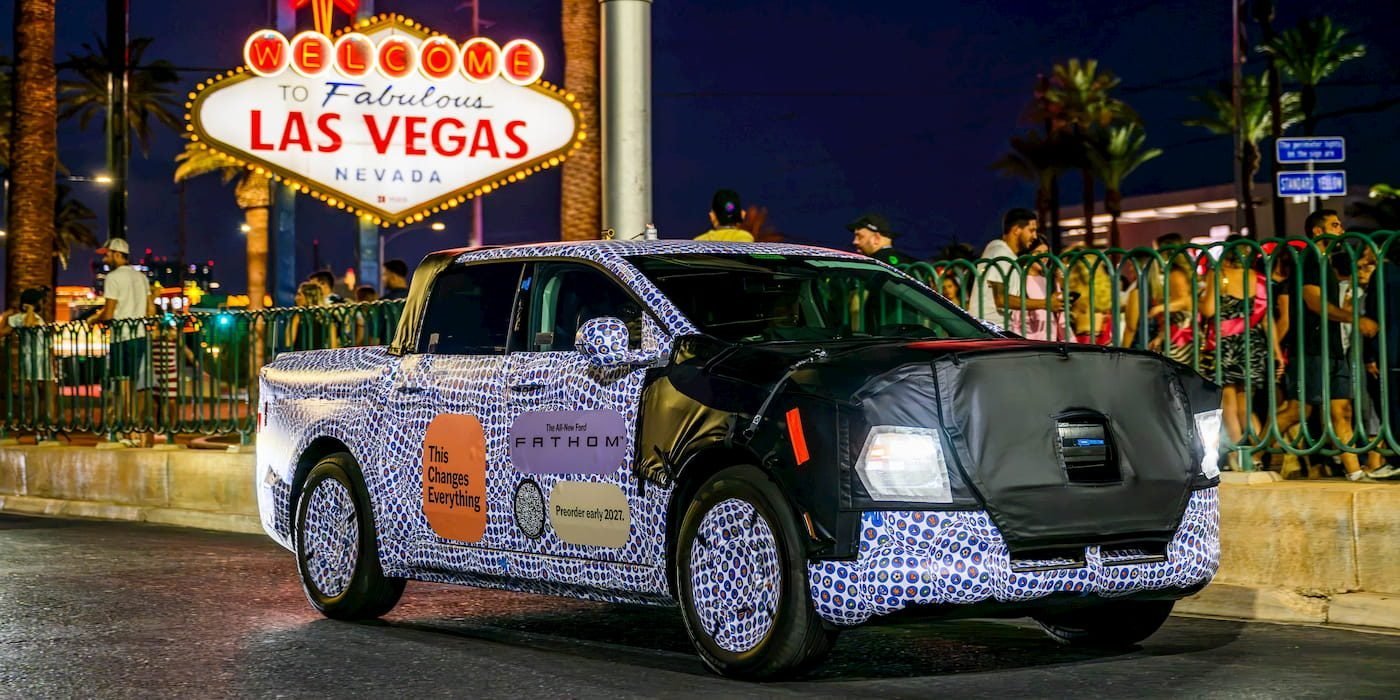
And here’s the part Ford surely noticed: the winners in this market right now are the value plays. The Ioniq 5, the bZ, the Equinox EV — all start around $35,000. The Mach-E, even after these cuts, starts at $42,040 all-in. Ford’s other big EV bet, the $28,350 Fathom pickup we covered last week, is aimed at that exact price fight — but it won’t arrive for a while, and the Mach-E has to hold the line now.
So view the 2027 update for what it is: Ford’s counterpunch. The big battery is standard because range-per-dollar is the metric that matters when gas is over $4 a gallon and every rival is advertising 300+ miles. The Trail exists because the adventure-wagon slice — Ioniq 5 XRT, Subaru Trailseeker — is one of the few places in the EV market that still has momentum. And the price cuts on GT and Rally are Ford admitting those trims were sitting too high for a 2026 buyer who could look at a Model Y instead.
What we still don’t know (and what to watch)
Ford’s announcement leaves a few real questions on the table, and we’re not going to paper over them.
First: certified EPA range. Ford says the 2027 numbers land closer to the on-sale date. Based on the 2026 extended-range figures — 320 miles RWD, 300 miles AWD — and the same 88/91-kWh packs, there’s no reason to expect drama, but a new front motor means new efficiency math, and we’ll believe the number when the EPA sticker prints it.
Second: charging. Ford didn’t announce any charging-speed changes, and the Mach-E’s 150-kW-ish DC fast charging has been its weakest spec-sheet line against the 800-volt crowd (Ioniq 5, EV6) for years. Nothing in this announcement fixes that. If you road-trip a lot, that matters more than any trim name.
Third: the NACS question. The Mach-E still uses CCS1 with an adapter path for Tesla Superchargers, and Ford confirmed it’s staying that way for 2027 — no native NACS port yet. Fine for now, since the adapter works, but it’s one more reminder that this is a refresh of a 2021 platform, not a new one.
Practical buying notes: orders go through your local dealer, not a configurator — Ford’s online Build & Price tool for the 2027 doesn’t open until early next year, and the Trail doesn’t arrive until Q1 2027. If BlueCruise matters to you on a Trail, spec the hardware at order time or forget it. And remember: MSRP is $39,995, but you’ll actually pay $42,040 with destination — “under $40,000” is true before the destination fee, and dealers may or may not have anything to add on top.
The verdict
So — buy the hype or wait? Here’s our decision framework.
Get the 2027 Select RWD if you were already Mach-E shopping: it’s $2,200 more than the 2026 base, but you’re getting the battery that used to cost thousands extra as an option. That’s the best value equation the Mach-E has ever offered at the entry level.
Get the Trail if your life involves gravel roads, trailheads, and winter weather — and you looked at the Rally and laughed at the price. $47,335 for Rally running gear on a Select budget is a genuinely smart package, as long as you understand it’s a soft-roader, not a rock crawler.
Get the GT if you want the performance trim — $53,040 is $2,400 less than last year for the same 480-hp hardware, which makes it the sleeper deal of this lineup.
Wait (or cross-shop) if you’re price-sensitive at the entry level: a $42,040 starting price still leaves the Mach-E several thousand above the Ioniq 5, bZ, and Equinox EV on sticker, even if the range math now favors it. And if fast road-trip charging is your priority, the 800-volt Koreans still win.
The bottom line: Ford didn’t redesign the Mach-E — it re-priced and re-specced it, and did both in the buyer’s favor everywhere except the base sticker. In a year when this car’s sales fell off a cliff, that’s exactly the right kind of update. We’ll revisit when the EPA numbers land.