
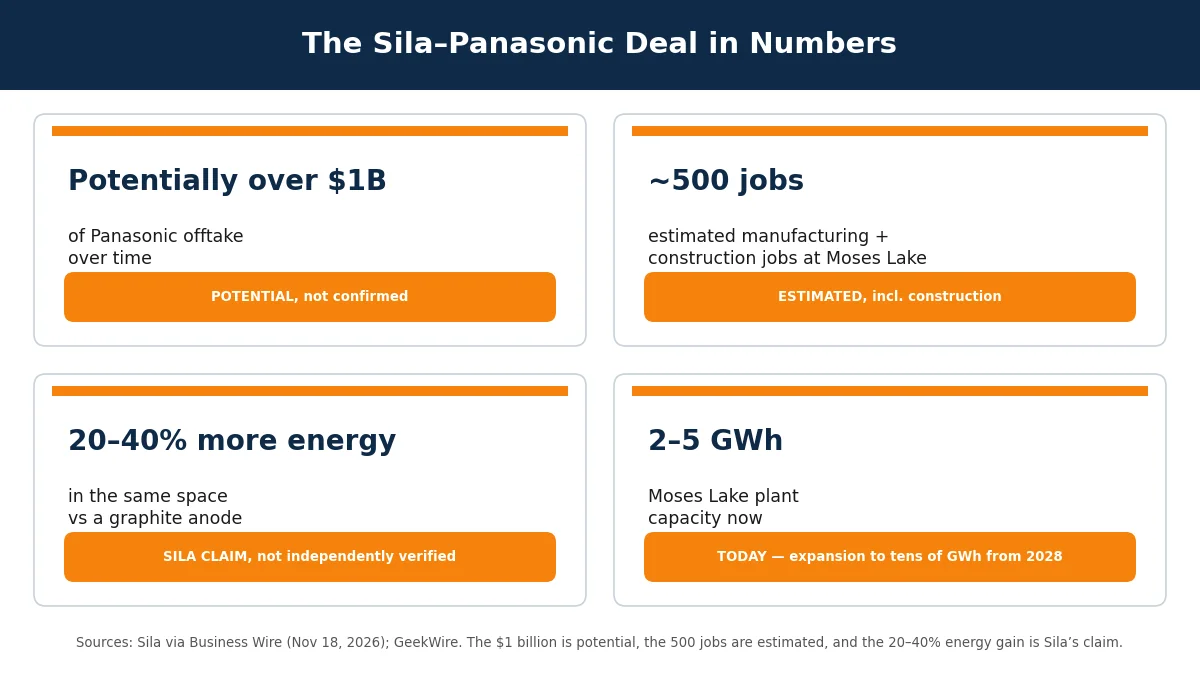
Sila signed a multi-year deal to supply its Titan Silicon anode to Panasonic's US battery plants, a deal with the potential for over $1 billion of offtake over time. The startup estimates about 500 more manufacturing and construction jobs at its Moses Lake, Washington plant as production scales. While GM closes a battery plant and a $2.4 billion Michigan battery project just died, Sila's plant is already running. We explain what a silicon anode is, how much money is really involved, and what to watch next.
The Sila deal vs the US battery pullback
| Project | What happened | Scale |
|---|---|---|
| Sila–Panasonic offtake | Multi-year deal, announced Nov 18, 2026 | Potentially over $1 billion; about 500 estimated jobs |
| GM Brownstown Battery Assembly | Closing; decommissioned when the lease ends in summer 2027 | Built packs for the Volt, E-Ray, and Celestiq |
| Gotion Michigan battery plant | Plans ended after an Oct 21, 2026 settlement | $2.4 billion project |
Sources: Sila via Business Wire; The Drive; MarkLines. Full sources at the end of this article.
Sila signed a multi-year deal to supply its Titan Silicon anode to Panasonic's US battery plants. The agreement carries the potential for over $1 billion of offtake over time, as per Sila, and the startup estimates about 500 more jobs at its Moses Lake, Washington plant. Sila says the anode can store 20% to 40% more energy in the same space as a graphite anode, which could mean more range for your next EV.
What Did Sila and Panasonic Actually Sign?
Sila and Panasonic Energy Corporation of North America signed a multi-year commercial offtake agreement on Nov 18, 2026, as per Sila. Sila will supply its Titan Silicon silicon-carbon anode material from its Moses Lake, Washington plant to power Panasonic battery cells. The two companies will also collaborate on intellectual property to strengthen their partnership.
Sila's co-founder and CEO, Gene Berdichevsky, called the agreement "a major commercial milestone for Sila," as per Sila. He said it signals that the Moses Lake plant will be ready to supply high-performance materials for key customers once qualified, and expand as needed.
Yasuaki Takamoto, CEO of Panasonic Energy Corporation of North America, said Sila's progress at Moses Lake has been "exceptional," as per Sila. He said the collaboration shows Panasonic's commitment to US manufacturing and to a more resilient battery supply chain in North America.
Sila was founded in 2011, and its Titan Silicon anode technology launched in 2021, as per Sila.
What Is a Silicon Anode, and Why Does It Matter for Your EV?
The anode is the part of a lithium-ion battery that stores lithium ions when the battery charges. Most EV batteries use a graphite anode. Sila's Titan Silicon is a silicon-carbon composite that can replace some or all of the graphite in a lithium-ion anode, as per GeekWire.
Silicon can hold far more energy than graphite, but it swells as it absorbs lithium. That swelling has kept silicon out of most EV batteries. Sila's silicon-carbon composite is built to handle that swelling, so the anode keeps its shape through charging cycles.
Sila says Titan Silicon can store 20% to 40% more energy in the same space, cut recharging time roughly in half, and deliver more power than a battery using a conventional graphite anode, as per GeekWire. Those are Sila's own claims, not independently verified figures. But if they hold up in Panasonic's cells, the payoff for a driver is plain: more range from the same size battery, and less time waiting at a charger.
The battery is the most expensive part of an EV. We break down what a replacement battery costs for the Ford F-150 Lightning. A better anode does not change that cost on its own, but a battery that holds more energy in the same space means a carmaker can hit a range target with a smaller, cheaper pack.
Is the $1 Billion Real Money?
Not yet. The Sila Panasonic deal is described as potentially worth over $1 billion, but that figure is a ceiling, not a check that has cleared. Sila's own release says the multi-year agreement carries "the potential for over $1 billion of offtake over time," as per Sila. C&EN puts it the same way: Sila "will sell up to $1 billion of its silicon anode materials" to Panasonic, as per C&EN.
An offtake agreement means Panasonic commits to buy material over time, once the material is qualified for its cells. The money arrives as Panasonic orders and Sila delivers. If qualification stalls or orders fall short, the total will be lower.
The jobs figure needs the same care. Sila estimates "an estimated additional 500 manufacturing and construction jobs" at Moses Lake as production scales, as per Sila. GeekWire puts it as "roughly 500 additional manufacturing and construction jobs over the coming years," as per GeekWire. Those are estimated jobs, including construction work, arriving over years as the plant grows. They are not 500 people hired on day one.
So the $1 billion and the 500 jobs are real, but they are potential and estimated, not guaranteed. That is still a strong signal. Panasonic does not sign a multi-year offtake with a startup it does not trust to deliver.
What Does the Moses Lake Plant Look Like?
The plant began operations on Sep 23, 2025, as per Sila. Sila calls it the nation's first automotive-scale silicon anode plant. It spans more than 600,000 square feet on a 160-acre site in Moses Lake, Washington.
Initial capacity is 2 to 5 GWh, as per Sila. That initial capacity is designed to supply batteries totaling about 2 GWh, enough for roughly 20,000 to 50,000 EVs depending on how the material is used, as per GeekWire. Sila has about 100 full-time employees at the Moses Lake site now, as per GeekWire.
The expansion will lift capacity to tens of gigawatt-hours, as per GeekWire. Sila aims to begin manufacturing at the expanded facility in 2028, with output increasing over time, as per GeekWire. Sila says the plant can expand up to 250 GWh within five years and become the largest anode production facility in the world, as per Sila. That 250 GWh figure is a company aim, not built capacity. The plant today is 2 to 5 GWh.
Sila is not the only company building battery capacity in the US. BMW's Woodruff plant in South Carolina will build batteries for the iX5, the first US-made BMW EV. But Sila's plant is already running, and the Panasonic deal gives it a customer big enough to justify the expansion.

Who Is Paying for the Expansion?
A mix of federal money and private capital is paying for the expansion. In August 2026, Sila received a conditional federal loan commitment of up to $1.4 billion from the Pentagon's Office of Strategic Capital, as per GeekWire. The loan is conditional. Sila must meet financial, legal, technical, and other requirements before it can be finalized.
The US Department of War's Office of Strategic Capital announced the conditional loan commitment on Aug 7, 2026, as per the US Department of War. The commitment would support expanded production of silicon-carbon anodes and the buildout of a lithium-ion battery cell manufacturing facility. The applications include satellite operations, unmanned aerial systems, and munitions, plus defense, energy, aerospace, and transportation.
The Pentagon's interest is not only about cars. Silicon is "almost necessary to achieve the performance required for batteries used by the defense industry, electric aircraft, and data centers," as per Charlie Parker of Ratel Consulting via C&EN. That is why a battery-materials company can draw defense money.
Sila also received a $100 million grant during the Biden administration in October 2022, as per GeekWire. Those funds helped build the Moses Lake plant. On the private side, Sila has raised $1.6 billion from investors, including a $300 million round announced in July 2026, as per GeekWire. The company is valued at $2.27 billion, as per PitchBook via GeekWire.
Why This Deal Stands Out While US Battery Plants Close
This is the part no top-10 page frames for a car reader. Sila is expanding while other US battery projects pull back. GM confirmed in October 2026 it will close its Brownstown Battery Assembly plant outside Detroit, as per The Drive. The plant built battery packs for the Chevrolet Volt, Corvette E-Ray, and Cadillac Celestiq. It will be decommissioned when the lease expires in summer 2027.
GM says the closure is lease-driven, "not related to GM's electric vehicle strategy," as per The Drive. But GM's Q3 2026 US EV deliveries fell 62.1% year over year, as per CarBuzz. The pullback comes as the US EV market adjusts to life after the tax credit ended.
Gotion's proposed $2.4 billion battery plant in Mecosta County, Michigan, also failed. Gotion and Green Charter Township reached a settlement on Oct 21, 2026, ending plans for the plant, as per MarkLines.
Group14, which is building its own silicon-anode plant in Moses Lake, has delayed production. Group14 targets mid-2027 to bring the first of two production units online, as per GeekWire. Sila's plant is running. Group14's is not yet.
C&EN frames the market this way: despite slowing demand for electric cars and the auto industry's shift toward low-cost cathode chemistries, high-performance silicon-based anode materials are finding niches, as per C&EN. Sila just found the biggest niche of all: a global cell maker buying its anode for American-built cells.
Washington is also pushing US companies to build battery supply chains at home instead of relying on China. The BYD vs Tesla tariff debate shows how that pressure is playing out. A US-made anode, sold to a US cell plant, is exactly the kind of domestic supply chain that policy is trying to build.
What Does This Mean for Your Next EV?
Not a specific car, and not soon. Sila has not named which vehicles will use Titan Silicon. Panasonic supplies cells to Tesla, as per GeekWire, but that does not mean Tesla's cars will use the anode. No automaker has been named.
The honest line is this: Panasonic cells with Titan Silicon could mean longer range and faster charging in future EVs, because Sila says the anode stores 20% to 40% more energy and charges roughly twice as fast. But the expanded Moses Lake facility does not start manufacturing until 2028, as per GeekWire. The first EVs with this anode are years away, not months.
What to watch is qualification. The deal signals that the Moses Lake plant will be ready to supply once the material is qualified, as per Sila. If Panasonic qualifies Titan Silicon for its cells, the next step is an automaker naming it. Until then, the deal is a supply-chain story, not a car you can buy.
What Happens Next
Sila will scale Moses Lake production to meet Panasonic's volume requirements and its other commercial commitments, as per Sila. Manufacturing at the expanded facility begins in 2028, as per GeekWire. Group14 targets mid-2027 for the first production unit at its Moses Lake site, as per GeekWire. GM's Brownstown plant is decommissioned when its lease ends in summer 2027, as per The Drive.
The story is one day old, and the mainstream auto blogs have not covered it yet. The window for this angle closes when one of them does. Watch for Panasonic's qualification of Titan Silicon, and for the first automaker to name it. Those two events will tell you whether this deal turns into a car you can buy.
Frequently asked questions
Is the $1 billion Sila–Panasonic deal confirmed?
No. The deal carries the potential for over $1 billion of offtake over time, as per Sila, and C&EN describes it as up to $1 billion. The money depends on Panasonic ordering and Sila delivering. It is a multi-year offtake agreement, not a guaranteed $1 billion payment.
What is a silicon anode?
The anode is the part of a lithium-ion battery that stores lithium ions when the battery charges. Most EV batteries use a graphite anode. Sila's Titan Silicon is a silicon-carbon composite that can replace some or all of the graphite, as per GeekWire. Sila says it can store 20% to 40% more energy in the same space as a graphite anode.
When will EVs with Sila's anode arrive?
Sila has not named any vehicle. The expanded Moses Lake facility starts manufacturing in 2028, as per GeekWire. The first EVs with Titan Silicon are years away, not months.
Will Tesla use Sila's Titan Silicon?
Sila has not said so. Panasonic supplies cells to Tesla, as per GeekWire, but that does not mean Tesla's cars will use the anode. No automaker has been named.
How We Verified This Data
We checked the deal terms and the $1 billion figure against Sila's own press release on Business Wire, the jobs and plant figures against GeekWire's reporting, the $1.4 billion conditional loan against the US Department of War's Office of Strategic Capital release, the silicon-anode market context against C&EN, and the GM and Gotion pullback against The Drive, CarBuzz, and MarkLines. Every number in this article comes from those sources, and each one is named next to the number it backs.
Sources
- Sila via Business Wire, Nov 18, 2026 — Sila Inks Long-Term Offtake Deal with Panasonic Energy to Power Domestic Battery Production — the deal, the potential over $1 billion of offtake, the estimated 500 jobs, the Berdichevsky and Takamoto quotes, Sila founded 2011, Titan Silicon launched 2021.
- GeekWire, Nov 17–18, 2026 — Battery startup Sila lands potential $1B Panasonic deal, plans Central Wash. expansion adding 500 jobs — the potentially over $1 billion figure, the roughly 500 jobs over the coming years, the 20% to 40% more energy and roughly half charging time claims, the Moses Lake plant figures, the 2028 manufacturing start, the $1.4 billion conditional loan, the $100 million grant, the $1.6 billion raised and $2.27 billion valuation, the Group14 delay.
- C&EN, Nov 18, 2026 — Sila Nanotechnologies, Panasonic Energy silicon anode battery — the up to $1 billion figure, the silicon-anode market context, the "almost necessary" quote from Ratel Consulting.
- US Department of War, Office of Strategic Capital, Aug 7, 2026 — $1.4 billion conditional loan commitment to Sila — the conditional loan commitment, the requirements before financial close, the applications including satellites, drones, and munitions.
- Sila, Sep 23, 2025 — Sila Opens Nation's First Automotive-Scale Silicon Anode Plant — the Moses Lake plant opening, 600,000+ square feet on a 160-acre site, 2 to 5 GWh initial capacity, up to 250 GWh within five years as a company aim.
- The Drive, Oct 20, 2026 — GM's Ongoing EV Pullback Has Claimed a Battery Plant — the GM Brownstown closure, the summer 2027 decommission, the Volt, E-Ray, and Celestiq packs, GM's lease-driven framing.
- CarBuzz, Oct 22, 2026 — GM Tempers EV Ambitions with Plant Closure — GM's Q3 2026 US EV deliveries down 62.1% year over year.
- MarkLines, Oct 21, 2026 — Gotion Michigan battery plant settlement — the $2.4 billion Gotion Michigan plant plans ending after the Oct 21, 2026 settlement.
Follow EVThrottle on Google. Add us as a preferred source to see our stories first in Top Stories.
Related stories
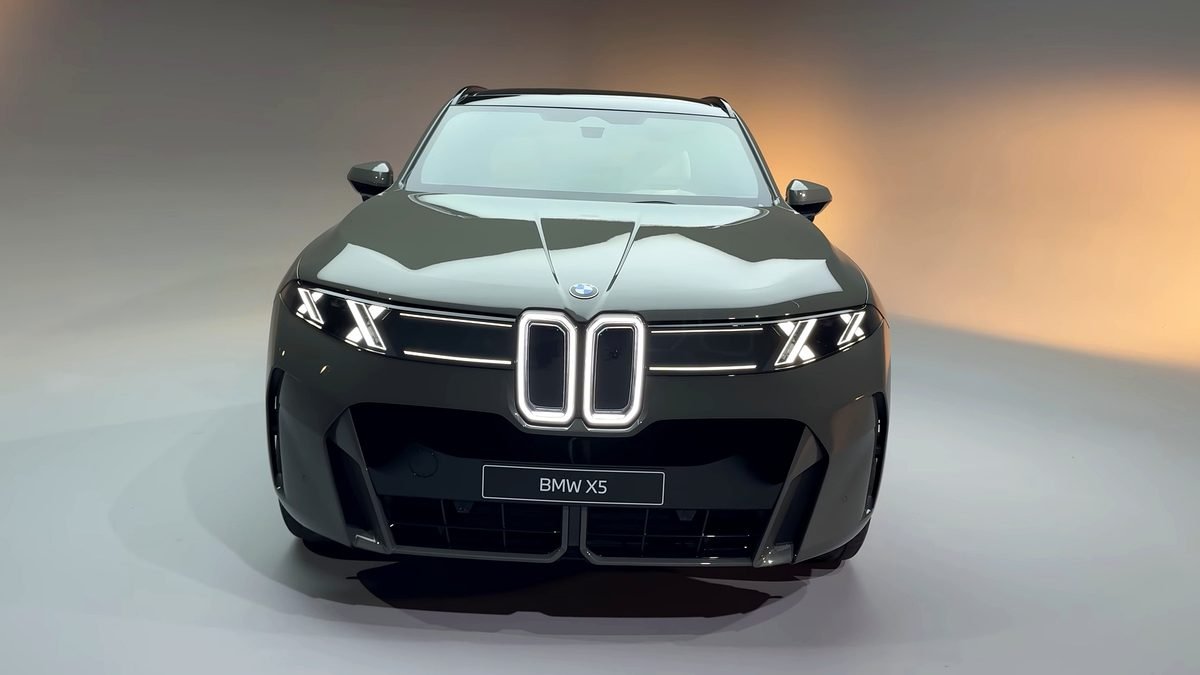
BMW Opens $700M Battery Plant in South Carolina for Its First US-Made EV, the iX5
BMW opened its $700 million Woodruff battery plant on November 13, 2026. Its 144-kWh packs will power the iX5 60 xDrive, a $79,800 electric SUV with an estimated 435 miles of range, built 15 miles away in Spartanburg.
November 13, 2026
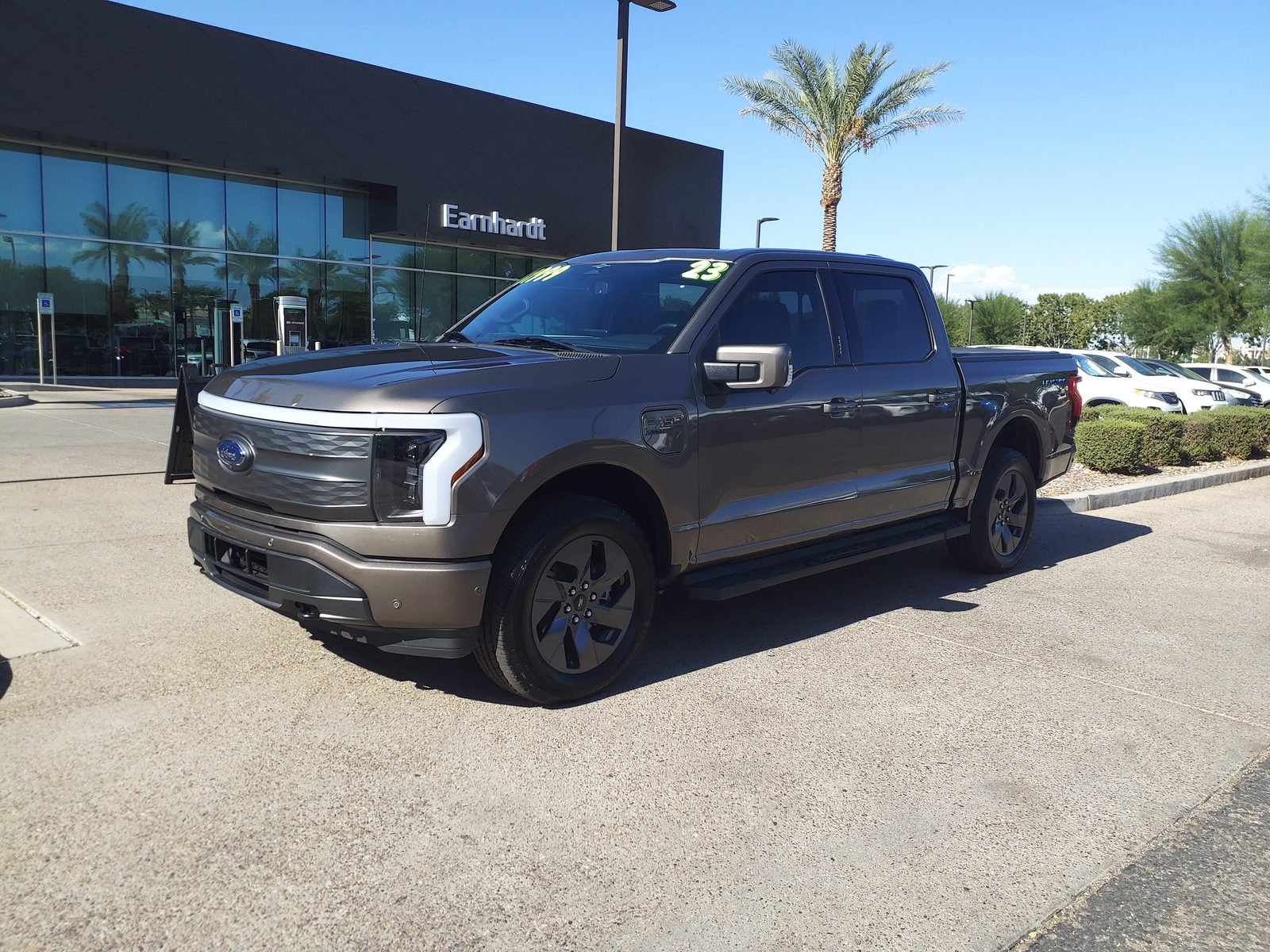
Ford F-150 Lightning Battery Replacement Cost: What a 234,000-Mile Truck Actually Paid
A 234,000-mile F-150 Lightning needed a battery out of warranty and paid $5,000. Here is the real Ford F-150 Lightning battery replacement cost in 2026, from salvage packs to full dealer swaps.
October 17, 2026

US EV Sales Climb a Year After Tax Credit End
A year after the $7,500 EV tax credit ended, US EV sales are growing again. Q3 2026 hit 262,649 sales, used EVs are booming, and Tesla leads the comeback.
November 8, 2026
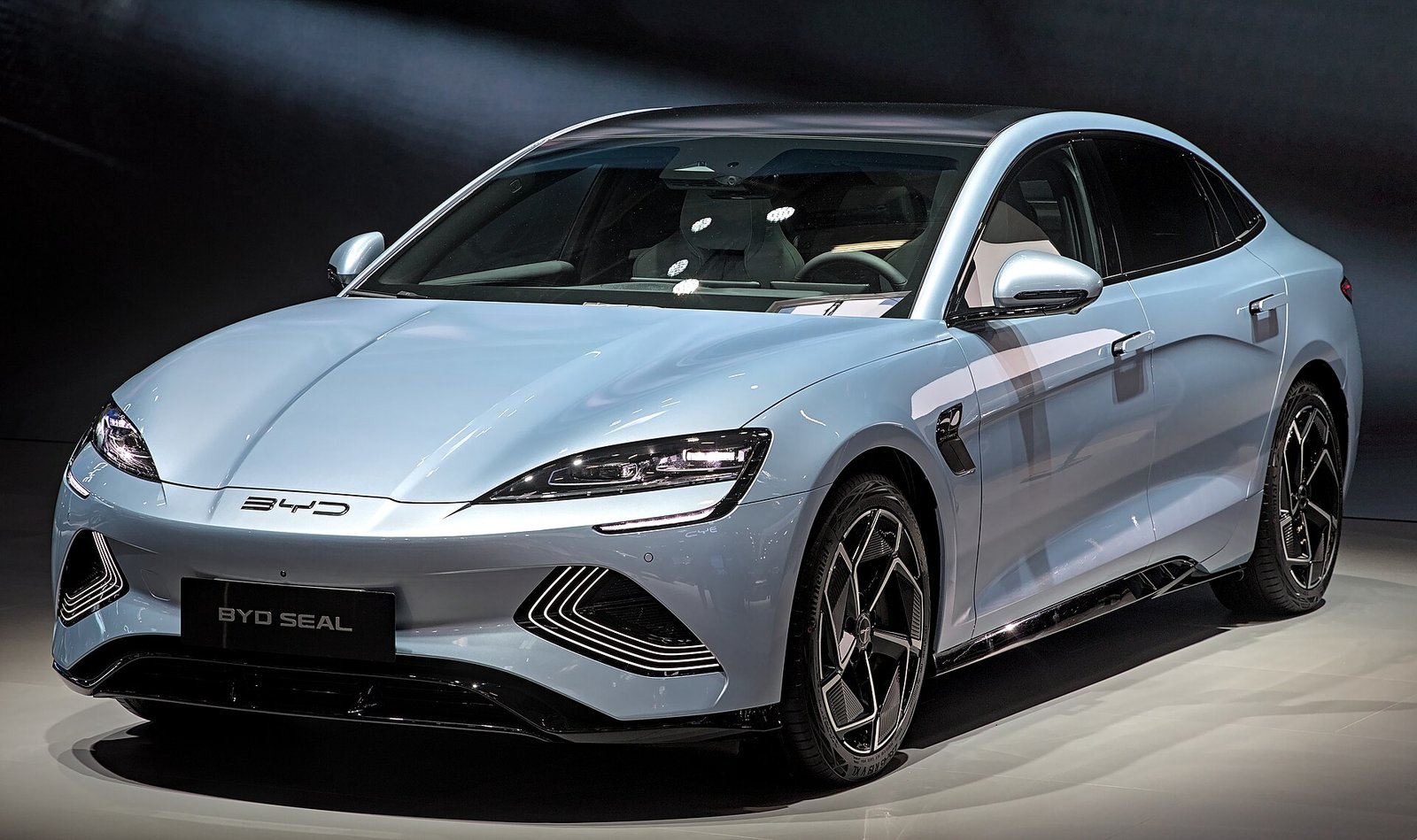
BYD vs Tesla: Should the US Let the World's Biggest EV Maker Sell Cars Here?
BYD vs Tesla, by the verified numbers: BYD sold 2.26 million EVs in 2025 to Tesla's 1.64 million, and its cheapest car costs about $9,900 in China — but a 100% US tariff keeps it out of America. The scoreboard, the price gap, and both sides of the argument.
October 23, 2026