On October 21, 2026, China’s biggest car exporter rolled two brand-new SUVs onto a stage in Wuhu, Anhui — the all-new TIGGO7, a family SUV, and the TIGGOX7, the first model in an entirely new TIGGOX series. Here’s the deal: the launch itself was light on specs and pricing. What makes it matter is the timing. Chery just told Reuters it’s open to partnering with an American automaker to finally crack the US market, and the Canadian border is opening as early as next year. So no, you can’t buy these in America today. But the company that built them has never been closer to your driveway.
Chery is the automaker that has steamrolled through Europe — where Chinese brands now account for one in every ten cars sold, as Carscoops put it this week — and it isn’t hiding its intentions anymore. Two new global SUVs, a UK market share that has VW looking over its shoulder, and a senior executive openly shopping for an American partner: this debut is the latest move in a very deliberate campaign. Let’s get into what we know, what we don’t, and why it matters on this side of the Pacific.
| Question | Answer |
|---|---|
| What debuted? | The All-New TIGGO7 (family SUV) and the TIGGOX7 (first TIGGOX-series model, billed as a “Family Comfort Exploration SUV”), at CHERY Brand Night in Wuhu, Anhui, on October 21, 2026, under the theme “Together. For Family” — per Chery’s official announcement |
| Any specs released? | Almost none officially — no dimensions, powertrains, or prices were disclosed. Chinese regulatory filings surfaced earlier in 2026 show the next-gen TIGGO7 at 4,655 mm long on a 2,720 mm wheelbase, as CarsGuide reported |
| What powertrains? | Not confirmed. Chinese media reports point to a carryover 1.5-liter turbo (115 kW/230 Nm) for China. The current export TIGGO7 offers a 1.5T, a 1.6T, and a Super Hybrid plug-in with about 90 km of electric range |
| How much will it cost? | Not announced — Chery gave no pricing hints at the debut |
| Can Americans buy one? | No — Chery doesn’t sell in the US. But VP Charlie Zhang told Reuters the company is open to partnering with a US automaker, and a Canada launch is planned for early next year, per Carscoops |
| Why should American buyers care? | Chery is China’s top car exporter, holds 7% of the UK market (second only to VW, per SMMT), and its Jaecoo 7 became the first Chinese car to top the UK sales chart in March. North America is the obvious next target |
Two SUVs, one message: family
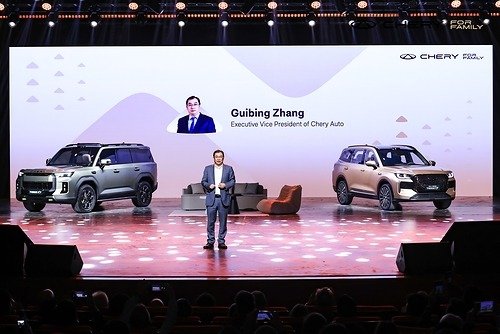
Chery didn’t do a typical auto-show reveal. Brand Night was built around real families — from Ecuador, Poland, and the UK opening the evening with stories of getting through hard times together, then families from Romania, South Africa, and Brazil talking about backing each other’s ambitions, per the company’s official release. The two SUVs drove onto the stage between the stories, each one matched to a different idea of family life.
The All-New TIGGO7 is the everyday one. Chery describes it as a family SUV built around comfortable space, dependable quality, and comprehensive safety — the commutes, the school pickups and drop-offs, the weekend outings. Nothing exotic in the pitch, and that’s the point: this is the bread-and-butter global SUV, the nameplate that already anchors Chery showrooms from South America to Australia.
The TIGGOX7 is the interesting one. It’s the first model in a brand-new TIGGOX series, positioned as a “Family Comfort Exploration SUV” — daily urban comfort that’s also capable across varied road conditions. Read between the lines and that’s Chery aiming at the weekend-adventure crowd: the family that does the school run Monday through Friday and wants to head for the hills on Saturday. From the stage photo, the two vehicles share the new design language but the X7 looks like the bolder, more ruggedly styled of the pair.
On stage, Guibing Zhang, Executive Vice President of Chery Auto, told the crowd that Chery responds to changing family needs “through technology, products that grow with families and service throughout their journeys.” Football legends Edwin van der Sar and Peter Crouch appeared as CHERY brand partners — a reminder that in markets like the UK and Europe, Chery is now spending real money on brand-building, not just shipping containers of cars. The company says more than 4.55 million users worldwide drive its vehicles. For a brand most Americans have never heard of, that number should give you pause.
The All-New TIGGO7: what we actually know
Real talk: if you came for a spec sheet, you’re going to be disappointed — and that’s not on us, that’s on Chery. The debut announcement disclosed zero specs, zero powertrains, and zero prices. That’s unusually thin even for a brand-night reveal, which suggests the commercial launch — with trim walk and pricing — is still to come, likely at an upcoming auto show or the Chery International User Summit events Chery teased alongside the debut.
What we do have comes from Chinese regulatory filings. Earlier in 2026, documents filed with China’s Ministry of Industry and Information Technology surfaced showing a thoroughly overhauled TIGGO7: 4,655 mm long (up 120 mm), 1,880 mm wide, 1,690 mm tall, riding on a 2,720 mm wheelbase (up 67 mm), as CarsGuide detailed. The styling moves on from the current car: a full-width grille face, a light bar across the tailgate, flush door handles. Chinese media reports point to a carryover 1.5-liter turbo making 115 kW and 230 Nm paired with a CVT in base Chinese-market versions. Treat that powertrain tip as a report, not a confirmation — export markets have historically gotten different, stronger engines.
And that growth in size matters. At 4.65 meters, the new TIGGO7 moves firmly into Toyota RAV4 and Honda CR-V territory — the single most competitive slice of the global SUV market. CarsGuide has already framed it as a RAV4, MG HS, and Haval H6 rival. The outgoing car (4,513–4,553 mm) played slightly under that size class; the new one doesn’t apologize. It’s bigger, bolder, and clearly aimed at the exact segment Chery needs to win to be taken seriously in Western markets.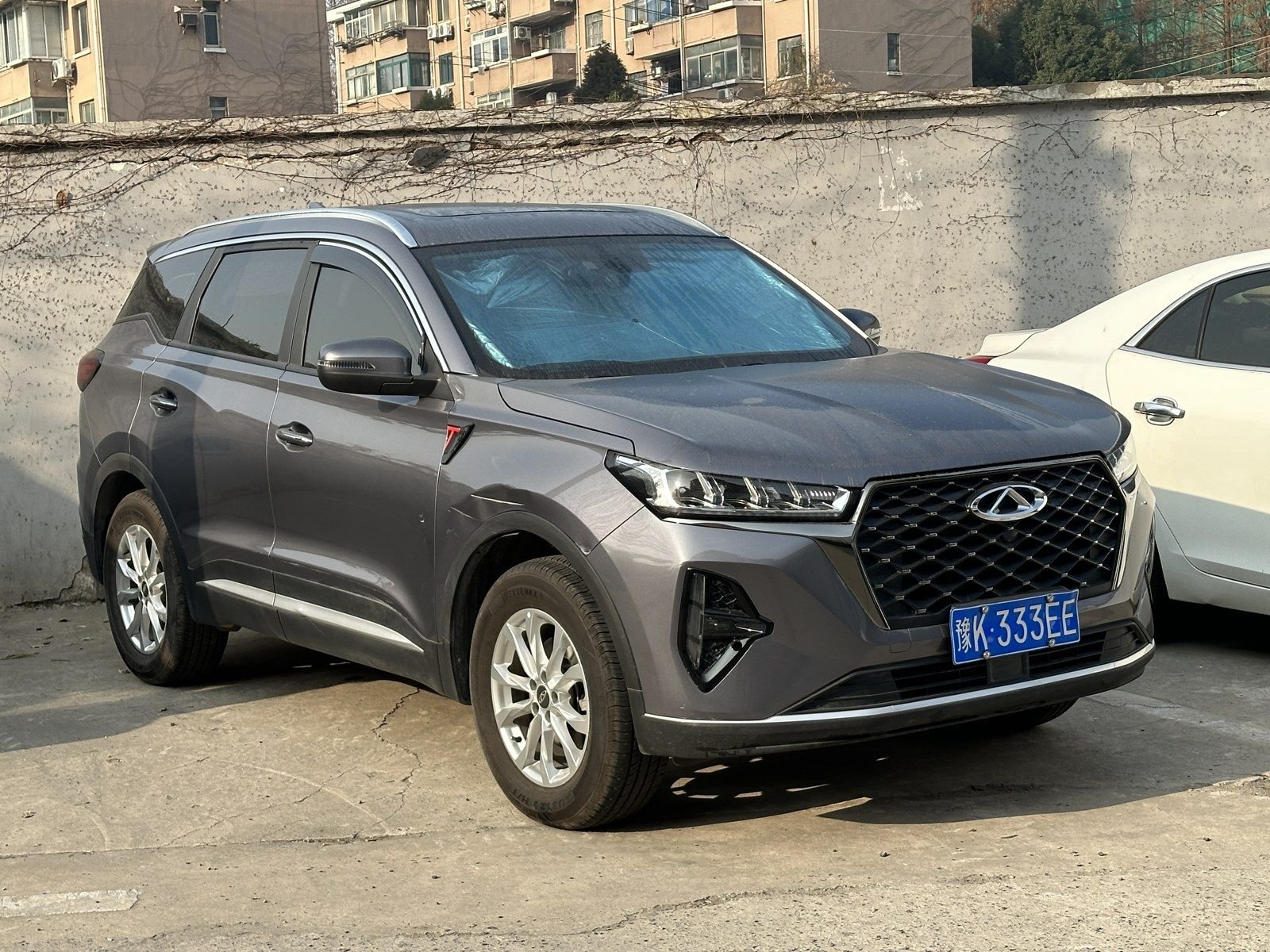
The TIGGOX7: Chery’s adventure bet
If the TIGGO7 is the known quantity, the TIGGOX7 is the wildcard — and maybe the more important of the two debuts. Launching an entirely new series is a statement. The TIGGO nameplate has carried Chery’s global SUV business for years; spinning off a TIGGOX line suggests the company sees room for a distinct, more lifestyle-oriented branch of the family. Think of it the way Toyota treats the 4Runner against the RAV4: same showroom, different promise.
Here’s what Chery actually said: the TIGGOX7 is a “Family Comfort Exploration SUV” that combines everyday urban convenience and comfort with capability across varied road conditions. That’s it. No dimensions, no drivetrain details, no word on whether it offers all-wheel drive — though the “exploration” billing would be a strange thing to put on a front-drive-only mall crawler, so it’s reasonable to expect at least some rugged hardware. We’re not going to invent it, though. Until Chery talks, the X7’s spec sheet is a blank page with an interesting title.
Want the honest answer on why this matters? Adventure-styled family SUVs are printing money globally right now — from the Subaru Forester Wilderness to the Ford Bronco Sport to Chery’s own Jaecoo 7, which Carscoops notes was mocked in the British press as a “Temu Range Rover” before becoming the first Chinese car ever to top the UK sales chart. Chery clearly learned that lesson: give buyers rugged looks, honest capability, and a price that undercuts the establishment by five figures, and the jokes stop fast. The TIGGOX series looks like the institutionalized version of that playbook.
For context: the TIGGO7 you can buy today
Since Chery didn’t hand us a spec sheet, the current export TIGGO7 is the best preview of what the new one will offer — and it’s genuinely competitive hardware. The 2026 export range runs three powertrains: a 1.5-liter turbo (108 kW/210 Nm) through a 7-speed dual-clutch, a 1.6-liter turbo (145 kW/290 Nm) that does 0–100 km/h in 8.3 seconds, and the Super Hybrid plug-in pairing a 1.5-liter hybrid engine with dual electric motors and an 18.4 kWh CATL lithium-iron-phosphate battery — about 90 km of electric range and over 1,100 km of combined range, per a 2026 export-market breakdown.
The value proposition is where it gets spicy. In Australia, the current TIGGO7 starts at $31,990 before on-road costs, per CarExpert, and the Super Hybrid plug-in goes for $38,990 drive-away — which WhichCar called Australia’s cheapest plug-in hybrid SUV when it tested it in June. That’s RAV4-hybrid money for a PHEV with a 93 km electric range and a 7-year warranty. In the UK, the plug-in starts at £24,995 and reviewers have been blunt about the trade-offs: Carwow’s verdict was that the PHEV “gets uncomfortably close” to more expensive alternatives for space, kit, and comfort — but skip the base 1.6 petrol, which it found noisy and thirsty in real-world driving.
Safety’s covered too: the current TIGGO7 carries a five-star Euro NCAP rating, and UK reviewers note the full Level 2 driver-assistance suite comes standard on upper trims. Reviewer Steve Fowler found the Super Hybrid smooth and genuinely efficient in UK testing — over 50 miles of real-world electric range and a relaxed long-distance cruiser, though he noted the ride can be firm on broken roads. That’s the hardware baseline the all-new model has to beat.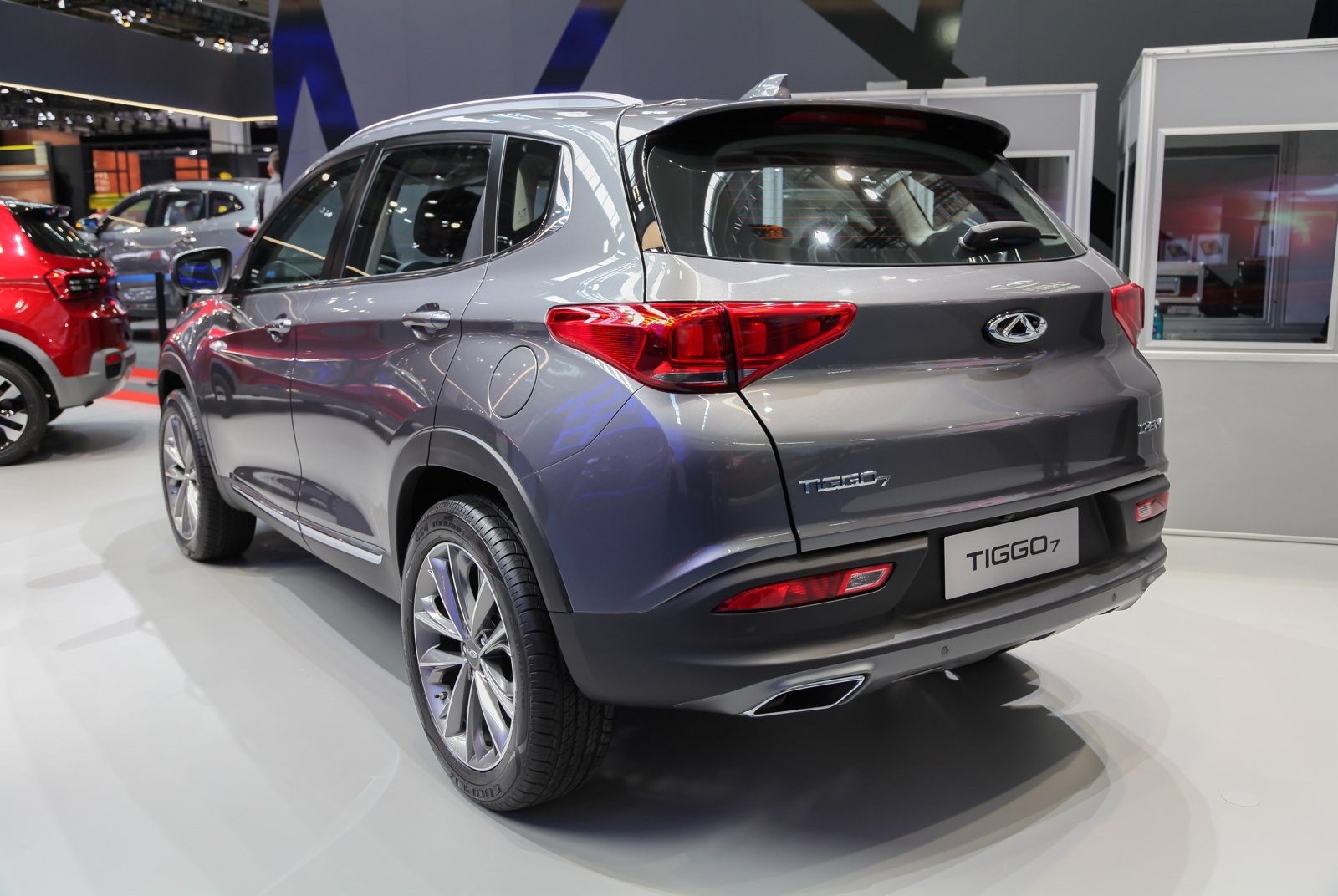
The real story: America’s next door just opened
Now the part that actually matters for US readers. On October 22 — one day after Brand Night — Carscoops reported on a Reuters interview with Chery Vice President Charlie Zhang, conducted at company headquarters in Wuhu, in which Zhang said Chery is open to partnering with American automakers. His words: “We’re very open to different options, even a potential partnership with American automakers.” And on the tech side: “Definitely from a technical point of view we will be able to find a China-free solution in terms of hardware and software,” per Carscoops.
That “China-free solution” line is doing a lot of work. Chinese brands are effectively locked out of the US by tariffs of 100% or more on imported vehicles and data-security rules that ban Chinese vehicle software — a ban that already forced Geely-owned Polestar to exit the US this year. A partnership with a Detroit automaker, or localized production with non-Chinese hardware and software, is Chery’s way of threading that needle. Zhang didn’t name names or describe deal structures, but the comments are the clearest statement yet of Chery’s American ambitions.
The near-term beachhead is Canada. Zhang told Reuters that Chery is preparing a brand launch in Canada early next year, after Prime Minister Mark Carney’s government opened the door to Chinese brands during trade negotiations in January. Chery already sells vehicles in Mexico. So the map is filling in: Mexico today, Canada next year, and the US under active negotiation. For a company that was founded on the banks of the Yangtze in 1997 and originally billed itself as a cheerful low-cost brand, this is a long way from the starting line.
Europe was the dress rehearsal, and it went better than anyone expected. Chery’s brands — Chery, Omoda, Jaecoo, iCAUR, and Lepas — collectively hold 7% of the UK market so far this year through September, making Chery the top-selling Chinese carmaker in Britain and the second-largest seller overall after Volkswagen, according to the Society of Motor Manufacturers and Traders, Reuters reported on October 15. And the product pipeline isn’t slowing: Reuters also confirmed Chery’s iCAUR brand will unveil a five-seater electric SUV in Britain in early 2027. When a Chinese brand is outselling everyone in the UK except VW three years after arriving, the “it can’t happen here” argument starts sounding thin.
Chery by the numbers: the export machine
Some scale, because the numbers are genuinely startling. Chery has been China’s number-one passenger-vehicle exporter for 23 consecutive years, per Gasgoo — this isn’t a newcomer, it’s the company that figured out how to sell Chinese cars abroad before anyone else did. In September 2026 alone, the group sold 292,000 vehicles, up 4.2% year-on-year, with January–September sales reaching 2.21 million units — and overseas deliveries of 1.55 million vehicles already surpassing the entire full-year 2025 total, according to Chery’s own figures. The main CHERY brand did 198,681 of those September sales, up 17.2%, per Chery’s Hong Kong listing disclosures — the company now trades as 9973.HK after its 2026 IPO.
The portfolio is broader than most Western buyers realize. Alongside the CHERY brand, the group runs Exeed, Jetour, iCAR, and Luxeed, and its export-facing lineup includes Omoda, Jaecoo, iCAUR, and Lepas — the brands doing the heavy lifting in Europe. Chery operates in more than 130 countries and regions, and the group’s global user base has reached 18.53 million vehicles, including 5.85 million overseas. And it’s pivoting hard toward electrification abroad: Chery International’s president told media earlier this year that pure-electric and plug-in hybrid models are projected to make up 65–70% of all overseas sales in 2026 — roughly 1.05 million units — on the way to 1.5 million total overseas sales, per EVShift. “Our sales of new-energy vehicles abroad are growing fast,” he said. “The pace of growth proves to be very impressive.”
Bottom line: the TIGGO7 and TIGGOX7 aren’t launching into a vacuum. They’re the latest products from a company selling nearly 300,000 vehicles a month, with overseas deliveries already ahead of the entire 2025 total, and already proven it can win in the world’s toughest regulatory markets. The debut is news; the machine behind it is the story.
How they stack up: RAV4 and CR-V territory
So how do these two fit against what Americans actually buy? The compact SUV segment — RAV4, CR-V, Rogue, Equinox — is the biggest battlefield in the US market, and the all-new TIGGO7’s reported 4,655 mm length puts it squarely in the mix: right around the current RAV4’s footprint, a touch shorter than the CR-V. The wheelbase stretch to 2,720 mm suggests rear-seat space that won’t embarrass it against the Japanese establishment.
On paper, the powertrain story is where a US-spec TIGGO7 could actually land punches. The current Super Hybrid plug-in — 1.5-liter turbo, dual motors, 18.4 kWh LFP battery, ~90 km of electric range — is hardware the RAV4 Prime’s audience would recognize, likely at a meaningfully lower price if Chery’s Australia and UK pricing is any guide. The risk, flagged by UK reviewers of the current car, is refinement: the base petrols are noisy and thirsty in real-world driving, and the ride tuning skews firm. An all-new generation is exactly when you’d expect those weaknesses addressed — but we won’t know until Chery publishes specs and journalists drive it.
The TIGGOX7 has no direct American analogue yet because we don’t know its specs — but the concept (family comfort plus real off-pavement capability) is the fastest-growing flavor in the segment. If Chery gives it all-wheel drive and prices it like it prices everything else, it’d be hunting the Bronco Sport and Forester Wilderness crowd at a discount. Big “if,” honestly stated.
Can you buy one? The practical stuff
Short answer: not in the United States, and not soon. Chery has no US dealer network, no homologated models, and no announced timeline for American sales. The tariffs and software rules that keep Chinese cars out aren’t going away overnight, and a partnership — the route Charlie Zhang floated — would take years to bear fruit even if talks started tomorrow.
What to watch instead: the Canada launch early next year is the canary in the coal mine. If Chery establishes a real dealer and service network north of the border, US entry becomes a question of when, not if — cross-border shopping is a thing, and a successful Canadian operation proves the product and the business model in North American conditions. The iCAUR electric SUV landing in the UK in early 2027 is the other signal: Chery is building Western-market EVs on Western timelines now.
If you’re shopping the segment today, the honest guidance is this: the RAV4 Hybrid, CR-V Hybrid, and Tucson Hybrid remain the safe, proven picks with full US dealer and parts support. The TIGGO7 story is worth following as a preview of the pricing pressure coming for those models — a five-star-Euro-NCAP plug-in hybrid family SUV for the price of a mid-trim RAV4 is the kind of math that eventually reshapes a segment, whether or not the badge on the grille says Chery yet.
The verdict
The October 21 debuts gave us two new nameplates and almost no numbers — frustrating, but not unusual for a brand-night reveal. What we know: the All-New TIGGO7 grows into true RAV4/CR-V size with a new design language, and the TIGGOX7 opens a new adventure-oriented series. What we don’t: specs, powertrains, prices, and launch markets. Chery will fill those gaps at the commercial launch, and we’ll update this story when it does.
The decision framework is simple. If you’re a US buyer: file this under “watch closely.” Nothing here changes what you should buy this weekend. If you’re in Canada, the UK, Australia, or Latin America: the new TIGGO7 deserves a spot on your shortlist when pricing lands, based purely on what the current car delivers for the money — just wait for independent reviews of the new generation before signing anything. And if you work in the auto industry: the company that just doubled down on family SUVs in Wuhu is the same one openly shopping for an American partner in the same week. That’s not a coincidence. That’s a plan.