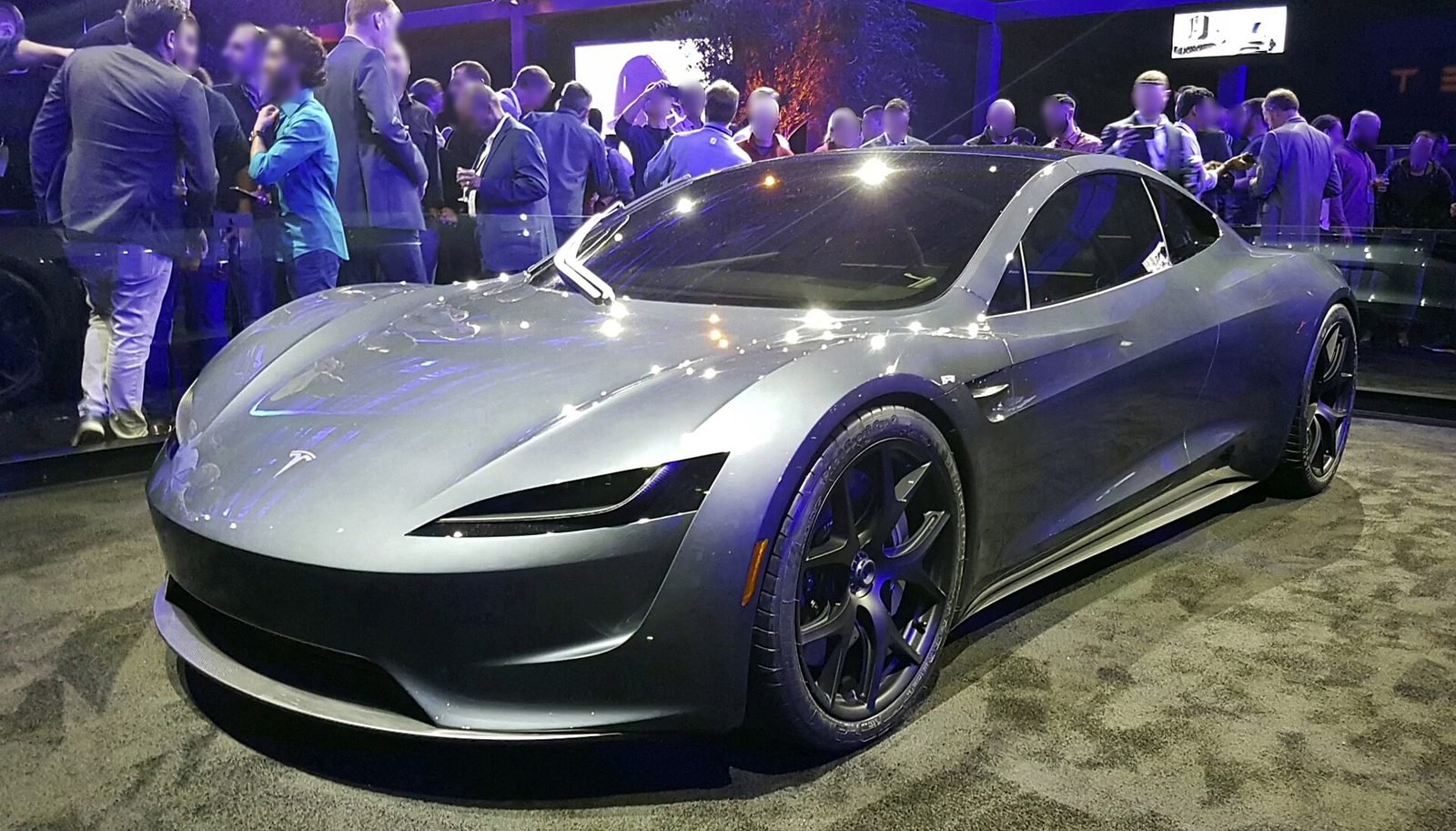
On October 16, 2026, Elon Musk posted a short clip on X with seven words: “Turns out the future does have flying cars.” The video shows the new Tesla Roadster airborne over a row of parked Teslas. Within hours, it became one of the most-watched car videos of the year — and it sent three search phrases into the stratosphere: tesla roadster flying car, elon musk flying car, and tesla flying car.
This is the full story behind that video: what it shows frame by frame, how big it got, what those top searches actually mean, what the clip doesn’t tell you, and what happens next.
The post, word for word
Musk’s post was as simple as posts get. No thread, no specs, no link — just the clip and the line “Turns out the future does have flying cars.” It was posted during Tesla’s Roadster reveal event, streamed live on X from a SpaceX facility in Texas on October 16, 2026.
Tesla’s own account followed up with more footage and a two-word caption: “Real life, baby.” That wasn’t just swagger. Musk had insisted on a live audience at the event specifically so attendees could vouch that the physics was real and not AI-generated. In 2026, when any video can be faked in an afternoon, “real life, baby” is practically a legal disclaimer.
What the video actually shows, frame by frame
Press and broadcast coverage of the clip — including TV5 News’ breakdown — lets us walk through it:
- The flight: the video opens on the money shot — the white Roadster airborne, clearing a lineup of parked Teslas. It’s a short, controlled hop, not sustained flight: launch, arc, landing.
- The wall climb: the Roadster drives up a near-vertical curved ramp while on-screen gauges display live g-force and altitude readings. At the top, it hangs upside down, held to the surface by the underbody suction system.
- The showboating: smoke-filled burnouts and drifts around the arena floor, thruster plumes visible, the car sliding like it’s auditioning for an action movie.
What you’re watching is a combination of two systems working together: SpaceX cold-gas thrusters (small jets that puff compressed air to lift and steer the car) and a powerful underbody fan that sucks the car toward the surface below. The fan is what makes the upside-down driving possible; the thrusters are what make the jumps possible.
How big did it get?
Musk’s video passed 54 million views on X in under a day, making it one of the biggest automotive moments on the platform this year. For comparison, most car reveals are lucky to crack a few million. This one did tens of millions before most of America woke up.
The ripple effects were immediate:
- Search exploded. The three phrases — tesla roadster flying car, elon musk flying car, tesla flying car — dominated auto-related search and YouTube tags within hours. They’re still the top-ranking keywords attached to this story.
- The press piled in. The New York Post framed it as a reminder that the future can still be thrilling rather than dystopian. The BBC carried Musk’s pre-demo promise to the crowd: “Today you are going to see some things that will blow your mind.”
- Even rivals applauded. OpenAI CEO Sam Altman — who has publicly feuded with Musk for years and once demanded a $50,000 Roadster deposit refund after waiting seven and a half years — posted that the new Roadster “looks absolutely incredible,” as KuCoin’s news desk reported.
- The memes arrived on schedule. A Knight Rider turbo-boost meme comparing the jump to KITT earned a reply from Musk himself: “One of my favorite shows as a kid!”
The top 3 keywords everyone is searching — answered
If you landed here from one of the three big searches, here’s the direct answer to each:
1. Tesla roadster flying car
This is the car itself: the second-generation Tesla Roadster, unveiled October 15–16, 2026, with SpaceX-designed cold-gas thrusters and an underbody suction fan. It does short aerial maneuvers — jumps, flips, upside-down driving — but it is not a flying car in the commuting-through-the-sky sense. Three trims were announced: Performance (road-ready two-seater), Thrust (adds rear thrusters, 0–60 in under a second), and Rocket (full flight hardware, invite-only, not street legal). Production is targeted for 2028.
2. Elon musk flying car
This is the man and the moment: Musk’s “Turns out the future does have flying cars” post is the single piece of content that made the phrase go mainstream. It’s also the latest chapter in a nine-year saga — Musk first promised this Roadster in 2017 with a $200,000 price tag and 2020 delivery, then watched the date slip to 2022, 2023, 2025–26, and now 2028. The video is real; the timeline is the part to watch.
3. Tesla flying car
The broader question people are asking: does Tesla now make a flying car? The honest answer is “sort of, and only just.” The demo proved short controlled flights are possible with thrusters and suction. What it didn’t prove is a product: no confirmed purchase price (reservations are $50,000 for Performance and $250,000 for Thrust, with the final price TBD), no factory plan, no crash certification. As one widely shared critique put it: “that at best glided.”
The story behind the clip
The video wasn’t a standalone stunt — it was the climax of a full reveal event at SpaceX’s test facility near Waco, Texas. Here’s what the cameras caught that night:
- A driverless Roadster drove up a towering curved ramp, curled over the top, and hung upside down — held by suction pulling a claimed 2G, twice the force of gravity. Musk joked it “could suck the chrome off a trailer hitch.”
- The car launched off the ramp, rotated mid-air on its thrusters, and landed on its wheels. The driver’s seat was empty “to make sure we don’t kill anyone.”
- In the headline run, the Roadster flipped clean over five parked Teslas — a Cybercab, Cybertruck, Semi, Model Y, and Model 3 — while the event timer flashed 0.81 seconds for 0–60 mph. Engineering chief Lars Moravy said production cars should do even better.
Fans also spotted an easter egg on Tesla’s website that week: flip the Roadster photo upside down and it reads “THIS SIDE UP.” Cosmic Book News has the details, plus the full spec rundown: over 300 miles of range claimed, 230+ mph targeted, all of it unverified by independent testing.
What the video doesn’t tell you
Viral clips are great at wonder and terrible at context. Here’s the fine print:
- It’s not street legal — at least not the version that flies. Tesla clarified that the air-ready Rocket trim won’t be road legal. The base Performance trim is meant to be a road car.
- There’s no autopilot. In a twist, Musk said the Roadster will be Tesla’s only vehicle operated exclusively with manual controls — no standard Autopilot, with heavy safety gear stripped out in favor of pure speed, per the World Today Journal’s event report. (Two days later he added that the car will also perform its stunts autonomously on command — manual until you press the stunt button.)
- The price is TBD. The reservation page takes $50,000 (Performance) or $250,000 (Thrust), but Tesla says the final purchase price gets confirmed only when configurators go live.
- 2028 is a target, not a promise. Given the history — 2020, 2022, 2023, 2025–26 all came and went — treat the date as aspirational.
- The interior is spartan. Seats built directly into the chassis to save weight, a steer-by-wire system, and a steering yoke. This is a machine built for numbers, not naps.
How the “flying” works (the simple version)
Two systems, both developed with SpaceX:
- Cold-gas thrusters: about ten small nozzles around the car blast compressed air — the same basic idea spacecraft use to turn in orbit. The demo car carried roughly 600 liters of compressed air in carbon-fiber tanks packed into every spare gap. The puffs lift the car and steer it mid-flip.
- Fan suction: a big fan under the car creates downforce (how hard the fan pushes the car toward the surface) — about 2G, enough to drive upside down on the ramp.
The tanks recharge on board, so there’s no exotic fuel. But the physics budget is small: seconds of airtime, not minutes. A leap, not a journey.
Why this post mattered more than the event
Here’s the thing about “Turns out the future does have flying cars”: the event had maybe hundreds of witnesses, but the post had tens of millions. In 2026, the reveal is the post. Tesla understands this better than any car company alive — the seven-word caption did more marketing than a Super Bowl ad could.
It also landed at a perfect cultural moment. As the New York Post’s coverage noted, this fall’s entertainment is full of tech-CEO villains — documentaries and dramas painting founders as destabilizing forces. Musk’s counter-programming was a car doing a backflip. Optimism, it turns out, still goes viral.
And it revived the biggest question hanging over both of Musk’s companies: analysts at Barclays have written that a formal Tesla–SpaceX combination could be announced soon, with Wedbush’s Dan Ives putting merger odds above 80% by 2027. Neither company has confirmed talks. But a post pairing “Tesla x SpaceX” with a flying car tends to get people talking.
What happens next
Reservations are expected to open in the coming weeks for the US, Canada, and China. Then comes the long quiet: no factory announcements, no certification milestones, just a 2028 target and a lot of waiting. Musk has since promised the car will perform any demo stunt autonomously (“sentience,” he called it) and that Tesla will build a looping test track at its Texas headquarters for owners to try it all.
Whether the Roadster becomes a real product or the most expensive vaporware in auto history will be decided by the boring stuff: factories, regulators, crash tests, and a price tag Tesla still won’t name. We’ll be tracking all of it — start with our definitive Roadster guide and the autonomous-stunts story.
Quick answers
Is Musk’s “flying cars” video real? Yes — it was filmed at a live event with witnesses, precisely so no one could call it AI.
Did the car really fly? It did short, controlled aerial maneuvers: a jump over parked cars, a mid-air flip, an upside-down ramp drive. Not sustained flight.
What are the top searches about it? “Tesla roadster flying car,” “elon musk flying car,” and “tesla flying car” — all answered in full above.
When can I buy one? Tesla targets 2028 production. Reservations ($50,000/$250,000) are expected to open in the coming weeks.
How much will it cost? Final prices are unannounced. The 2017 pitch was $200,000 base, but Tesla says to treat current figures as speculation.
The bottom line
“Turns out the future does have flying cars” is seven words that sold a dream to 54 million people. The video is real, the physics is real, and the spectacle is unmatched. Everything else — the price, the date, the road legality, the product — is still to come. Until then, it remains the best car video on the internet, and the three searches it launched aren’t slowing down.