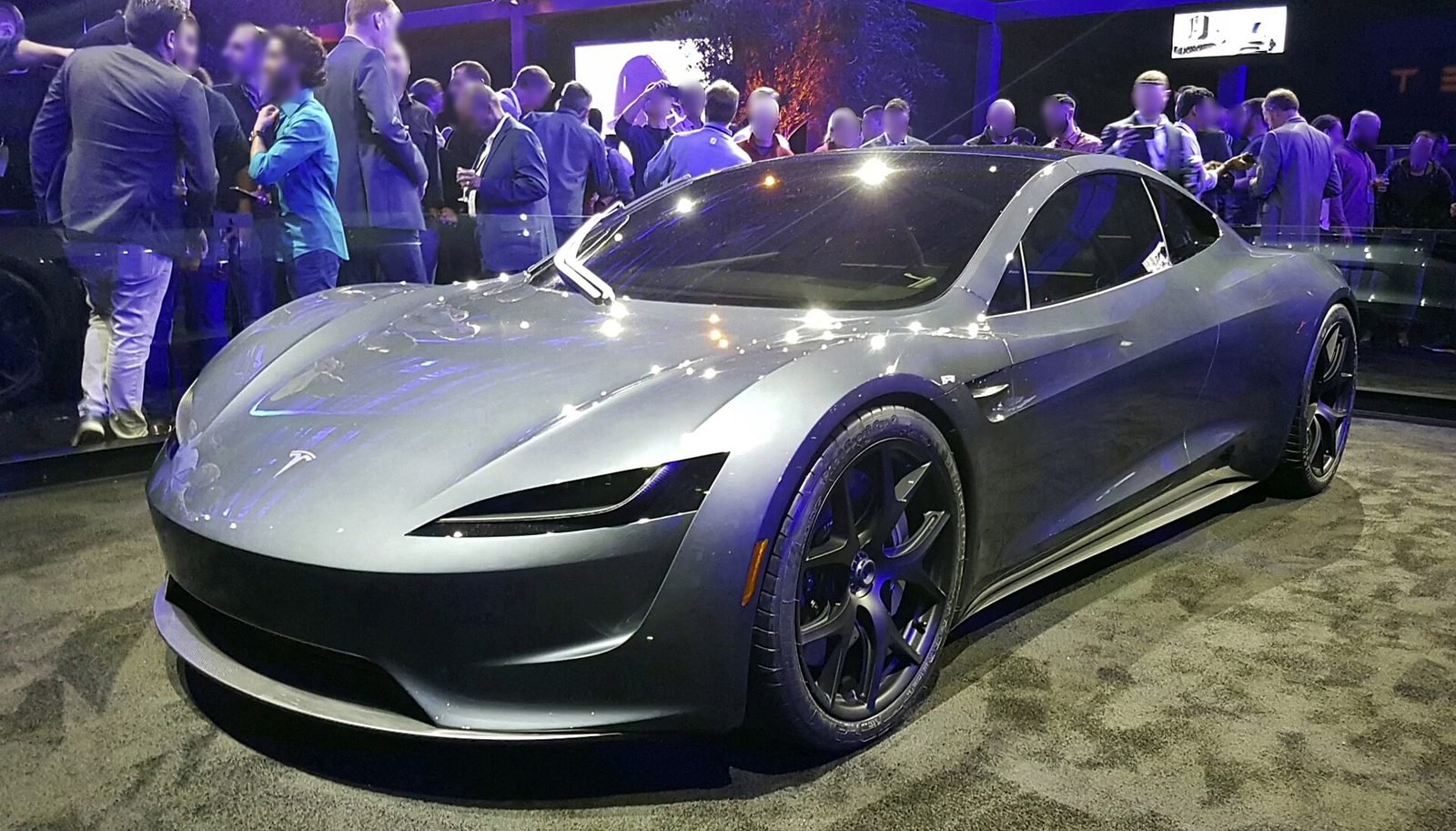
If you’ve searched “elon musk tesla roadster flying car” in the last few days, you’re one of millions. The phrase is everywhere — Google, X, YouTube, group chats, even Spanish-language searches. Here’s the full story in one place: what the car is, what it actually did in Texas, how the technology works, what it costs, when it arrives, and what’s real versus hype.
Short version: Tesla unveiled a redesigned Roadster on October 15, 2026, at a SpaceX test site in Texas. A driverless prototype drove up a curved ramp upside down, flipped through the air on rocket thrusters, jumped over five parked Teslas, and hit 60 mph in 0.81 seconds. Then Musk spent the next two days promising the production car will do all of it by itself.
What is the Elon Musk Tesla Roadster flying car?
It’s the second-generation Tesla Roadster — a two-seat electric supercar Tesla first promised in 2017 and finally showed in production-intent form nine years later. The “flying car” nickname comes from its party trick: SpaceX-designed cold-gas thrusters (small jets that puff compressed air to push the car around) plus a fan suction system underneath that lets it drive upside down.
Important: it’s not a flying car the way most people picture one. It can’t cruise through the sky or commute above traffic. What it does are short, controlled aerial maneuvers — launches, flips, landings. Think of it less like a Jetsons car and more like the world’s most expensive stunt machine.
Tesla calls it a halo car — a flagship meant to show off what’s possible, not to sell in huge numbers. Musk himself has warned it won’t move the needle on Tesla’s finances in any big way. That honesty is refreshing, and it tells you exactly what this car is for: spectacle.
Nine years in the making
To understand the skepticism around this car, you need the backstory. The original Roadster reveal in 2017 promised a $200,000 base price, 620 miles of battery range, a top speed past 250 mph, and 0–60 in under 1.9 seconds. Production was supposed to start in 2020.
Then the date slipped: 2022, then 2023, then 2025–26. A demo promised for late 2025 never happened. Meanwhile the car itself changed completely — the sharp, angular 2026 redesign looks almost nothing like the sleek 2017 prototype, trading curves for a Cybertruck-inspired wedge with a full-width light bar.
Through it all, Tesla kept taking money. In 2017 the company collected $50,000 deposits on the base car and $250,000 in full for the Founders Series (Hypebeast). Thousands of reservation holders waited years; some, like Sam Altman, eventually asked for refunds after waiting seven and a half years. That history is why every new Roadster promise now gets a very careful look.
What the Texas demo actually showed
The reveal happened October 15 at a SpaceX facility near Waco, Texas, in front of a live audience. Musk insisted on witnesses — he wanted attendees to personally vouch that the physics was real and not AI-generated. In 2026, that’s not paranoia; it’s marketing.
Demo one: the ramp. A white Roadster with nobody inside drove up a towering curved ramp, curled over the top, and hung upside down, held to the surface by the underbody fan. Engineering chief Lars Moravy says the suction pulls up to 2G — twice the force of gravity — and Musk joked it “could suck the chrome off a trailer hitch.” Then the car launched off the end of the ramp, rotated mid-air on its thrusters, and landed on its wheels. Musk’s explanation for the empty driver’s seat: “to make sure we don’t kill anyone.”
Demo two: the kickflip. The Roadster launched into the air and flipped clean over five parked Teslas — a Cybercab, Cybertruck, Semi, Model Y, and Model 3. The event timer flashed 0.81 seconds for the 0–60 run. Moravy said production cars should do even better, with the top trim targeting more than 230 mph and over 300 miles of range. All manufacturer claims, none independently tested.
The crowd reaction was genuine, and the clips traveled fast: Musk’s own video passed 54 million views on X in under a day. For a fuller rundown of the night’s biggest moments, see our reveal recap.
How the “flying” technology works (in plain English)
Two systems, both developed with SpaceX. Here’s what each one does, without the engineering degree:
- Cold-gas thrusters: ten small nozzles around the car blast compressed air — the same basic idea spacecraft use to turn in orbit. The demo car carried about 600 liters of compressed air in carbon-fiber tanks stuffed into every spare gap in the body. The puffs push the car off the ground and steer it mid-flip.
- Fan suction: a big fan under the car sucks it toward the surface below, creating downforce (how hard the fan pushes the car down). Tesla says it makes about 2G — enough to drive upside down on the ramp without falling off.
Together they allow powered jumps, flips, and controlled landings. The air tanks recharge on board, so there’s no exotic fuel involved — just air, compressed to very high pressure. But here’s the limit that matters: we’re talking seconds of airtime, not minutes. A leap, not a journey. As one widely shared critique put it: “that at best glided.”
The three trims and what they cost
Tesla’s reservation page lists three versions, and they differ mostly in how much of the flight hardware they get:
- Performance: the base two-seater, with an active rear wing and the underbody suction fan used in the ramp stunt. Reservation: $50,000 ($5,000 by card, then $45,000 by wire within 10 days).
- Thrust: adds the rear cold-gas thruster system. Tesla says this cuts 0–60 to about 0.8 seconds. Reservation: $250,000.
- Rocket: the full show — perimeter jets for complete aerial maneuvers, single seat. Invite-only, and Tesla hasn’t published a reservation price. (Trim details via ToperNews)
Now the part everyone asks about: the actual purchase price. Tesla hasn’t announced one for any trim. The reservation agreement says the final figure gets confirmed only when configurators go live. So a reservation is a five- or six-figure placeholder on a car with a TBD sticker price. Treat any specific price you see online as speculation for now.
For context, the six-figure EV era is officially here regardless: the New York Times reports the new Roadster will start at $200,000-plus, and Jaguar’s 1,000-hp Type 01 landed a week before the reveal. If you want the pricing landscape, our six-figure EV breakdown has the details.
When can you actually buy one?
Tesla’s target is production in 2028. Given the nine-year history above, here’s the honest way to read that: it’s a target, not a plan. Tesla gave no timeline for anything between now and then — no factory announcements, no certification milestones.
Prediction markets currently give the car under a 5% chance of reaching customers by the end of 2026 and about a 61% chance for 2027 deliveries. Those are bets, not facts, but they capture the mood: hopeful, not convinced.
Then there’s the unglamorous stuff nobody clapped for at the reveal: crash certification, road legality (Musk admits the car may not be legal in every jurisdiction), and insurance for a vehicle packing a reported 80 kilonewtons of thrust in some configurations. Moravy himself called it “not necessarily a safety-optimized car.” All of that has to be solved before a single customer car ships.
The newest twist: it drives its own stunts
Two days after the reveal, Musk added the strangest feature yet. Replying on X to tech blogger Robert Scoble — who described the Roadster as one computer driving another — Musk answered “True” and said the car will have “sentience” (as reported October 17) and perform any stunt from the presentation automatically, with no driver input.
The enabler is drive-by-wire: electronic steering, braking, and acceleration with no mechanical linkages, so software can operate the entire car. Pick a stunt, and the car executes it. And in a twist only Musk could deliver, he also called the Roadster the vehicle that will remain Tesla’s only manually driven car in the long term. You drive it — until you press the button that tells it to drive itself off a ramp.
Tesla is even planning a looping test track at its Texas headquarters — “crazy” and “beyond Hot Wheels,” per Musk — where owners can try all of this. We covered the full announcement in our stunts deep-dive.
Why SpaceX is all over this car
The thrusters were developed with SpaceX. The demo happened at a SpaceX facility. The engineering team straddles both companies. Naturally, searches for “elon musk spacex tesla megadeal” are climbing — analysts at Barclays have written that a formal Tesla–SpaceX combination could be announced as soon as this month, according to Engadget’s live coverage.
Nothing is confirmed. But the logic is visible: one man runs both companies, one company’s rockets are becoming the other company’s party tricks, and the demo’s whole staging — live witnesses, a SpaceX site, rocket hardware on a car — reads like a preview of a combined pitch. Whether a megadeal happens or not, the Roadster is already the most SpaceX thing Tesla has ever built.
What the internet thinks
The demo broke the internet in the most literal sense: 54 million views, thousands of memes, and a reply thread uniting Sam Altman (who posted “good job”), a Knight Rider turbo-boost meme that Musk himself replied to (“One of my favorite shows as a kid!”), and politicians from Ron DeSantis to Kari Lake.
The skeptics have been just as loud — and some of their points are fair. Our reactions roundup has the best, the funniest, and the most brutal takes in one place.
Should you put down $50,000?
Honest buyer guidance, since people are actually wiring this money:
- What you get: a place in line and bragging rights. Not a car, not a price, not a delivery date.
- What you risk: $50,000 (or $250,000) sitting with Tesla for two-plus years, on a car whose final price, specs, and legality are all TBD. Ask 2017 reservation holders how the wait felt.
- What would change our mind: a confirmed purchase price, a factory plan, and crash-test paperwork. Until then, this is a very expensive lottery ticket on the future.
None of that is a prediction the car won’t happen. It’s just the math: the upside is owning the wildest production car ever made; the downside is an interest-free loan to Tesla. Make sure you’re comfortable with both.
Quick answers
Is the Elon Musk Tesla Roadster flying car real or fake? The car and the demo are real — real hardware, real physics, real witnesses. What’s exaggerated is the “flying car” label: it does jumps and flips, not sustained flight.
How much does it cost? Reservations are $50,000 (Performance) and $250,000 (Thrust); Rocket is invite-only. Final purchase prices haven’t been announced.
When does it come out? Tesla targets 2028. The company’s history with Roadster dates suggests keeping expectations flexible.
Is it street legal? The base trims are intended as road cars. The full stunt hardware on the Rocket trim isn’t approved for public roads, per Tesla’s own site.
Can it really drive upside down? In the demo, yes — the suction fan held it to the ramp at a claimed 2G. Whether owners will ever be allowed to try it is another question entirely.
Will it really do its own stunts? That’s Musk’s October 17 promise: drive-by-wire autonomy that performs any demonstrated stunt on command. Promised, not demonstrated — yet.
The bottom line
The Elon Musk Tesla Roadster flying car is the most entertaining car reveal in years — a genuine engineering stunt wrapped in a $50,000 reservation ask. The thrusters are real, the suction is real, and the videos are spectacular. Whether it becomes a real product or the most expensive vaporware in auto history will be decided not by rocket jets, but by the boring stuff: factories, regulators, crash tests, and a price tag Tesla still won’t name.
Until 2028, enjoy the videos. And if you’re one of the millions searching “elon musk tesla roadster flying car” every day — now you know the whole story.