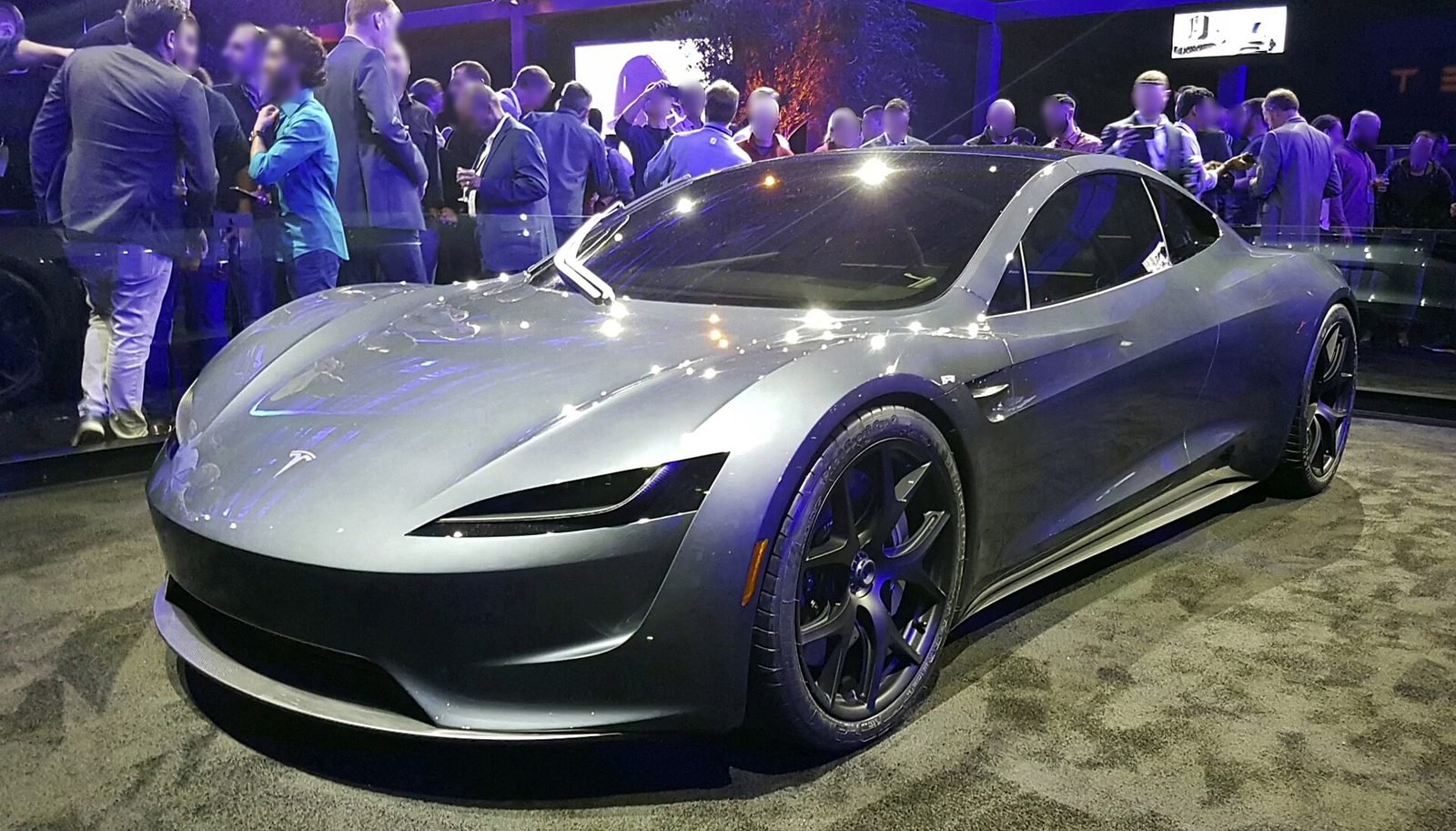
The Elon Musk Tesla Roadster flying car saga just added its wildest chapter. Two days after a driverless Roadster climbed a curved ramp upside down and backflipped through the Texas sky, Musk went on X and casually promised the production car will perform every one of those stunts by itself.
It started with tech blogger Robert Scoble, who watched the demo and described the setup as one computer driving another rather than a human working the controls. Musk’s reply was a single word — “True” — followed by the kicker: the Roadster will have what he called “sentience” and will be able to perform any stunt shown at the presentation automatically, with no driver input required.
“Sentience”: your Roadster does its own stunts
The enabler is drive-by-wire. Musk confirmed the Roadster uses electronic controls for steering, braking, and acceleration — no mechanical linkages — which means a computer can operate the whole car. In practice, owners would pick a stunt and the car would execute it: the ramp climb, the mid-air flip, the kickflip over a row of parked cars.
Here’s the twist that makes it stranger: Musk also said the Roadster is meant to remain Tesla’s only manually driven car in the long term. A car you drive yourself — until you press the button that tells it to drive itself off a ramp. Only in 2026.
The Elon Musk flying car discourse has mostly argued about whether the thing can really fly. This shifts the argument: the question isn’t just what the car can do, but who — or what — is doing it.
A looping track “beyond Hot Wheels”
Where exactly do you practice backflipping a $250,000 car? Tesla’s answer: a looping test track at its Texas headquarters where owners can test-drive the Roadster. Musk called the planned track “crazy” and said it would go beyond Hot Wheels — which, given Hot Wheels already sells loop-the-loop sets, sets an interesting bar.
No timeline for the track, no location details beyond Texas. But it tells you how Tesla sees this car: not a commuter, a theme-park ride you own.
Reservations open in weeks: the price question
Let’s talk Tesla flying car price, because that’s the search everyone is actually running. Tesla updated its reservation page with three trims: Performance (two seats, active rear wing, the underbody suction fan) reservable at $50,000; Thrust (adds the rear cold-gas thruster system, 0–60 in about 0.8 seconds) at $250,000; and Rocket, a limited single-seat trim with perimeter jets that’s invite-only.
Call it a new Tesla flying car, Tesla’s new flying car, or just the new flying Tesla — whatever the phrasing, the catch is that Tesla hasn’t announced a final purchase price for any trim. The reservation agreement says the figure gets confirmed when configurators go live. You’re putting down five figures on a car whose sticker price is, officially, TBD. (That’s $5,000 by card plus $45,000 by wire within 10 days for Performance, per the reservation terms.)
Reservations are expected to open in the coming weeks for the US, Canada, and China. Production target: 2028.
What the demo actually showed
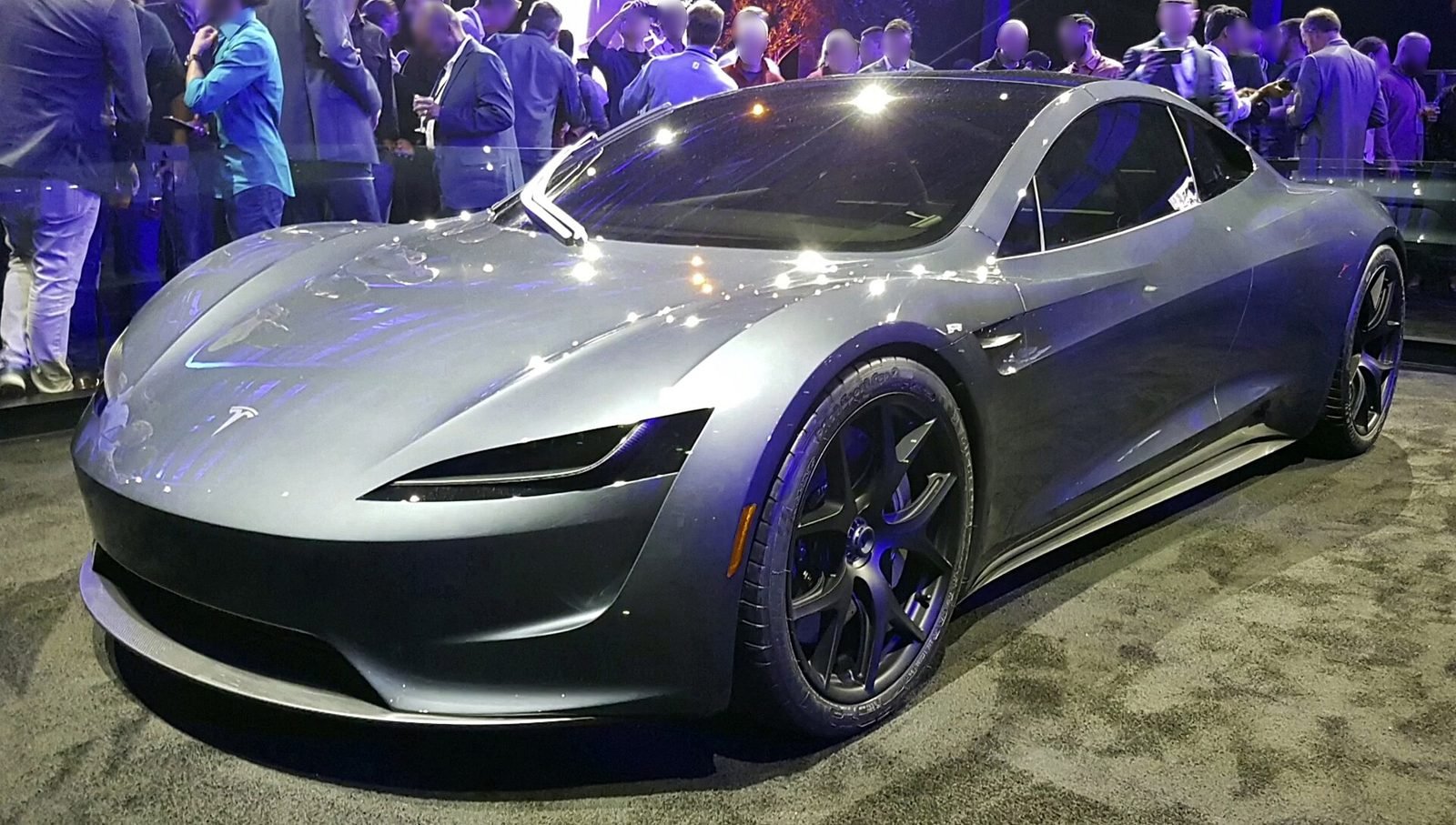
Quick recap for anyone who missed Thursday: at a SpaceX test site near Waco, Texas, a Roadster with no one inside drove up a towering curved ramp, clung to it upside down on fan suction — engineering chief Lars Moravy says the system pulls up to 2G, enough that Musk joked it “could suck the chrome off a trailer hitch” — then launched off the end, flipped mid-air on ten cold-gas thrusters fed by some 600 liters of compressed air, and landed on its wheels. Musk’s explanation for the empty seat: “to make sure we don’t kill anyone.”
Then the encore: the car jumped clean over five parked Teslas — Cybercab, Cybertruck, Semi, Model Y, Model 3 — in what Tesla called a “kickflip,” and the timer flashed 0.81 seconds for 0–60. Moravy says production cars should do better, with the top trim targeting over 230 mph and 300+ miles of range. All manufacturer claims, none independently tested.
The SpaceX question
Searches for “elon musk spacex tesla megadeal” are climbing, and it’s not hard to see why. The thrusters were developed with SpaceX, the demo happened at a SpaceX facility, and analysts at Barclays recently wrote that a formal Tesla–SpaceX combination could be announced as soon as this month. Musk hasn’t confirmed any deal — but he did insist on a live audience for the demo so attendees could personally vouch the physics wasn’t AI-generated. When your product demo needs witnesses to prove it’s real, you’ve understood the assignment for 2026.
The skeptic’s corner
Now the cold water. In 2017 Tesla promised this car for 2020; the date has since slid to 2022, 2023, 2025–26, and now 2028. Prediction markets currently give it under a 5% chance of reaching customers by end of 2026 and about 61% for 2027 deliveries. Moravy himself admitted the car is “not necessarily a safety-optimized” one, and Musk said it might not be legal in every jurisdiction. What was shown were controlled hops — spectacular ones — not sustained flight, and the flight hardware lives on the invite-only Rocket trim that isn’t street legal.
None of that means the demo was fake. It means there’s a long road between a stunt car in Waco and a car in your garage.
Quick answers
Is the Tesla flying car real or fake? Real footage, real physics, real witnesses. What’s “fake” is the idea of a flying car in the Jetsons sense: this thing does jumps and flips, not commutes through the sky.
Is there a Tesla balance bike? No — Tesla doesn’t make a balance bike, and this article won’t help you find one. (If that’s the search that brought you here, you may be thinking of the Cyberquad for Kids, or the algorithm just got creative.) Stick around anyway; the flying car is worth it.
Seeing “nuevo tesla” in your searches? You’re not alone — Spanish-language search interest in the new Tesla is spiking across the US and Latin America. Same car, same stunts, mismo loco. English-language searches like "tesla new flying car" are spiking just as fast.
What happens next
Reservations in the coming weeks will be the first real test — how many people wire $50,000 for a car with no confirmed price. Then the wait until 2028, during which Tesla has to solve the unglamorous stuff: crash certification, road legality, insurance for a car with 80 kilonewtons of thrust. The stunts were the easy part. Building the car is the stunt.