Tesla will spend €3 billion ($3.31 billion) on a new production facility at Gigafactory Berlin-Brandenburg, with room to build up to 1 million Cybercabs a year. The permit application goes in before the end of 2026, construction starts in the first half of 2027, and production begins in 2029. The plant already builds the Model Y — the Cybercab would be its second product, and the biggest bet Tesla has made on a car with no steering wheel.
Key takeaways
- Tesla is spending €3 billion on a new Giga Berlin facility; Cybercab production starts in 2029.
- Reaching 1 million Cybercabs a year takes about 10 years.
- The Cybercab costs $29,990, plus a mandatory $299-a-month subscription.
- It only drives inside Tesla’s Robotaxi zones in Texas and Florida.
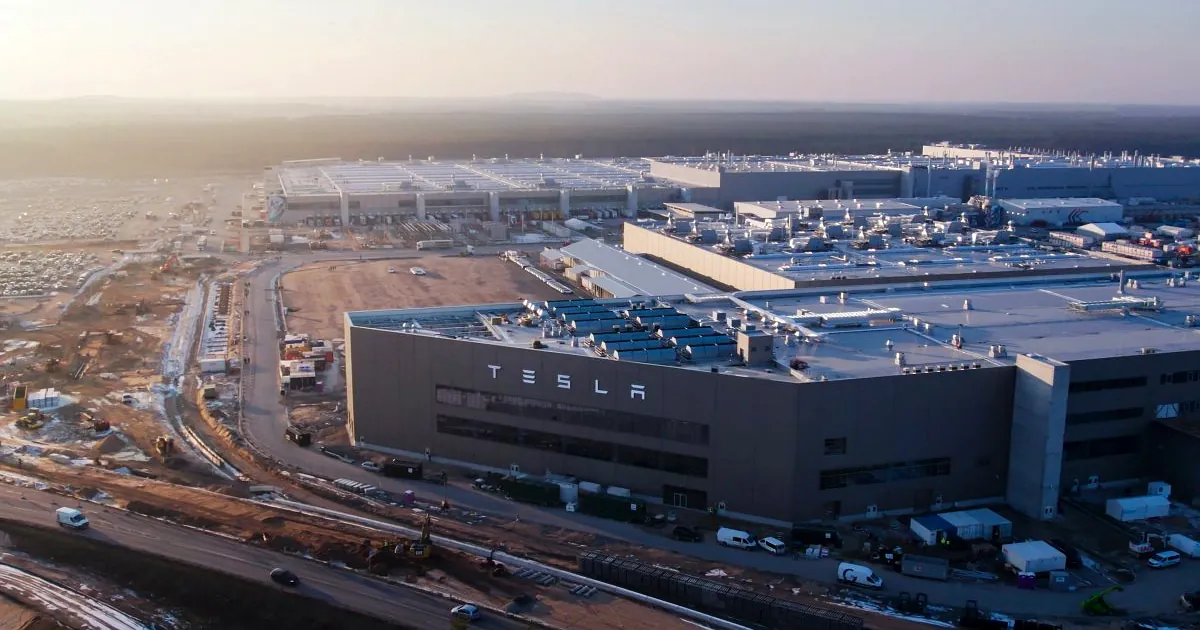
Tesla will spend €3 billion ($3.31 billion) building a new production facility at Gigafactory Berlin-Brandenburg, with the aim of producing up to 1 million Cybercabs a year. The company confirmed the plan on Monday, November 16, 2026. Production starts in 2029, and the new hall will more than double the size of the factory. For buyers, the news finally puts a date on a European-built Cybercab: a permit application, a construction start, and a production year, all attached to the same announcement.
That makes Grünheide the home of the Tesla Giga Berlin Cybercab — the first time Tesla has named a second product for its only European plant. Until now, the factory has built one car: the Model Y. The Cybercab would be its second, and the biggest bet Tesla has made on a car with no steering wheel. It is also the car at the centre of MKBHD’s bet that Tesla cannot sell a $29,990 Cybercab by December 31, 2026 — and he has since ordered one himself.
| What Tesla announced | Detail |
|---|---|
| Investment | €3 billion ($3.31 billion) |
| Where | New production facility at Gigafactory Berlin-Brandenburg, Grünheide, Germany |
| Target | Up to 1 million Cybercabs a year |
| Permit application | Before the end of 2026 |
| Construction starts | First half of 2027 |
| Production starts | 2029 |
| Full output | Over about 10 years |
What Tesla Announced at Gigafactory Berlin
Tesla is investing €3 billion ($3.31 billion) in its Gigafactory in Grünheide, its only plant in Europe, to build a new production facility for the Cybercab. Reuters reported the plan on November 16, 2026, after the German papers Frankfurter Allgemeine Zeitung and Handelsblatt first carried the news. The company aims to produce up to 1 million Cybercabs a year at the site, with a building permit application going in before the end of 2026, construction starting in the first half of 2027, and production beginning in 2029.
Tesla's own words, carried by AFP, set the tone: "This will lay the foundation for the world's most technologically advanced Tesla factory here in Gruenheide." AFP renders the figure as $3.4 billion — the same €3 billion at a different exchange rate. This article uses Reuters' $3.31 billion figure.
The announcement lands in a year when Tesla has already put the Cybercab to work. The two-seat driverless car has been carrying paying Robotaxi passengers in Austin, Texas, since September 2026, and more than 300 Cybercabs are now in that fleet. What Berlin adds is scale: a second factory, on a second continent, built to turn a taxi-fleet car into a mass-market one.
Tesla Cybercab Price, $299 Subscription, and 5-Year Cost
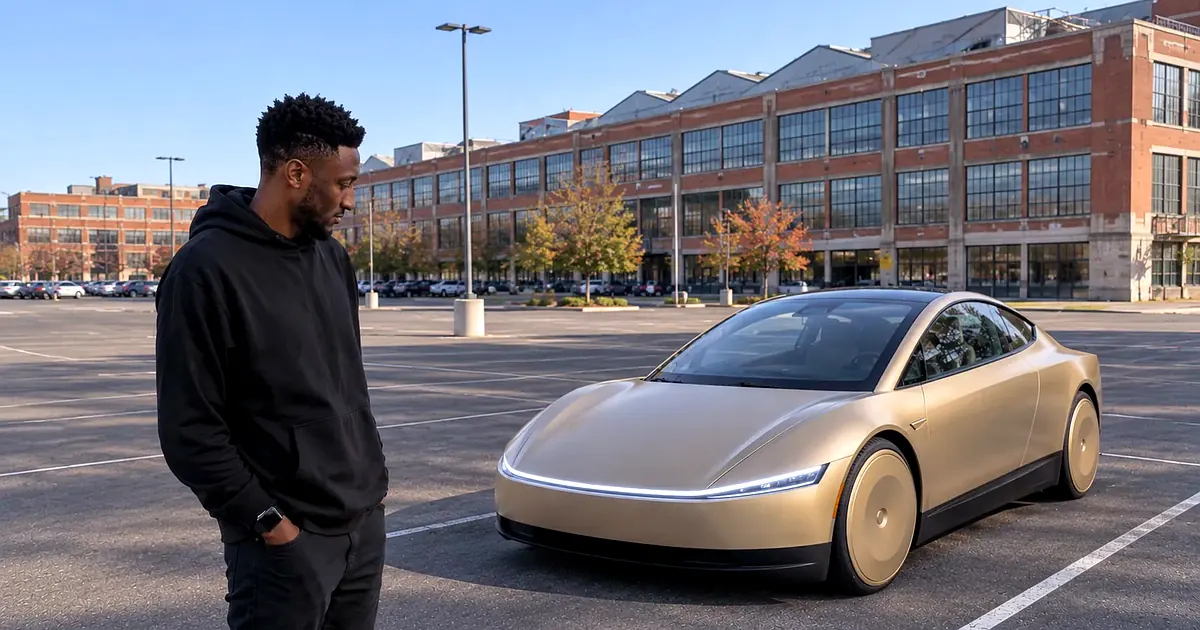
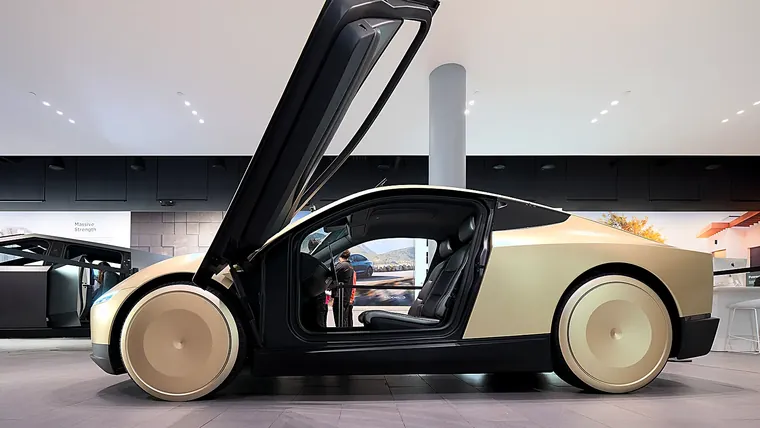
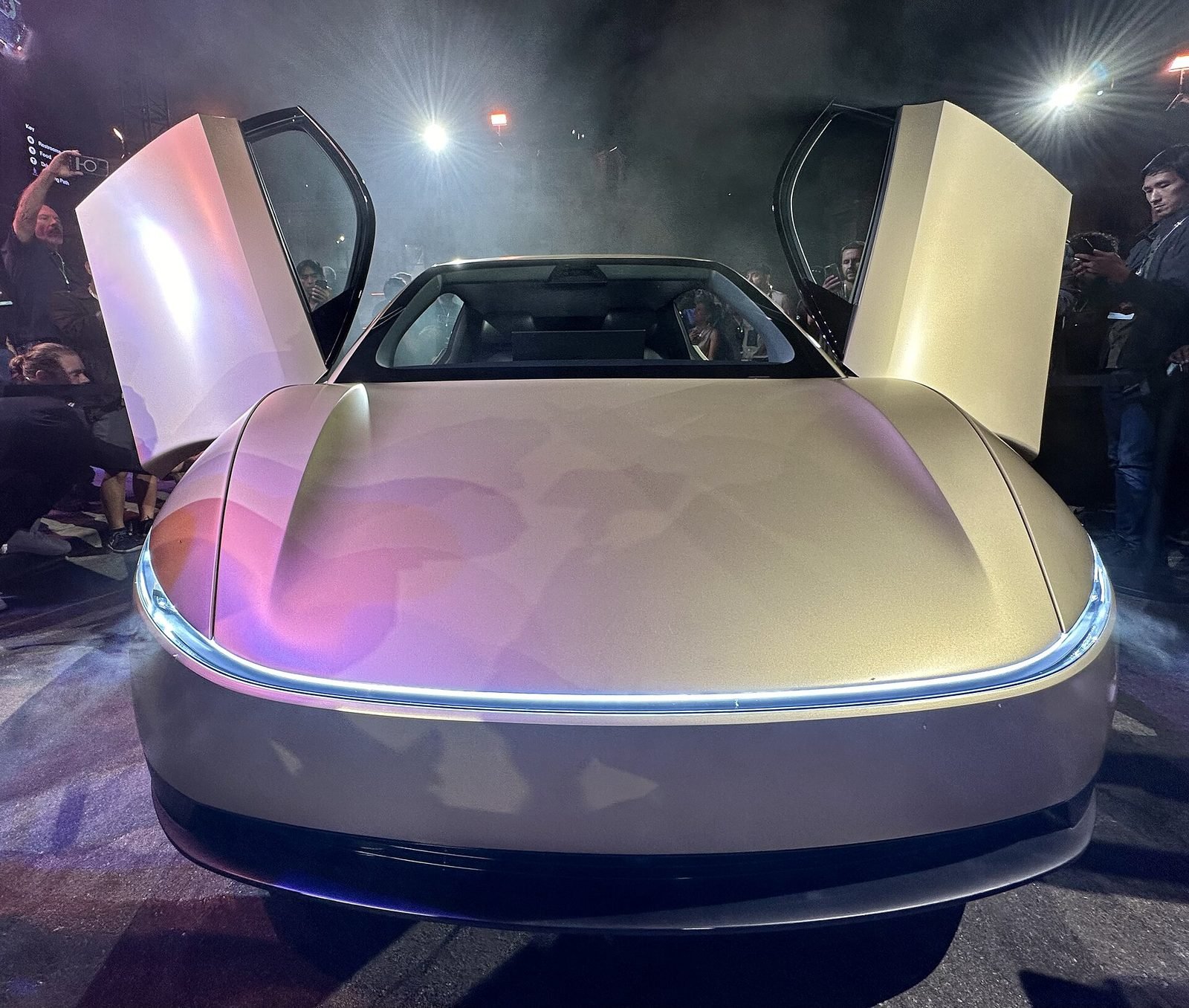
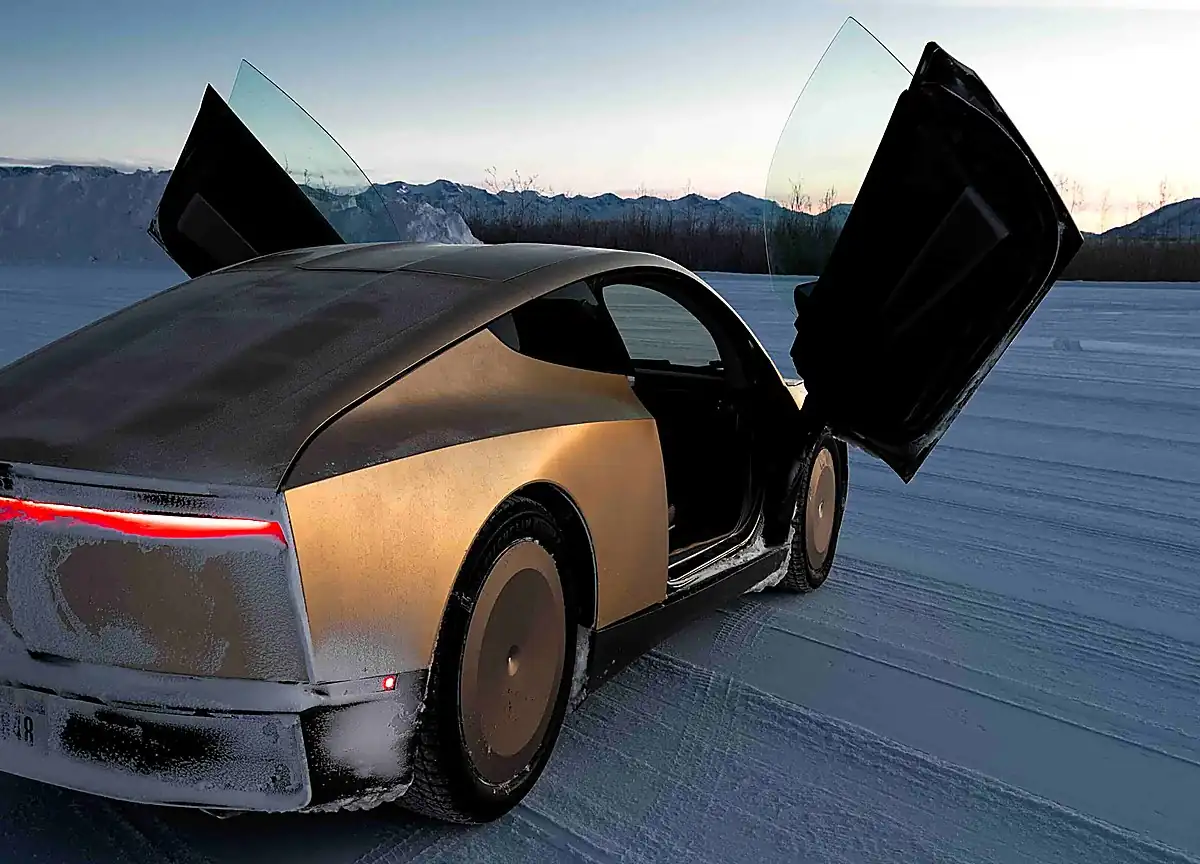
The Cybercab is a two-seat car built from the start to drive itself. It has no steering wheel, no pedals, and no rear window. The body is finished in gold, the doors swing up like butterfly wings, and the cabin holds two seats and a 20.5-inch touchscreen. There is nothing for a driver to hold on to, because there is no driver.
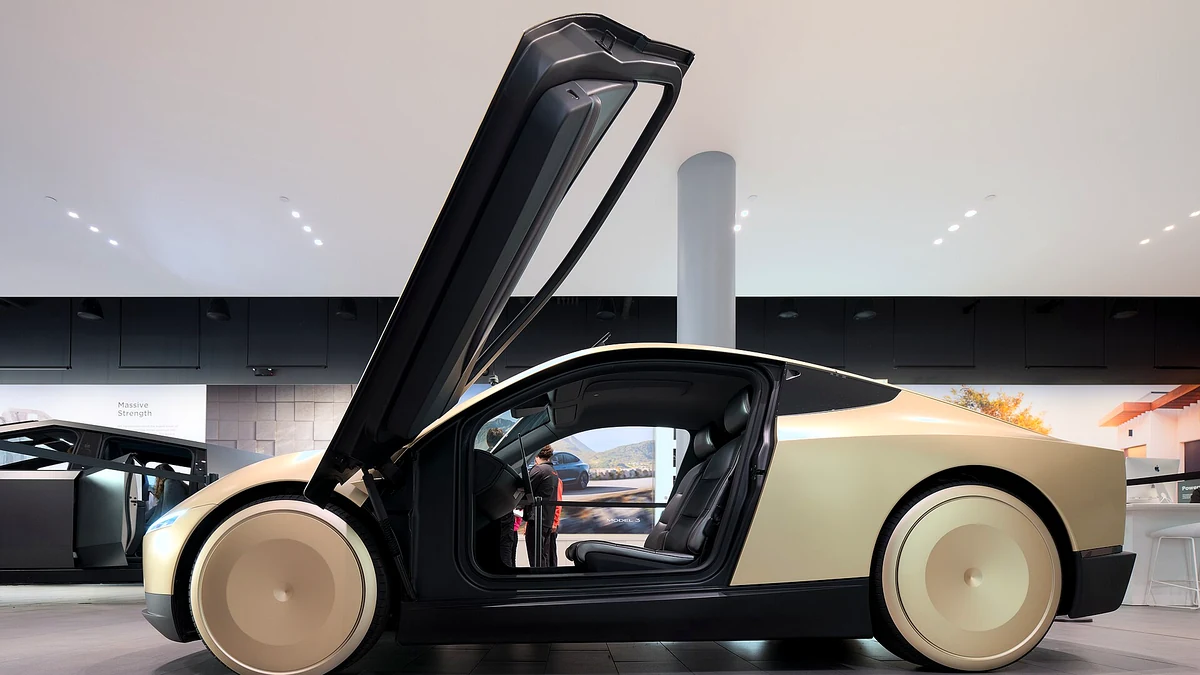
The doors are the detail that makes the car look like nothing else on the road. The car has been photographed in snow at dusk, its butterfly doors open, the gold paint and the red light bar standing out against the winter light.
Tesla opened orders to private buyers on November 13, 2026, for select customers only. The price is $29,990 before taxes, with a $1,000 non-refundable deposit due at ordering — and the deposit is part of the price, not on top of it. The catch is the subscription: a $299-a-month Autonomy Subscription is required to operate the car, with the first month included. Stop paying and the car stops. The subscription box comes pre-checked on the order page, and a buyer can technically uncheck it — but the car then cannot drive on public roads at all: with no steering wheel or pedals and no active subscription, it will not move. Over five years, the subscription adds $17,641 (59 paid months), putting the car and subscription together at $47,631, before insurance, maintenance, taxes and charging.
No private buyer has received one yet. First deliveries are estimated for December 2026 across five Texas cities — Austin, Dallas, Houston, Fort Worth and San Antonio. Austin is where Cybercabs already work for a living, carrying paying Robotaxi passengers since September. Production began at Gigafactory Texas in April 2026, and the Austin fleet now has more than 300 Cybercabs. The car operates only inside Tesla's Robotaxi zones, in eight cities across Texas and Florida.
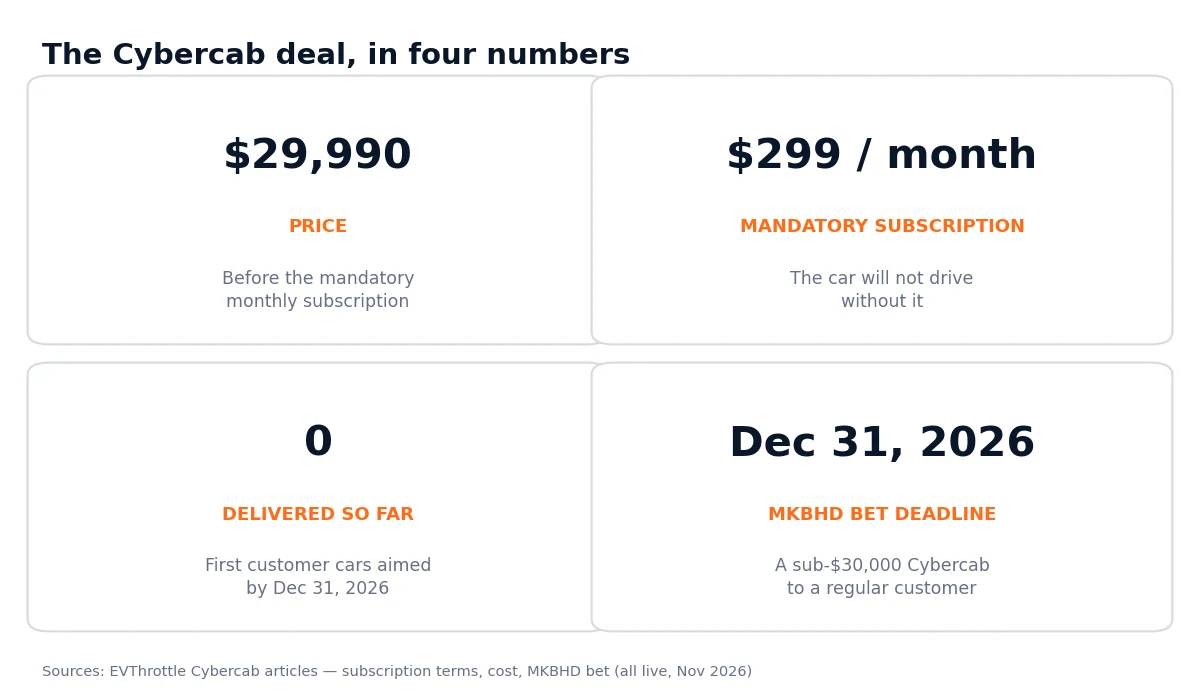
The $299 monthly fee is already contested — by Musk himself. On November 14, 2026, replying to Marques Brownlee on X, Musk said the fee is too high and should run closer to $115 a month, matching what Tesla charges for Full Self-Driving and connectivity on its other cars. That is a suggestion, not a price change: Tesla has announced nothing, and the $299 terms still govern every order placed today.
For the full fine print, Auto Aspect's 27-minute breakdown of the Cybercab order agreements walks through the $299 subscription, the approved cities, and the $50,000 resale rules.
Tesla's official Cybercab film, "The Future is Autonomous", shows the car as Tesla wants buyers to see it: individualized point-to-point transport that adjusts to your climate, seating and music before it arrives. It is the company's own pitch for the car Berlin will build.
Put the five-year numbers side by side and the Cybercab is not the cheap option its sticker suggests. A buyer who keeps the car for five years pays more for the driverless Cybercab than for a Model 3 or a Model Y with Full Self-Driving — and those cars can be driven anywhere, by anyone, with or without a subscription.
| Five years of ownership | What you pay | What you get |
|---|---|---|
| Cybercab | $47,631 ($29,990 + $17,641 subscription) | A driverless car that only runs inside Robotaxi zones |
| Model 3 + Full Self-Driving | $42,930 | A car you can drive anywhere, with supervised self-driving |
| Model Y + Full Self-Driving | $45,930 | The same, in a bigger car |
The table uses the figures from EVThrottle’s Cybercab cost coverage, published in November 2026: the Cybercab's first-year total is $33,279, and its five-year total is $47,631 against $42,930 for a Model 3 with Full Self-Driving and $45,930 for a Model Y with Full Self-Driving. The Cybercab costs $1,701 more than the Model Y with Full Self-Driving over five years — and $4,701 more than the Model 3. The premium buys one thing: no driving at all.
Where Can You Drive the Tesla Cybercab? (Geofencing & US Rules)
A Cybercab cannot drive anywhere. It is geofenced — it only runs inside Tesla's approved Robotaxi zones, eight cities in Texas and Florida. Outside those zones, it does not operate. The eight cities are Austin, Dallas, Houston, Fort Worth and San Antonio in Texas, and Miami, Orlando and Tampa in Florida. That is the driving list. The delivery list is shorter: buyers take delivery in five Texas cities only — Austin, Dallas, Houston, Fort Worth and San Antonio.
The zones are not the same for every car. Cybercab rides are only offered in Austin for now, where more than 300 of them run alongside the Model Y robotaxis, with Dallas next. A private Cybercab is for personal use only — owners cannot put it on the Robotaxi network to earn money, and third-party ride-hailing, delivery and rental work is off limits without Tesla's approval.
The safety question is open too. Tesla self-certified the Cybercab as meeting US federal motor vehicle safety standards, even though it has no steering wheel, pedals or mirrors — and it holds no exemption from those standards. The National Highway Traffic Safety Administration opened an audit query on September 3, 2026 — the same day paid Cybercab rides began in Austin — and a week later issued a special order requiring Tesla to give sworn answers to 21 questions on how the car complies. The inquiry covers roughly 1,000 Cybercabs in the US, and incomplete answers carry civil penalties of up to about $139 million. Tesla filed its response on October 30 and asked for the whole file to be kept confidential. NHTSA has announced no findings yet. In June, NHTSA proposed dropping the brake pedal requirement for vehicles built only for autonomous driving. That investigation is about the American car, but any finding would shape how the Berlin car is certified in Europe as well.
Why Tesla Chose Berlin Instead of Texas for 1 Million Cybercabs
Berlin got the job because it is Tesla's only plant in Europe, and because it is the plant with room to grow. The factory already builds the Model Y for Europe and Canada. Texas already builds the Cybercab — production there began in April 2026 — but Texas also builds the Model Y and the Cybertruck, and its Cybercabs serve the American Robotaxi fleet. Berlin is the European base, and a Cybercab built in Germany reaches European buyers without a ship or a tariff.
Four days before the announcement, Berlin plant manager André Thierig told the Automobilwoche Congress that the second factory "won't be building another Model Y factory" — and that no product decision had been made. The November 16 announcement is that decision. Tesla has not said which version of the Cybercab Berlin builds first, or what a Berlin-built Cybercab will cost in euros. Musk had already pointed the way: in October, he called the Cybercab the "most likely next major product" for Giga Berlin, with the Optimus humanoid robot possibly following. The land for the new hall is already cleared.
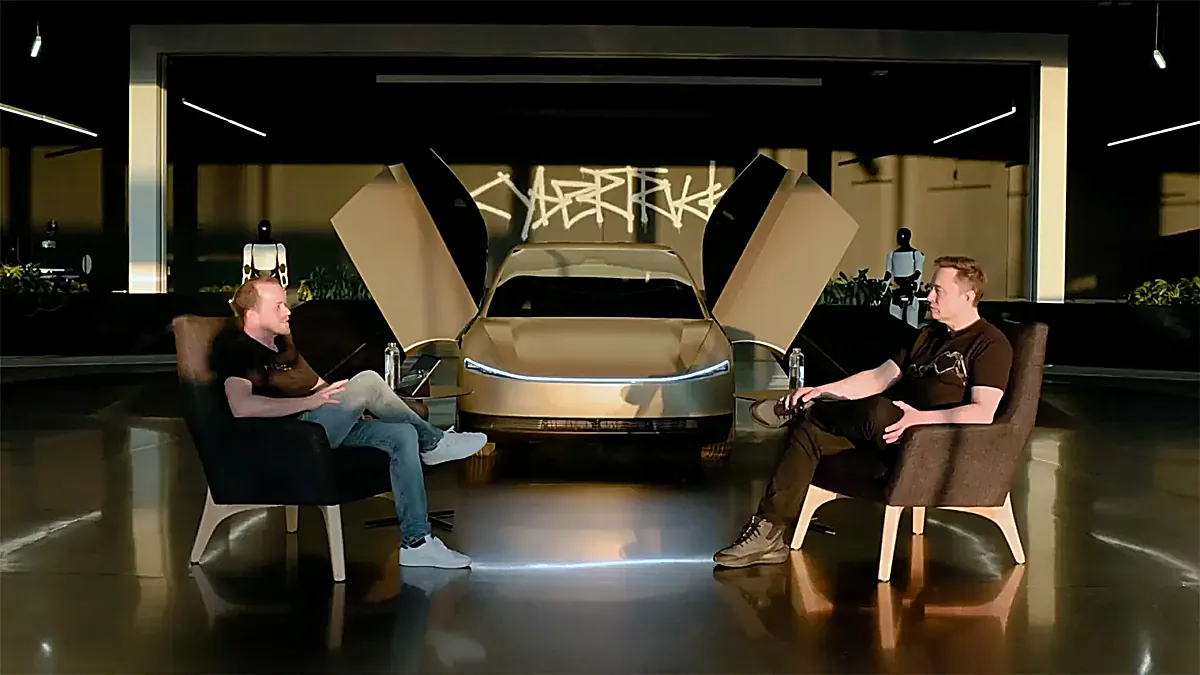
The contrast with Germany's own carmakers is hard to miss. While Volkswagen, Mercedes-Benz and BMW have been cutting costs and trimming production plans at home, Tesla is spending €3 billion to expand in Brandenburg. Reuters made the same point in its report: Tesla is growing in Germany while the German industry shrinks. That is the political backdrop to the €3 billion — and part of why the state government celebrated it on the day.
What 1 million a year actually means
One million Cybercabs a year would nearly triple what Giga Berlin builds today — and it would equal about 43% of everything Tesla can build in a year right now. That is the scale of the bet, and it is EVThrottle's own calculation from the verified numbers below.
Berlin's current output target is 7,500 Model Ys a week, or about 375,000 a year. Divide 1,000,000 by 375,000 and you get 2.67 — the new target is about 2.7 times today's output. Tesla's total installed capacity, from its third-quarter 2026 earnings call, is about 2.3 million vehicles a year. Divide 1,000,000 by 2,300,000 and you get 43.5% — one plant, in one German town, would hold room for more than two-fifths of Tesla's entire current capacity. The new hall alone tells the same story: 536,000 square metres, more than twice the size of the current 219,000-square-metre building.
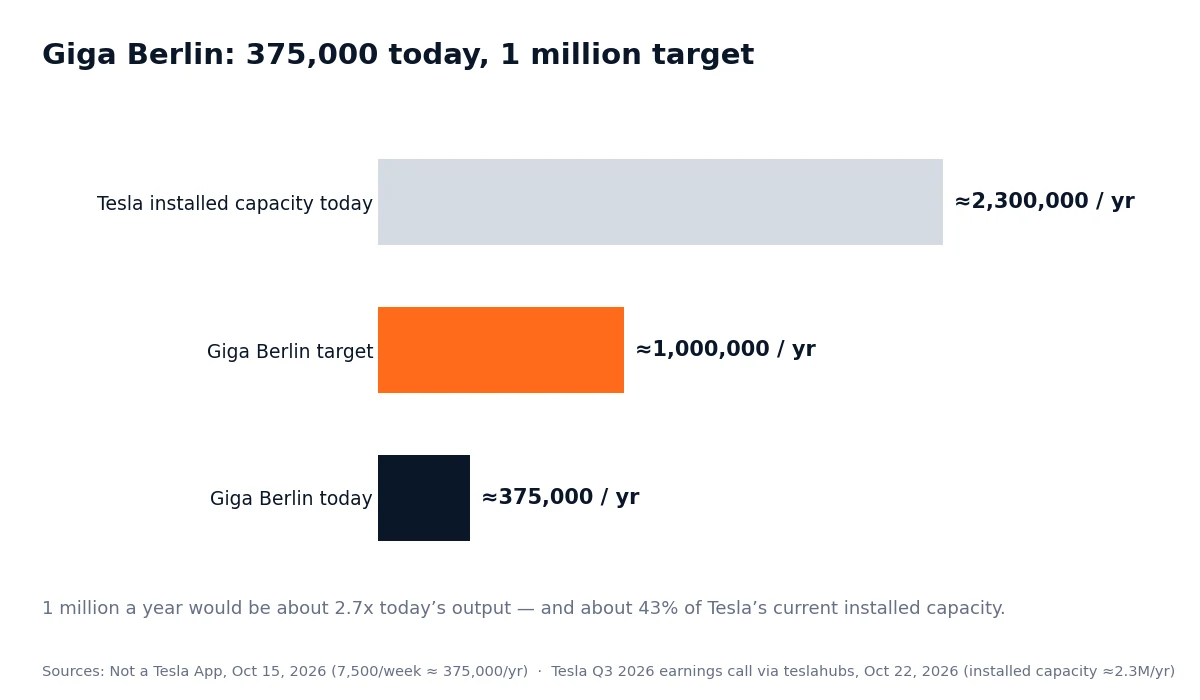
Tesla has also talked about speed: at full line speed, the company says a Cybercab could come off the line every 10 seconds. Treat that as Tesla's stated ambition, not a verified annual rate — a line running at that pace, all day, every day, would build far more than 1 million cars a year, so the real constraint will be demand, permits, and hiring, not the line itself. The wider context is Tesla's own target of 5 million vehicles a year by about 2030, set out on the same earnings call. Berlin's 1 million would be a fifth of that.
| Berlin today | Berlin after the expansion | |
|---|---|---|
| Annual output | About 375,000 (7,500 a week) | Up to 1,000,000 |
| Main product | Model Y | Model Y + Cybercab |
| Factory floor | 219,000 sq m | Plus a 536,000 sq m new hall |
| Workers | About 13,000 on site | 2,000 already hired, several hundred more coming |
| Battery cells | Cell production coming | Full cell production by mid-2027 |
The worker numbers come from the plant itself: 2,000 new workers have already been hired for the expansion, and the WOLF Financial post on the day of the announcement put the current headcount at about 13,000, with several hundred more to come. Full battery-cell production in Grünheide is due by mid-2027, which matters because the Cybercab's battery is built around Tesla's 4680 cells.
What Berlin builds today
Today, Berlin builds one car: the Model Y. The target is 7,500 a week, or about 375,000 a year, and the line is already running close to that — about 7,000 a week, according to the WOLF Financial post on the day of the announcement. The plant built its 750,000th vehicle earlier this year. Every Model Y for Europe and Canada is built here.
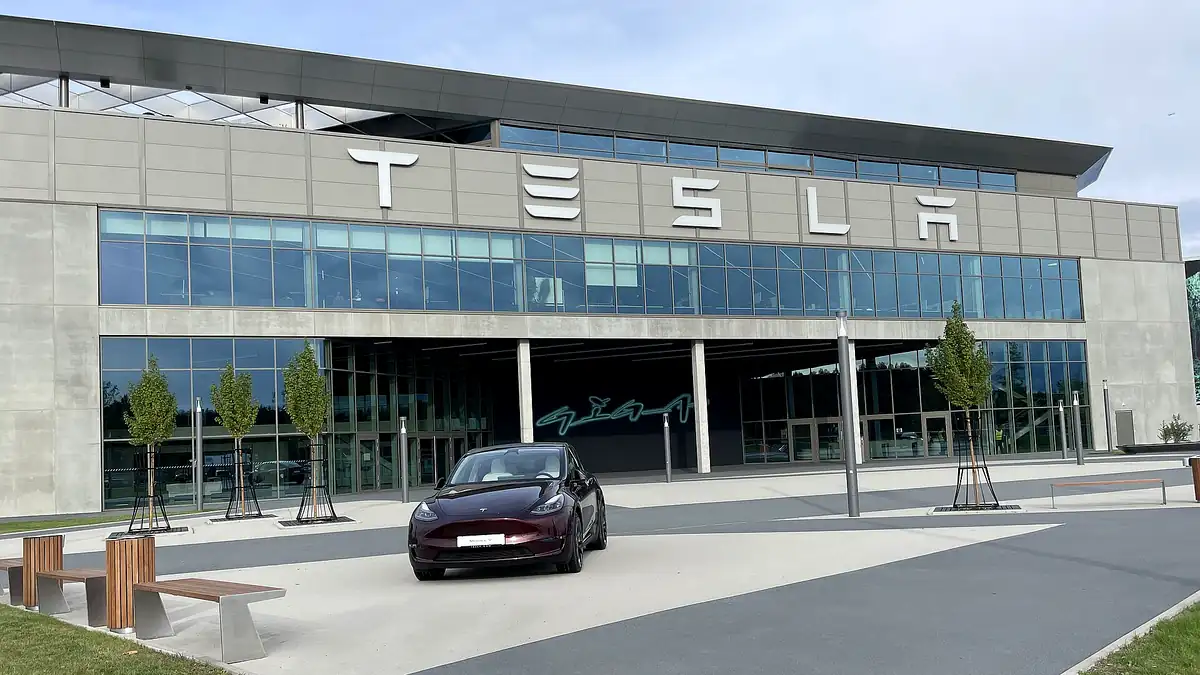
A car comes off the line every 45 seconds across 15 shifts a week. The body line runs on orange KUKA robots, working the car bodies as they move down the line.
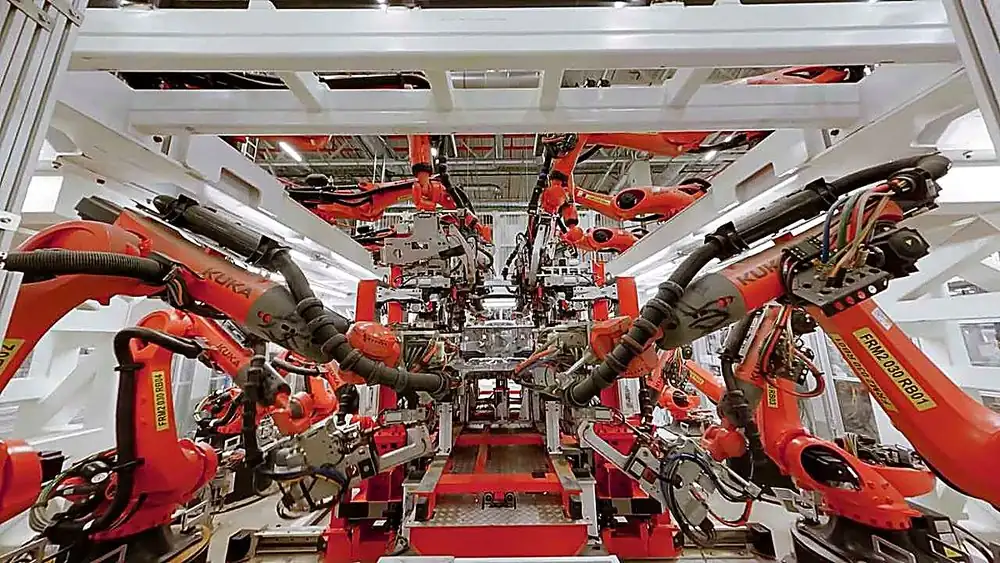
That is the base the Cybercab builds on. The factory already runs at near-full tilt on one product, with a trained workforce of about 13,000 and a supply chain that serves the whole European market. The expansion does not replace that — it adds a second product on a second hall, with 2,000 new workers already hired. Full battery-cell production in Grünheide is due by mid-2027, ahead of the Cybercab's 2029 start.
Timeline: From 2026 Permits to 1 Million Cybercabs a Year
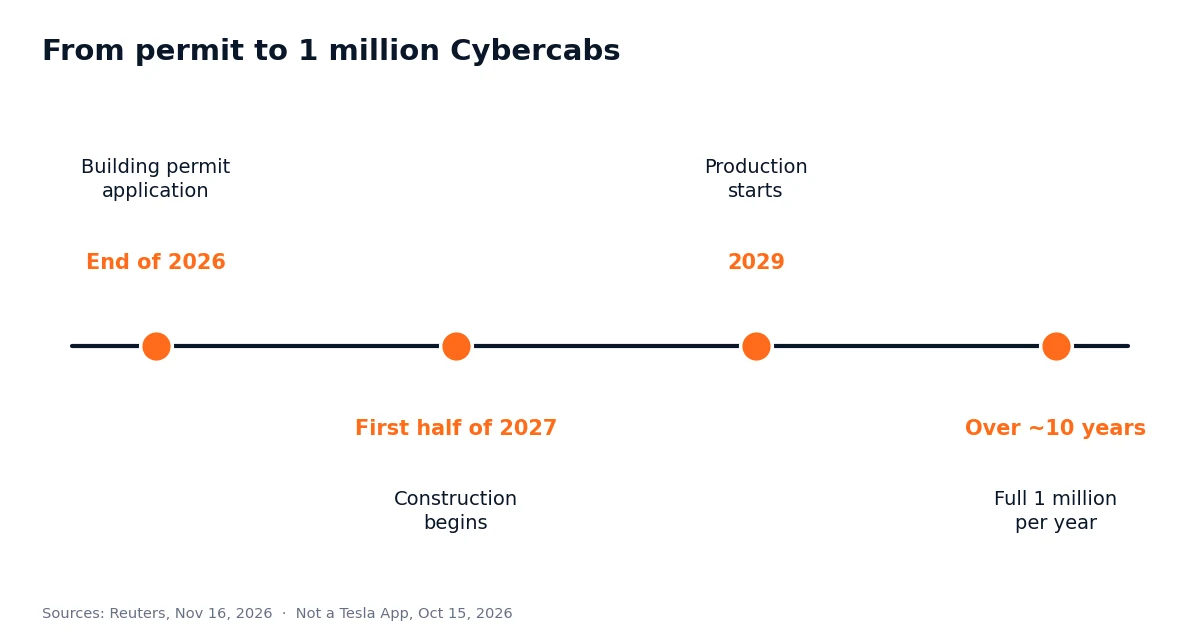
The road to 1 million Cybercabs a year has four steps, and the first one is paperwork. Tesla files the building permit application before the end of 2026. Construction starts in the first half of 2027. Production begins in 2029. Full output — the whole 1 million a year — takes about 10 years from there.
The permit is the step to watch first. Tesla has said the application goes in before the end of 2026, and the October background reporting put the permit applications in December. If the application slips, construction slips with it, and the 2029 production start is the date that moves. The ten-year horizon matters too: the headline number — Tesla 1 million Cybercabs a year — is the end state of the expansion, not the run rate on day one in 2029.
Watch the hiring numbers too. Two thousand new workers are already hired, and several hundred more are coming on top of the roughly 13,000 people on site. If Tesla keeps hiring at that pace through 2027, the construction schedule is on track. If hiring stalls, the 2029 date is the first thing at risk.
What the 2029 Berlin Date Means for US vs. European Buyers
For an American buyer, 2029 is a distant date — and the wrong clock to watch. The deadline that matters in the US is December 31, 2026: Marques Brownlee, known as MKBHD, bet his hair that Tesla could not sell a $29,990 Cybercab by that date, then ordered one himself. EVThrottle covered the bet, its terms, and its deadline. A Berlin-built Cybercab would not reach American buyers in any case — Berlin builds for Europe, and the American cars come from Texas.
For a European buyer, 2029 is the date that matters. A Cybercab made in Germany would be a locally-built driverless car for the European market, built in the country where the car is already on tour — four stops in Germany, including Berlin, are running now. The questions a European buyer should ask are the same ones the timeline raises: does the permit go in on time, does construction start in the first half of 2027, and does Tesla name a European price before production starts?
What to watch before then: the first deliveries in December 2026 across five Texas cities, the NHTSA investigation, and the subscription price. If those deliveries slip, or the fee changes, the Berlin plan’s economics change with them.
Frequently Asked Questions
How much does the Tesla Cybercab cost?
The Tesla Cybercab costs $29,990 before taxes, with a $1,000 non-refundable deposit applied toward the purchase price. However, buyers must also pay a mandatory $299-per-month Autonomy Subscription (with the first month included), bringing the five-year total cost to $47,631 before insurance, charging, and taxes.
Does the Tesla Cybercab require a $299 monthly subscription?
Yes. Because the Cybercab has no steering wheel or pedals, it cannot be driven manually and will not move without an active $299-a-month Autonomy Subscription and required maintenance. On November 14, 2026, CEO Elon Musk said the fee is too high and should be closer to $115 a month, though Tesla has not officially changed the price.
Where can you drive the Tesla Cybercab in the US?
The Tesla Cybercab is geofenced and can only operate inside Tesla's approved Robotaxi zones across eight cities in Texas and Florida. It cannot be driven freely on unrestricted public roads outside those supported service areas.
When will the Tesla Cybercab be delivered to buyers?
In the US, Tesla opened invite-only Cybercab orders on November 13, 2026, with first private deliveries estimated for December 2026 across five Texas cities (Austin, Dallas, Houston, Fort Worth, and San Antonio). In Europe, Cybercab production at Gigafactory Berlin will not begin until 2029.
Is the Tesla Cybercab legal without a steering wheel or pedals?
The Cybercab currently operates in limited Robotaxi service in Austin, Texas, under Tesla's self-certification, but the National Highway Traffic Safety Administration (NHTSA) has opened an active investigation into whether a vehicle without a steering wheel or pedals complies with federal motor vehicle safety standards.
When will Tesla Giga Berlin start building Cybercabs?
Tesla plans to start Cybercab production at Gigafactory Berlin-Brandenburg in Grünheide, Germany, in 2029. The company will file the building permit application before the end of 2026 and begin construction on the new €3 billion ($3.31 billion) facility in the first half of 2027.
Will Giga Berlin build 1 million Cybercabs in 2029?
No. Production starts in 2029, while reaching the full capacity target of up to 1 million Cybercabs per year is expected to take roughly 10 years after launch.
Will Berlin-built Cybercabs be sold in the United States?
No. Gigafactory Berlin supplies the European market, whereas US Cybercabs are manufactured at Gigafactory Texas in Austin, where production began in April 2026.
Is the €3 billion the price of the Cybercab?
No. €3 billion is the factory investment. The car costs $29,990, plus $299 a month.
Sources
- Reuters, November 16, 2026 — Tesla announces $3.3 billion expansion of Germany plant
- Not a Tesla App, October 15, 2026 — Tesla plans to expand Giga Berlin output to 1 million vehicles per year
- Tesla News Wire, November 12, 2026 — Berlin manager: a second factory wouldn't be another Model Y
- Previously, November 14, 2026 — Tesla opens Cybercab orders at $29,990, with a $299-a-month catch (Musk's $115 suggestion, NHTSA investigation)
- WOLF Financial on Threads, November 16, 2026 — Cybercabs in Germany by 2029
- Staatskanzlei Brandenburg on Instagram, November 16, 2026 — Cybercabs made in Brandenburg
- Tesla on YouTube — Cybercab: The Future is Autonomous (official film)
- Paul Tan, November 14, 2026 — Tesla Cybercab now on sale for personal use in the US (self-certification, NHTSA audit, approved cities)
- Auto Aspect on YouTube — Tesla Officially Opens $29,990 Cybercab Orders - With One Major Catch (order-agreement breakdown)
- DockDuty, October 25, 2026 — Cybercab NHTSA Investigation: What the Two Files Say (AQ26002 scope, civil penalties)