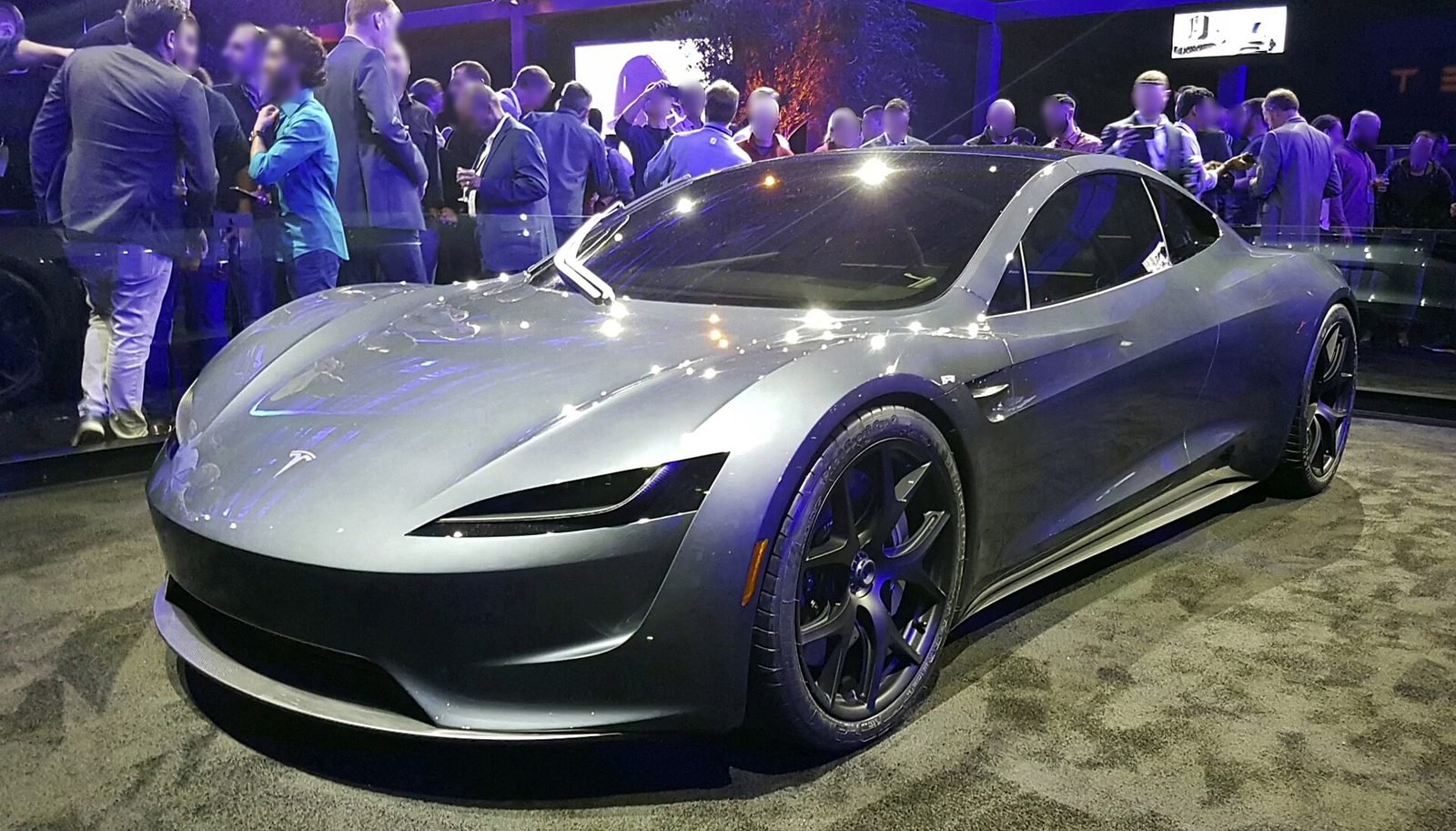
Last night, at a SpaceX test site outside Waco, Texas, Tesla finally unveiled the car it has been teasing since November 2017. The redesigned Roadster drove up an inverted ramp, jumped clean over five of its own siblings, and posted a 0-to-60 time of 0.81 seconds on the event’s own timer. Nine years late — and if even half of what was shown holds up, the wait might have been worth it.
Let’s start with what’s confirmed, because Tesla put this part in writing. The Roadster comes in three trims. The base Performance is the one Tesla calls “road ready”: two seats, active aerodynamics, and a multi-mode suction system for extra downforce on and off the track. Tesla claims 0–60 in under 1.6 seconds, and you can reserve one today for $50,000.
Step up to Thrust and things get silly. Rear-mounted cold-gas thrusters — actual SpaceX-style hardware, running on compressed air stored in carbon-fiber pressure vessels rather than rocket fuel — cut the claimed 0–60 time to under 0.9 seconds. It still seats two, and Tesla is asking a $250,000 reservation for what it describes as limited availability. Then there’s Rocket: ten thrusters positioned around the car, a claimed 0–60 in under 0.59 seconds, a top speed over 230 mph, exactly one seat — and it’s not approved for public roads. Rocket is invite-only. Every trim is rated for more than 300 miles of range, per CNBC’s rundown of the reveal.
The specs are one thing; the demos were something else entirely. The livestream showed the car climbing a curved ramp upside down, held to the surface by fan-generated suction. Then came the party trick: a thruster-assisted “kickflip” that lifted the Roadster over the entire Tesla lineup — Cybercab, Cybertruck, Semi, Model Y, and Model 3 — while the car was moving. Elon Musk’s verdict on stage: “Flying cars are real.” He also teased an even bigger stunt down the line: an attempt at Evel Knievel’s famous Snake River Canyon jump, as Drive Tesla Canada reported from the event.
It helps to remember how long this took. The Roadster was first shown in 2017 with a 2020 production target and headline claims of 1.9-second 0–60, 250+ mph, and 620 miles of range. The date slipped, then slipped again — six postponements in 2026 alone, with the original October 1 event scrapped after severe Texas weather threatened the outdoor-only show. Tesla has been blunt that the old specs no longer apply; the new numbers are wilder in some ways (sub-one-second acceleration) and more modest in others (300+ miles of range instead of 620).
The design is a clean break from the 2017 prototype. The new car is wedge-shaped, with a full-width light bar and a large rear wing that extends out of the tail. Tesla says the look draws on jets and aerospace machines — the tinted glass is meant to echo the copper coating on spacesuit visors, and the Ano White paint is supposedly engineered for UV and cryogenic protection “in space.” Inside it’s pure minimalism: a steer-by-wire yoke, microsuede upholstery, a central touchscreen, and two smaller displays for critical driving data. The original Roadster was supposed to seat four; this one seats two, the Rocket seats one, and the seats are fixed to save weight. Track mode drops the ride height and toggles between high-downforce and low-drag aero, according to TFLcar’s breakdown. One more detail for the spec sheet: left-hand drive only.
The skeptic’s corner
Now the part where we pump the brakes. That 0.81-second 0–60 came from Tesla’s own event timer — Road & Track was careful to note it wasn’t independently verified. Everyone wants to know the Tesla Roadster price, and Tesla didn’t announce one — the company gave reservation amounts ($50,000 and $250,000, both described as fully refundable) but no actual sticker price, so the $200,000-plus estimates are still just estimates. And the production date is 2028, per TechCrunch’s live coverage — from a program that has missed every deadline since 2020. Believe the hardware you saw; pencil in the dates.
One thing Tesla did make easy: getting in line. Reservations reopened ahead of the event — $50,000 for Performance, fully refundable, straight from a credit card — and the company had already reopened the order books on October 1 ahead of the original reveal date, per Electrek. If the 2028 target holds, reservation holders are looking at a two-year wait, minimum. Tesla’s history says to treat that as a floor, not a promise.
Why it matters anyway
Because the Roadster was never about volume. Tesla’s car sales are down, BYD has passed it as the world’s top EV seller, and the company is betting its future on autonomy and robotics. The Roadster is the halo — the car that makes people believe Tesla can still build something outrageous. “This will be the actual car that’s on the roads,” Musk said on stage. “It literally is just going to puff itself up, and be able to do these maneuvers whenever you’d like.” The Verge called it “the best of the last of the human-driven cars,” quoting Musk’s own framing.
If you’re a buyer, the honest summary is short: the only Roadster you can actually get in line for is the Performance, the Rocket is a toy for Tesla’s friends, and nobody knows what any of them will cost. If you’re watching the industry, the interesting bits are the hardware — cold-gas thrusters and fan suction on a production-intent car — because that’s technology that could trickle down to things normal people drive. We’ll be watching the reservation page, the price announcement, and the inevitable independent tests. The nine-year wait is over; the two-year wait just started.