Volkswagen won something no automaker had ever won: an exemption from the European Union’s tariffs on China-built electric cars. The prize went to the Cupra Tavascan, a Spanish-branded coupe-SUV assembled exclusively in Hefei, China. And then the fine print kicked in — a secret import quota, a minimum price, per-car traceability, and a pledge to ship no other battery-electric vehicle to Europe under the arrangement.
Now, as VW looks to grow its Chinese imports, that precedent-setting deal is both its shield and its cage. Here is how the exemption works, what it costs Volkswagen, and why the industry is watching what happens next.
The deal: the EU’s first-ever price undertaking for a China-built EV
On February 11–12, 2026, the European Commission accepted a price undertaking from Volkswagen Anhui — VW’s joint venture with China’s JAC — covering the Cupra Tavascan. It was the first such arrangement ever granted for a China-built EV, and it replaced the 20.7% countervailing (anti-subsidy) duty that had stacked on top of the standard 10% import tariff since 2024, as Auto Express reported.
A price undertaking is Brussels’ alternative to duties: instead of paying the tariff, the exporter commits to sell at or above an agreed minimum price, removing the alleged unfair pricing advantage. Automotive Technology notes it made the Tavascan the first EV to dodge the EU’s China tariffs outright.
But the exemption is loaded with conditions, detailed by newmobility.news:
- A minimum import price — the car cannot be sold into the EU below the agreed floor.
- An annual maximum quantity — a hard import quota. The exact figure is confidential.
- Defined sales channels — the cars can only move through approved routes.
- Reporting duties and per-vehicle traceability — QR codes and alphanumeric monitoring track every car.
- EU investment commitments — Volkswagen Anhui pledged investment in Europe.
- No other BEVs — VW Anhui promised not to ship any other battery-electric vehicle to the EU under the arrangement.
The message from Brussels was clear: the door is open, but only this wide, and only for this car.
The car at the center of it
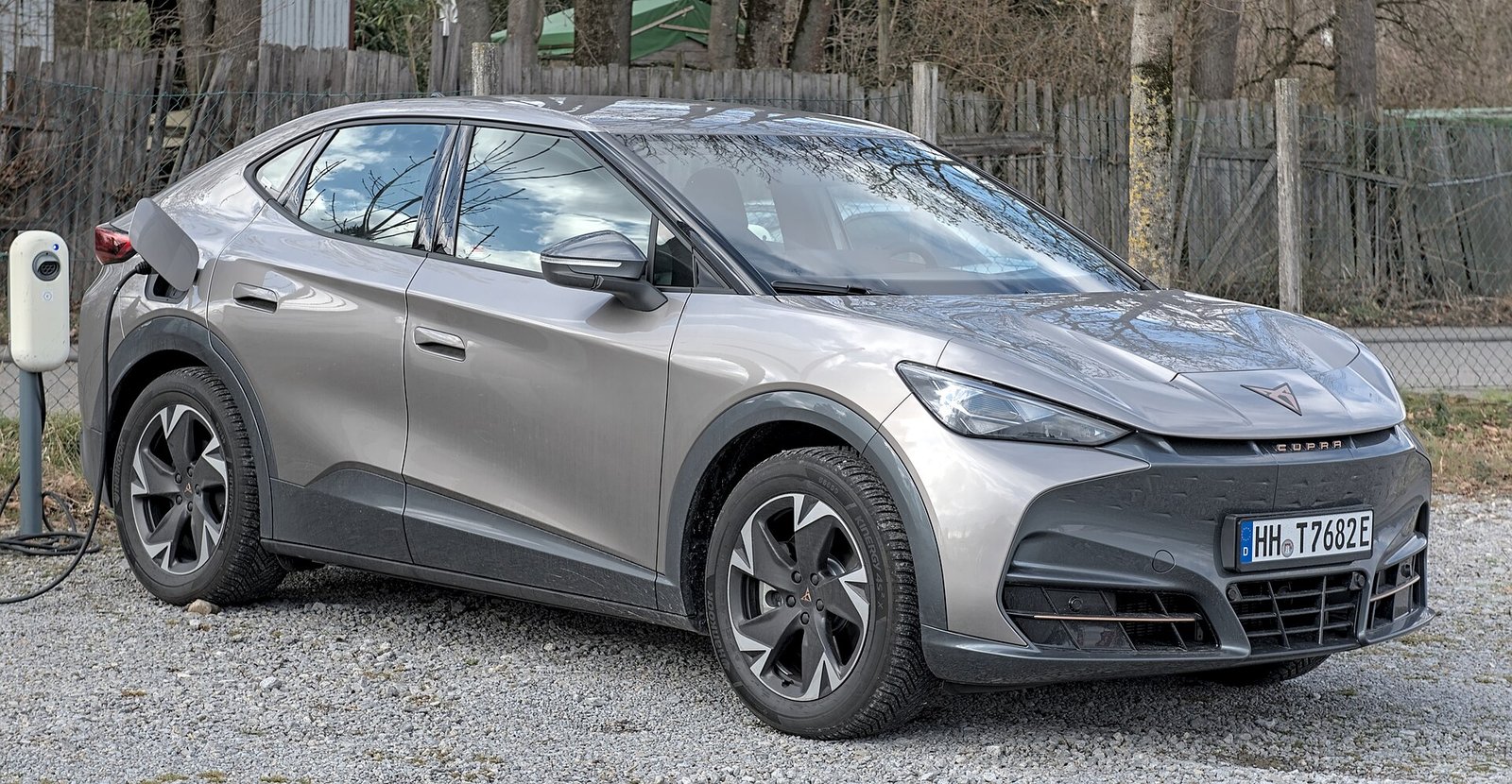
The Cupra Tavascan is a compact electric coupe-SUV built exclusively at the VW Anhui plant in Hefei — the only Cupra model made in China. It is the sister model to the VW ID.5, riding on the MEB platform, with a 77 kWh battery, up to 521 km (324 miles) of WLTP range, rear- or all-wheel drive, and up to 135 kW DC fast charging.
Before the deal, the combined 30.7% tariff burden meant SEAT was reportedly selling every Tavascan at a loss — global sales sit around 36,000 units, with only about 1,250 registered in Spain. After the undertaking, the car starts from €45,420 in Spain (roughly €1,400 more than in December 2025), and lists at £47,350 in the UK. The price floor keeps it honest; it does not make it cheap.
Why VW wants more Chinese imports
Volkswagen’s math is straightforward. Its Chinese joint ventures — including the majority-owned VW Anhui operation — can build EVs at costs European plants cannot match, and EU demand for affordable electric cars is softening under price pressure. The company’s “in China, for China” strategy, plus partnerships like the one with Xpeng, are built on leveraging Chinese manufacturing scale and speed.
The Tavascan undertaking was supposed to be the proof of concept: a legal, Brussels-blessed template for bringing China-built VW Group EVs into Europe without the duty penalty. Automotive News reported that Beijing even softened its stance on EV makers negotiating with the EU individually — a green light for more company-by-company deals.
The leash: a quota and a one-car pledge
Here is where the exemption turns into a constraint. The annual quota caps how many Tavascans VW can bring in — and the confidential figure is widely believed to be well below what the brand could sell. The minimum price prevents the undercutting that made Chinese production attractive in the first place. And the no-other-BEVs pledge is the real handcuff: VW cannot extend the arrangement to the ID. Unyx (the Tavascan’s Chinese-market twin), or any future China-built VW Group EV, without negotiating a whole new deal.
In other words, Volkswagen traded a 20.7% duty for a volume ceiling. Every additional China-built model it wants in Europe has to start the Brussels process from scratch — with no guarantee the Commission says yes twice.
The irony: Blume demands “Made in Europe” while holding the exemption
Meanwhile, VW CEO Oliver Blume is publicly demanding the opposite of what his own company secured. In Paris this October, Blume called for stronger European protection, telling Reuters: “Those who sell here should compete under comparable conditions and create jobs and value here in Europe too.”
The EU’s proposed Industrial Accelerator Act would require publicly funded EVs to be assembled in the EU with 70% local non-battery components — a rule that would make deals like the Tavascan undertaking far harder to repeat. Volkswagen, the sole holder of a China-built EV exemption, is now lobbying for the walls to go higher behind it. Rivals have noticed.
What comes next
The Tavascan deal is no longer a one-off — it is the template. On October 9, 2026, the EU and China announced a 16-point understanding after talks in Beijing: Chinese hybrid and plug-in hybrid exports to the EU could fall by more than half under new quota arrangements, and company-level price undertakings are now the established model, per eletric-vehicles.com. The next negotiation round lands in March 2027.
Everyone is watching who files next. The MINI Cooper SE and Smart #1 — both built in China through joint ventures — are the obvious candidates for their own undertakings. Volvo, Polestar, and the Chinese brands themselves (BYD, MG) face a choice: accept Brussels’ price-and-quota terms, build in Europe, or pay the duties. The Tavascan showed the door exists. It also showed the door has a bouncer, a guest list, and a cover charge.
What the internet thinks
The tariff saga has been argued out in public since February — and the comment sections are not kind to anyone:
- Asphalt Action (Facebook, 73K followers) — “EU befreit Cupra Tavascan von Strafzöllen” (EU frees the Cupra Tavascan from punitive tariffs). 22 comments debating whether the exemption genuinely helps consumers or just serves auto-lobby interests, with users noting how much of the car’s supply chain still sits in China. (21 likes, 22 comments)
- @thezonehu (Facebook, Hungarian automotive page) — reported the EU exception for the VW Group model. The 16-comment thread turned polarized fast: some asking if dropping the tariff actually makes the Tavascan cheaper, others relitigating German-brand reliability versus Toyota and Tesla. (140 likes, 16 comments)
- Cupra Tavascan owners group (Facebook) — members waiting on delayed deliveries treated the tariff deal as personal good news, with 14 comments trading shipping timelines and speculating whether the EU duty ruling was behind the holdups. Trade policy, translated into “when does my car arrive.” (14 likes, 14 comments)
Note: X/Twitter posts were not retrievable through the available social-search tools (which cover Instagram, Facebook, and Threads), and no video posts surfaced among the most-commented results — so the roundup above reflects where the debate actually happened.
Quick answers
What is the Cupra Tavascan tariff deal? In February 2026, the EU accepted Volkswagen Anhui’s price undertaking — the first ever for a China-built EV — replacing the 20.7% anti-subsidy duty with a minimum import price, an annual quota, traceability, and EU investment pledges.
Where is the Cupra Tavascan built? Exclusively in Hefei, Anhui, China, by Volkswagen Anhui (VW’s joint venture with JAC). It is the only Cupra model manufactured in China.
Can VW import other China-built EVs under the deal? No. VW Anhui pledged not to ship any other battery-electric vehicle to the EU under the arrangement — each additional model needs its own negotiation.
How much does the Cupra Tavascan cost now? From €45,420 in Spain and £47,350 in the UK. The EU’s minimum-price condition keeps it from undercutting European-built rivals.
What happens next in EU-China EV trade? An October 2026 EU-China understanding set hybrid/PHEV quotas and made price undertakings the template; the next talks are in March 2027, with MINI, Smart, and Volvo expected to seek their own deals.
The bottom line
Volkswagen got what every automaker with Chinese factories wanted: a legal way around the EU’s China EV tariffs. But Brussels wrote the exemption as a leash, not a license — capped volumes, a price floor, one car only. As VW pushes for more Chinese imports while its CEO demands “Made in Europe” protection, the Tavascan deal stands as the precedent everyone will cite and nobody can quite copy. The quota giveth, and the quota limiteth.