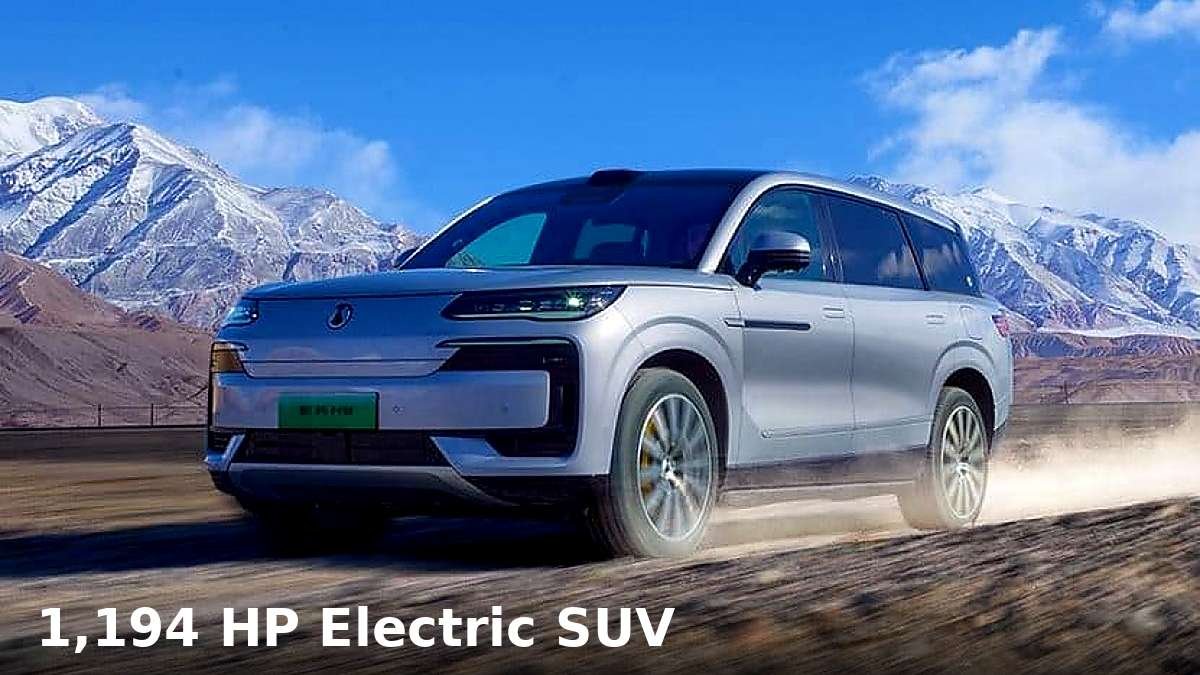
BYD’s Denza N9 is getting a fully electric version, and China’s latest regulatory filing reveals a powerful three-motor setup producing 890 kW (1,194 hp). The large electric SUV will be listed with both five-seat and six-seat configurations. However, its battery capacity, driving range and charging specifications have not yet been disclosed.
The filing is an important step toward the model’s potential launch, but it does not mean the vehicle has received final sales approval. Here’s what the available information tells us so far.
BYD Denza N9 EV gets an 890 kW tri-motor powertrain
The biggest highlight in the filing is the electric drivetrain. The Denza N9 EV uses three permanent-magnet synchronous motors, with one motor at the front and two at the rear. Together, they produce a listed peak output of 890 kW, equivalent to approximately 1,194 horsepower.
The front motor produces 270 kW, while each of the two rear motors contributes 310 kW. This gives the SUV an independently driven three-motor all-wheel-drive configuration.
The filing also lists a maximum speed of 240 km/h, or approximately 149 mph. That is the published figure in the Chinese regulatory information, not an independently tested performance result.
| Powertrain detail | Listed specification |
|---|---|
| Front motor | 270 kW |
| Rear motors | 310 kW each |
| Total peak output | 890 kW (1,194 hp) |
| Drivetrain | Tri-motor AWD |
| Maximum speed | 240 km/h (149 mph) |
The setup is associated with BYD’s e3, also known as Yisanfang, architecture. The platform is used in other Denza vehicles, including the Z9 GT. However, the filing does not confirm which of the platform’s additional driving functions will be included in the production N9 EV.
Sources: CnEVPost filing report and CarNewsChina.
BYD e3 platform: Compass U-Turn, rear steering and tyre-blowout control
The filing ties the N9 EV to BYD’s e3 (Yisanfang) architecture — the same tri-motor platform as the Denza Z9 GT. It pairs independent three-motor drive with a separate rear-wheel steering system, so each rear wheel can be driven and steered on its own.
BYD lists platform functions including Compass U-Turn, rear-steer parking and high-speed tyre-blowout stability control. On the Z9 GT, the Compass Turn locks one front wheel while the rear wheels steer independently to spin the car in a tight space, and the blowout system is designed to hold the car straight in its lane after a tyre failure at up to 180 km/h.
The catch: the N9 EV filing does not confirm which of these functions will be available on the production SUV. Treat them as platform capability, not N9 EV specification, until BYD confirms the details.
The filing does confirm one mechanical split. The two model codes use different braking hardware: one lists FinDreams integrated power braking, the other Bosch BWA and ESP. Both are brake-by-wire setups, and the filing gives no performance difference between them.
Denza N9 EV dimensions and seating options
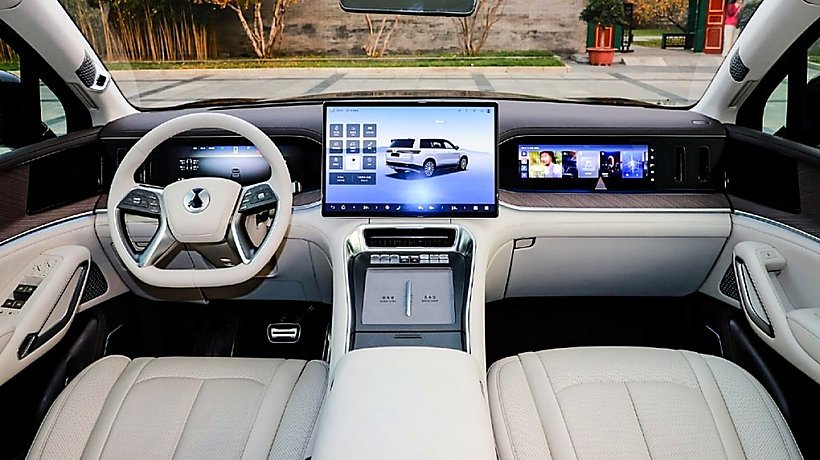
The electric version keeps the same overall dimensions as the existing Denza N9. It is a large SUV, with a wheelbase of more than 3.1 metres. The regulatory filing lists both five-seat and six-seat configurations, giving buyers two cabin layouts to choose from.
| Dimension | Specification |
|---|---|
| Length | 5,270 mm (207.5 in) |
| Width | 2,030 mm (79.9 in) |
| Height | 1,830 mm (72.0 in) |
| Wheelbase | 3,125 mm (123.0 in) |
| Seating | Five or six seats |
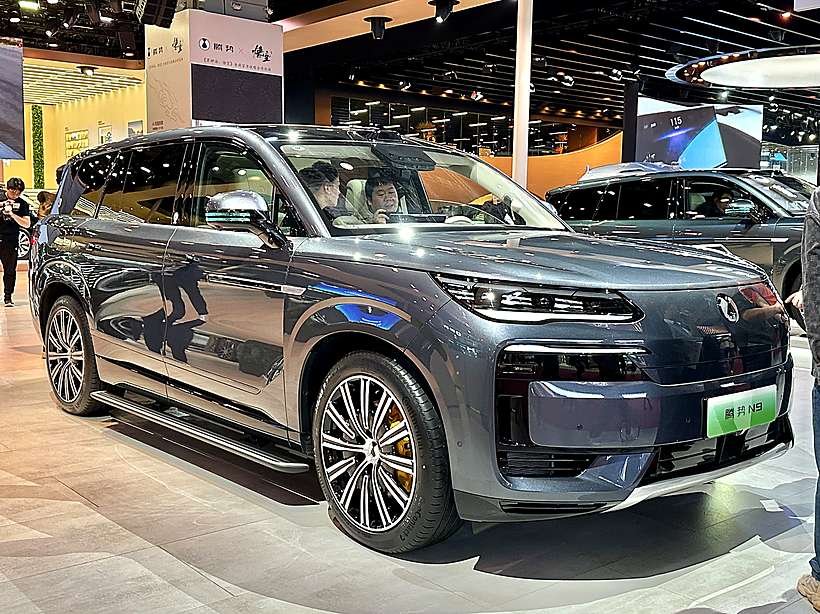
The filing images show that the electric SUV retains the familiar Denza N9 exterior design. It also features a roof-mounted LiDAR unit, a panoramic glass roof and power-operated side steps. A two-tone exterior finish is listed among the available options.
Battery, driving range and charging details remain unknown
BYD has specified a lithium iron phosphate (LFP) battery for the Denza N9 EV. The cells are supplied by Guangxi ASEAN FinDreams Battery, while Shenzhen BYD Auto Industry is listed as the battery-pack assembler.
But there is an important information gap: the filing does not reveal the battery’s total capacity, official CLTC range or charging performance. It would therefore be premature to estimate the SUV’s driving range or compare its charging speed with other electric SUVs.
| Battery information | What is known |
|---|---|
| Chemistry | Lithium iron phosphate (LFP) |
| Cell supplier | FinDreams Battery |
| Pack assembler | Shenzhen BYD Auto Industry |
| Battery capacity | Not disclosed |
| Driving range | Not disclosed |
| Charging specifications | Not disclosed |
This is one of the biggest details to watch for when BYD releases additional information. Battery size and charging performance will help determine how competitive the N9 EV is as a long-distance family SUV.
The Denza N9 EV weighs up to 3,180 kg
The regulatory information lists two curb-weight figures: 3,105 kg and 3,180 kg. Its gross vehicle weight is listed at 3,760 kg.
These figures are worth noting because the N9 is a substantial full-size SUV. Its weight, three-motor drivetrain and large body place it in a different category from smaller performance-focused electric crossovers.
The two model codes in the filing are QCJ6530ABBEV1 and QCJ6530ABBEV2. CarNewsChina reports that they use different braking-system configurations: one lists FinDreams integrated power braking hardware, while the other lists Bosch BWA and ESP.
Source: Electrek on the 3,760 kg gross weight.
Does the Denza N9 EV need a truck licence in Europe?
Possibly. The standard EU category B car licence covers vehicles up to 3,500 kg maximum authorised mass. The N9 EV’s gross vehicle weight is 3,760 kg — 260 kg over that line.
There is an exception worth knowing. Under Directive (EU) 2018/645, EU member states may let B licence holders drive alternatively fuelled vehicles up to 4,250 kg — but only where the country has adopted it, only with a licence held for at least two years, without a trailer, and only where the extra weight comes from the propulsion system. The derogation is also framed around goods transport, so it is not a clear-cut pass for a family SUV.
| Weight figure | Value |
|---|---|
| Denza N9 EV gross vehicle weight | 3,760 kg (8,289 lb) |
| EU category B licence limit | 3,500 kg (7,716 lb) |
| Alternatively fuelled vehicle derogation ceiling | 4,250 kg (9,370 lb) |
| Amount over the standard B limit | 260 kg |
In practice, buyers in many EU countries should expect to need a C1 licence for this SUV, and should check their own country’s rules before ordering. This is a China filing, not a European type approval, so nothing is settled yet.
The weight also sets the passenger maths. Gross weight minus the heaviest curb weight (3,760 − 3,180 kg) leaves 580 kg of payload — enough for five or six adults within the limit, before luggage. With the lighter 3,105 kg curb weight, payload rises to 655 kg.
How the Denza N9 EV compares with the existing plug-in hybrid
The current Denza N9 is a plug-in hybrid SUV. The new filing adds a battery-electric option to the lineup, rather than simply announcing another update to the existing PHEV.
The N9 PHEV Flash Charging Edition launched in May 2026 with a 75.3 kWh battery and a claimed CLTC electric range of 420 km (261 miles). Denza also stated that the PHEV could charge from 10% to 97% in nine minutes under its specified charging conditions.
| Specification | Denza N9 EV | Denza N9 PHEV |
|---|---|---|
| Powertrain | Fully electric | Plug-in hybrid |
| Motors | Three electric motors | Hybrid system |
| Listed output | 890 kW | 680 kW for Flash Charging Edition |
| Battery capacity | Not disclosed | 75.3 kWh |
| CLTC electric range | Not disclosed | 420 km |
| Seating | Five or six | Six-seat launch configuration |
| Curb weight | 3,105–3,180 kg | 3,280 kg (Flash Charging Edition) |
| Length | 5,270 mm | 5,258 mm |
The comparison highlights the main difference: the electric version has a much higher listed peak motor output, while the PHEV already has published battery and electric-range figures. The two vehicles should not be compared on range until BYD releases the EV’s battery and efficiency data.
On weight, the electric version is actually the lighter car. The filing lists the N9 EV at 3,105–3,180 kg, while the Flash Charging PHEV lists 3,280 kg — the EV drops the 2.0-litre engine and fuel system, and both versions share the same 3,760 kg gross weight. The EV is also 12 mm longer than the PHEV (5,270 mm vs 5,258 mm).
Denza’s lineup keeps growing — see our Denza N8 EV launch coverage.
Denza N9 EV vs Aito M9 and Zeekr 9X
The N9 EV lands in a small club of Chinese flagship SUVs. Its closest pure-electric rival is the Aito M9 BEV, while the Zeekr 9X is the tri-motor benchmark — with one important difference: the 9X is a plug-in hybrid, not a pure EV.
| Specification | Denza N9 EV | Aito M9 BEV | Zeekr 9X |
|---|---|---|---|
| Length | 5,270 mm | 5,230 mm | 5,240 mm |
| Wheelbase | 3,125 mm | 3,110 mm | 3,169 mm |
| Peak output | 890 kW | 390 kW | 1,030 kW (tri-motor Hyper) |
| Battery | LFP, capacity not disclosed | 100 kWh ternary lithium | 55.1 / 70 kWh (PHEV) |
| CLTC range | Not disclosed | 605–630 km | Electric range not directly comparable (PHEV) |
| Price in China | Not disclosed | From 509,800 yuan | From 465,900 yuan; tri-motor Hyper 559,900 yuan |
| Seating | Five or six | Five or six | Six (five-seat version added in 2026) |
All three offer six-seat cabins, and the N9 EV and the M9 also list five-seat layouts. The N9 EV’s five-seat option is the one to watch for buyers who want a large luxury SUV without a third row.
A full value comparison is not possible yet — the N9 EV has no published price, battery size or range. On footprint it sits between the two rivals; on power it beats the M9 BEV but trails the 9X’s tri-motor flagship. A larger 2026 Aito M9 (5,285 mm, 120 kWh pack, up to 750 km CLTC) launched in March 2026.
Will the BYD Denza N9 EV launch in the US?
There is no confirmed US launch date or US-market pricing in the regulatory information covered here. The filing relates to China’s vehicle approval process and should not be treated as confirmation of an American launch.
For now, the clearest takeaway is that BYD is preparing another powertrain choice for its Denza flagship SUV in China. Whether the electric N9 will reach other markets, and when, remains unconfirmed.
For the sales backdrop, see our BYD vs Tesla October 2026 China sales showdown.
Frequently asked questions
How much power does the BYD Denza N9 EV produce?
The Denza N9 EV has a listed peak output of 890 kW, equivalent to approximately 1,194 horsepower, from three electric motors.
What is the driving range of the Denza N9 EV?
Its official driving range has not been disclosed in the regulatory filing. The filing also does not provide battery capacity or charging specifications.
Does the Denza N9 EV have five or six seats?
China’s regulatory filing lists both five-seat and six-seat configurations.
What is the top speed of the Denza N9 EV?
The filing lists a maximum speed of 240 km/h, approximately 149 mph.
Does the Denza N9 EV need a C1 licence in Europe?
Under the standard EU category B limit of 3,500 kg, yes — its 3,760 kg gross weight is over the line. An alternatively fuelled vehicle derogation allows up to 4,250 kg in some member states, but it is optional per country and framed around goods transport, so check local rules.
Is the Denza N9 EV lighter or heavier than the N9 plug-in hybrid?
Lighter. The EV lists 3,105–3,180 kg curb weight against 3,280 kg for the Flash Charging PHEV, and both share a 3,760 kg gross weight.
What is the battery capacity and CLTC range of the Denza N9 EV?
Neither has been disclosed. The filing confirms an LFP battery with FinDreams cells but gives no capacity, range or charging figures.
What the Denza N9 EV filing tells us
The all-electric Denza N9 is shaping up to be a high-output, full-size electric SUV. Its 890 kW tri-motor setup, two seating configurations and LFP battery are the main details confirmed by the latest filing.
The next important update will be BYD’s official announcement of battery capacity, driving range, charging performance and market availability. Until then, those details remain open.
For now, the best next step is to watch for BYD’s production announcement and the final specifications. More from BYD: our Yangwang U9 Xtreme crash report.