
October belonged to China’s EV giants — both of them. BYD sold 490,168 new-energy vehicles, up 11% from a year earlier, and more than doubled its exports to 170,194. Tesla’s Shanghai plant wholesaled 67,829 Model 3s and Model Ys, up 10.3% — its 12th straight month of year-over-year growth.
Same month, same country, two very different stories. BYD is winning by going all-electric faster than anyone expected: battery-electrics topped 300,000 in a single month for the first time, while plug-in hybrid sales fell for the second month running. Tesla is winning by holding its ground — growing in China for a full year straight while its American home market cools off.
For US buyers, the punchline stings a little. BYD sold more pure-electric cars in one October — 305,743 — than Americans bought in the entire third quarter, about 262,500 per Kelley Blue Book estimates reported by Electrek. And you still can’t buy a BYD in America.
BYD’s October, by the numbers
BYD’s October disclosure, filed with the Hong Kong Stock Exchange on November 1, makes it the company’s best month since December 2024 and its fourth-best ever. It was also the sixth straight month of year-over-year growth and the eighth straight monthly increase — the slump that dragged BYD’s 2026 totals into the red is clearly fading.
| BYD, October 2026 | Units | vs Oct 2025 |
|---|---|---|
| Total NEV sales | 490,168 | +11.0% |
| Battery-electric passenger cars | 305,743 | +37.4% |
| Plug-in hybrid passenger cars | 177,382 | −17.2% |
| Exports | 170,194 | +102.8% |
| China domestic sales | 319,974 | −10.6% |
The headline inside the headline is the battery-electric surge. October was the first month BYD ever sold more than 300,000 pure EVs, the third straight monthly BEV record, and electrics jumped to 63.3% of BYD’s passenger-car sales — up from barely half a year ago. The flip side: plug-in hybrids dropped 17.2%, their second straight yearly decline, deepening from September’s 2.4% dip. BYD’s customers are voting for plugs, not pistons.
There’s a wrinkle worth being honest about. Exports more than doubled from last October, but they actually slipped 5.8% from September — the second straight monthly dip after August’s record 189,466. And domestic sales fell 10.6% from a year ago even as they bounced 13.1% from September. So October’s growth came entirely from the export column, and even that column cooled a little from its summer peak.
Zoom out and the year-to-date picture is still a mixed bag: 3,621,744 NEVs sold through October, down 2.2% from last year — though the decline has narrowed from nearly 4% at the end of September, per just-auto’s tally of the filing. Battery-electrics are up 5.9% on the year at 1,935,700; plug-in hybrids are down 11%. The math checks out against our earlier BYD vs Tesla breakdown: January-through-September BEV sales of 1.63 million plus October’s 305,743 lands right on 1,935,700.
The export engine — and the walls closing in around it
If you want one number that explains BYD’s 2026, it’s this: 1,513,154 vehicles exported in the first ten months, up 93.8% from last year. Exports have gone from a side business to the company’s growth engine while the home market shrinks — domestic sales are down nearly 28% on the year.
The export map keeps widening. BYD has sold more than 20,000 vehicles in South Korea in the first nine months of 2026, and a company vice president said in late October that new plants in Europe are on the way. Overseas markets now drive the story so completely that the stock jumped 2–3% on the October report, with Morgan Stanley reaffirming its Overweight rating on the export-profitability thesis.
But the trade walls are rising almost as fast as the ships are sailing. The EU has tariffs on Chinese-built EVs and plans to curb hybrid imports. Mexico and Turkey have put their own tariffs on Chinese cars. And Beijing itself is cutting the VAT rebates exporters get — one reason JPMorgan downgraded the stock, warning about “stagnating domestic demand, higher component costs, reduced VAT rebates on exports, and the EU PHEV import-quota prospect.” Those analyst moves come via Reuters and Bloomberg reporting, so treat them as the market’s read, not gospel.
Cui Dongshu, secretary-general of the China Passenger Car Association, isn’t losing sleep over the hybrid curbs specifically: “Any curbs on plug-in hybrid exports are unlikely to significantly affect overall new energy vehicle exports, given the dominant role of pure EVs.” He said that to The Edge last month, and October’s numbers — electrics at 63% of BYD’s mix — back him up.
Tesla’s quieter win: 12 months of growth in a row
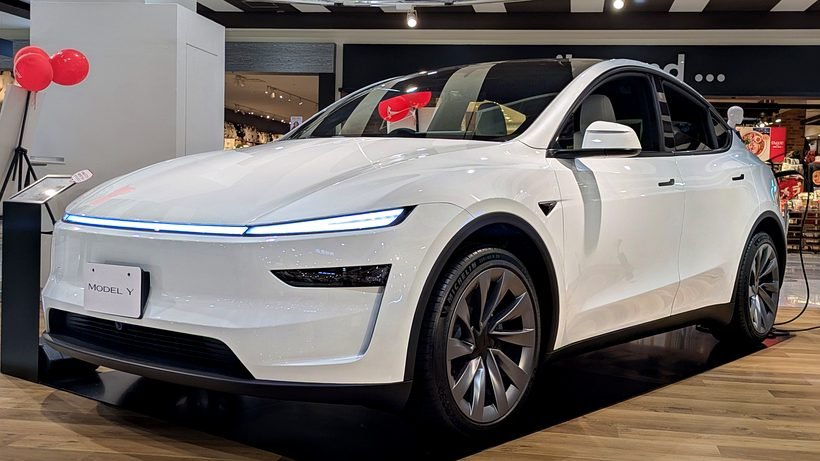
Tesla’s October looks modest next to BYD’s half-million, but the trend line is remarkable. The 67,829 China-made Model 3s and Model Ys wholesaled in October — a figure that covers both domestic deliveries and exports — marked the 12th straight month of year-over-year growth, accelerating from September’s 5% pace. Through October, Giga Shanghai has wholesaled 810,889 vehicles, up 21.4% on the year.
The honest caveat: October was also Tesla’s weakest month since February. Wholesale volume fell 28.9% from September’s year-to-date high of 95,366. That’s the rhythm of Tesla’s China business — big end-of-quarter pushes, quieter starts — but it means October’s growth is real and the monthly dip is, too. The CPCA hasn’t published the domestic-vs-export split for October yet, so anyone telling you exactly how many of those 67,829 stayed in China is guessing. For context, exports were nearly half of Shanghai’s wholesale volume through September, up from 29% a year earlier.

Reuters’ November 3 report added color beyond the headline number. New Tesla registrations “surged” across several European markets in October, extending the brand’s regional rebound. Tesla led imported-car sales in South Korea, a market that absorbed a fifth of Shanghai’s exports in the first nine months. And the company cut its annual capital-spending outlook by a fifth while posting positive third-quarter free cash flow — the spending discipline we flagged as the key thing to watch in the Q3 earnings coverage. The same report notes a potential Tesla–SpaceX mega-merger would likely face regulatory scrutiny on both sides of the Pacific over national-security and data-transfer concerns.
What this means if you’re shopping for an EV in America
Here’s the part that should frustrate US buyers. China’s new-energy vehicles hit a record 67% of new-car sales in September, according to Carbon Brief’s analysis of CPCA data — up from 6% in 2020. Gas-only car sales in China are down 31% this year. The world’s biggest car market has picked its winner, and it isn’t gasoline.
Meanwhile the US is moving the other way. Global EV registrations hit a record 11 million through October — while US sales fell 29%. The federal $7,500 credit is gone, and state rebates are a patchwork. So the country that invented the modern EV industry is watching its two biggest EV makers post record months in a market Americans can barely participate in.
Could that change? Not soon. Chinese-built EVs face a 100% Section 301 tariff at the US border, as we laid out in the tariff debate piece — a BYD that costs under $10,000 in China would still land near $20,000 before shipping, and nobody has tested whether the math works at volume. Canada’s quota system (49,000 Chinese-built EVs a year at a 6.1% tariff) is the closest thing to a North American door, and even there Tesla has paused new Model 3 orders under the quota until March 2027, per Canadian reporting. One outlet speculates BYD models could reach Canadian lots by mid-2027 — speculation, not a plan.
The realistic takeaway for American shoppers: the export wave is real, it’s just not coming here. It’s going to Europe, Southeast Asia, Latin America, and the Middle East — everywhere except the one market with a 100% tariff wall. What it does for you is indirect but real: the scale BYD and Tesla are building in China keeps pushing battery costs down worldwide, and that eventually shows up in the sticker price of the EVs you can actually buy.
New metal is already on the way
Neither company is sitting still. BYD launched the second-generation Seagull — the sub-$10,000 city car — on October 20 with flash charging on select versions, followed it with the third-generation Qin Plus DM-i on October 27, and has the second-generation Seal 07 launching November 5 with both battery-electric and plug-in hybrid powertrains. That’s three refreshed or new models in 16 days.
Tesla, for its part, is leaning on promotions to keep China demand humming into year-end. November deals reported in China include a ¥10,000 (about $1,400) cut on the Model 3’s final payment, ¥4,000 (about $560) off the Model Y, paint credits up to ¥8,000, 0% financing for up to five years, and ¥5,000 (about $700) off certified used cars. Those figures come from single-outlet reporting, so treat them as the current offer sheet rather than permanent pricing.
What the analysts are saying
Erica Downs, a senior research scholar at Columbia University’s Center on Global Energy Policy, told Carbon Brief that the Strait of Hormuz crisis and higher oil prices are “reinforcing China’s electrification of road transport” — calling it the “world’s largest oil supply disruption” and saying it vindicates China’s early EV bet, which was partly driven by worries about oil-supply security. Elon Musk echoed the sentiment in his own way last month, sharing an analyst’s post with the comment that “China’s dependence on oil is dropping fast.”
But there are ceilings forming. Zhang Yichao, a partner at consulting firm AlixPartners, told Carbon Brief that NEVs benefit from “government trade-in policies” and a “strong pipeline” of new models — yet he does not “see much more room ahead” for market-share growth, arguing China’s NEV share is unlikely to climb past 80%. With September already at 67%, the easy gains are gone. From here, growth has to come from exports — which is exactly what October showed.
October sales questions, answered
How many cars did BYD sell in October 2026?
490,168 new-energy vehicles, up 11% from October 2025 — BYD’s best month since December 2024. Battery-electrics hit 305,743, the first 300,000-plus month ever.
How many Teslas were sold in China in October 2026?
Tesla wholesaled 67,829 China-made Model 3s and Model Ys (domestic plus exports), up 10.3% year over year — the 12th straight month of annual growth, though down 28.9% from September’s record.
Can I buy a BYD in the United States?
No. Chinese-built EVs face a 100% US tariff, and BYD has no American sales operation. Its export wave is aimed at Europe, Asia, Latin America, and the Middle East instead.
Are BYD’s exports still growing?
Year over year, emphatically: up 102.8% to 170,194 in October, and up 93.8% through the first ten months. Month to month, they’ve cooled — down 5.8% from September, the second straight dip from August’s record.
Why did Tesla’s China sales drop from September?
Mostly calendar rhythm: September was a quarter-end push and the year’s high at 95,366. October is typically quieter, and the CPCA hasn’t yet published how October’s 67,829 split between domestic sales and exports.