Jaguar Land Rover has sued BYD, and the case started with a raid. Court-appointed bailiffs walked into two of BYD's offices in the Netherlands in August and seized digital records, acting for JLR. The British carmaker says BYD's new Ti7 SUV copies the Land Rover Defender, and not just in how it looks. JLR believes BYD took a Defender apart to reverse-engineer its technology, then built the Ti7 from what it learned.
A court in The Hague ruled on Wednesday, November 11, that the evidence seizure must end. The District Court ordered JLR to stop the seizure and arrange for the seized records to be destroyed under set conditions, and it halted the enforcement measures tied to the seizure. That ruling is procedural, not a verdict on whether BYD copied anything. But the case is already the biggest design fight in the car world in years, and it arrives just as the Ti7 reaches UK showrooms.
Here is the part that explains why JLR is fighting so hard. The Ti7 starts at £47,995 in the UK. The plug-in Defender 110 starts at £71,840. That is a gap of £23,845 for a seven-seat plug-in hybrid SUV that is more powerful and quicker than the Defender. The Ti7 does the Defender's job for a lot less money, and JLR knows it.
What JLR alleges
JLR's case has two parts, and the second one is the serious one.
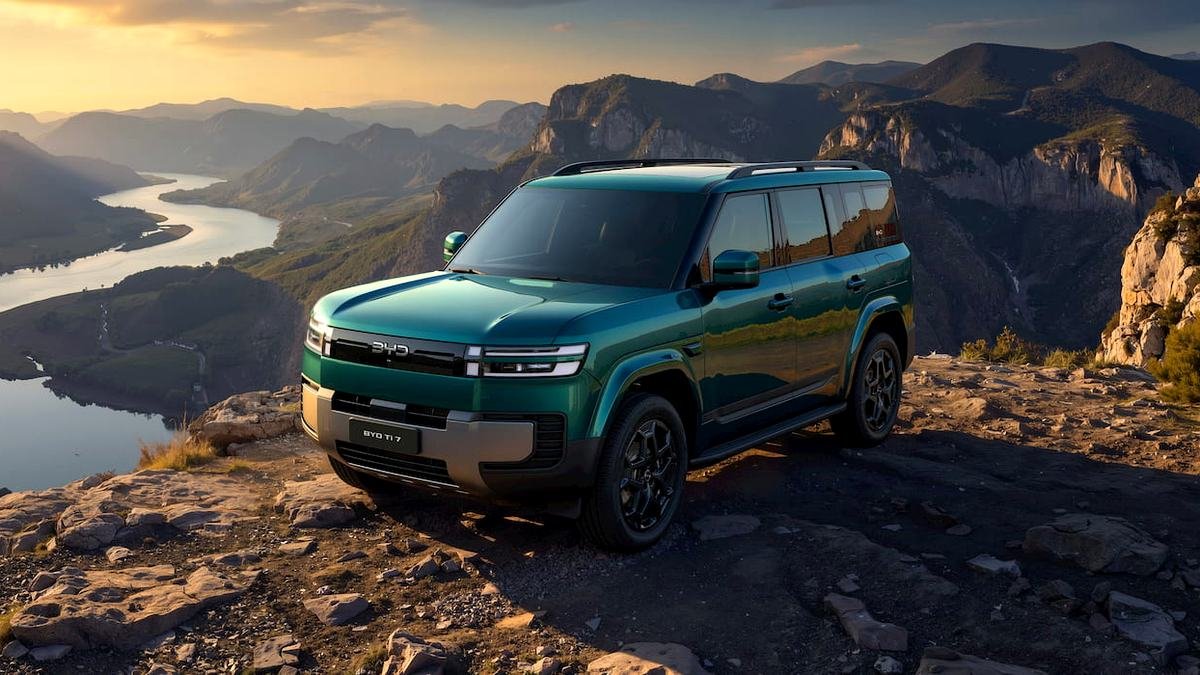
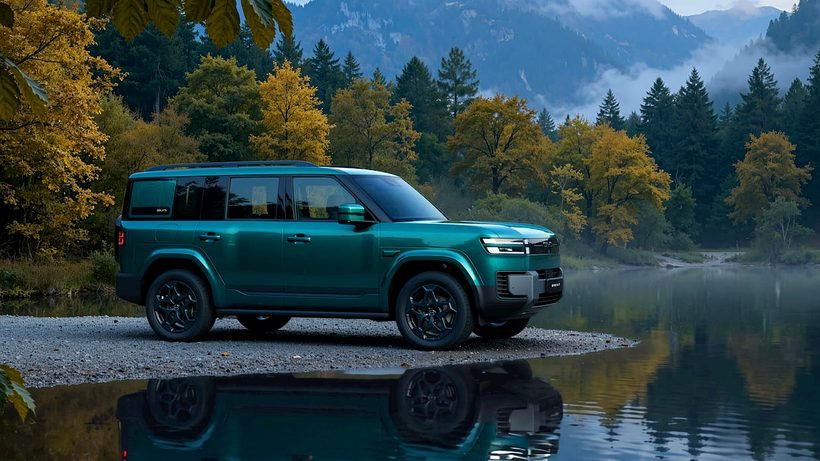
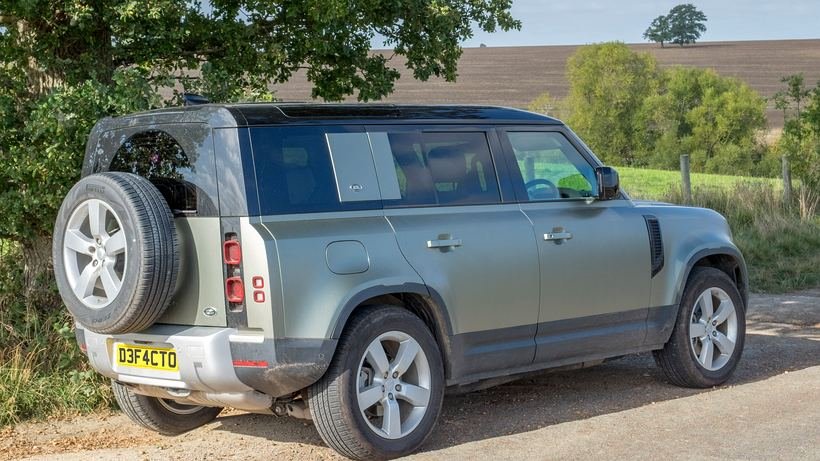
The first is design. JLR says the Ti7 infringes intellectual property rights tied to the Land Rover Defender. Look at the two SUVs side by side and the resemblance is hard to miss. Both are boxy, upright, three-row SUVs, and both carry an unusual square of painted surface floating above the beltline. BYD itself described the Ti7 as having "an unapologetically boxy profile." The Ti7 is 5,146mm long and seats seven, and commentators have called it a "Chinese Defender clone" with "more than a passing similarity" to JLR's global bestseller.
The second part is technology. JLR believes BYD stripped a Defender down and reverse-engineered some of its technology to build the Ti7. That is the allegation that turns a design dispute into something bigger. Benchmarking a rival's car is normal in this industry. Every carmaker buys competitors' cars and takes them apart. The line JLR says BYD crossed is using protected Defender technology in the Ti7 itself. If BYD did that, the case is about theft, not taste.
JLR wants the seized digital records to prove it. The records could show how the Ti7 was developed, whether BYD examined a Defender, and whether it got hold of protected technical information. That is why the raid happened, and why the fight over whether the records can be used matters as much as the design question.
The raid: what happened in August
The raid was reported by The Sunday Times on November 8, 2026. Court-appointed bailiffs acting for JLR seized digital records from BYD's offices in Schiedam and Hoofddorp, in the Netherlands, in August. JLR wanted the records secured before they could be destroyed, according to Autocar India.
Before the raid, BYD said it had done everything it could to cooperate with JLR's requests for information. After the raid, its lawyers challenged how much had been taken, calling the seizure a "fishing expedition" and arguing that too many files were seized. Lawyers for both companies appeared before a court in The Hague in October to argue over how the seized records could be used, The Telegraph reported.
Both companies have declined to comment on the case itself. BYD said it had no comment while the legal proceedings are ongoing. JLR also declined to comment.
The timing tells its own story. The raid happened in August, but the news only broke in early November, days before the Ti7 reached UK showrooms. BYD opened Ti7 orders in the UK and Europe in late July, launched the SUV in the UK in July, and starts customer deliveries in January 2027. The Ti7 is already on sale in China, where it is sold under BYD's Fangchengbao brand and has been available since September 2025.
What the Ti7 actually is
The Ti7 is not a small car, and it is not a cheap one by Chinese standards. It is a 5,146mm-long SUV, which puts it in the same size class as the Defender 110. It seats seven, and it was designed for Europe and the UK as a seven-seater from the start. That matters, because the Defender's plug-in hybrid only seats five.
The powertrain is BYD's DM-p, Dual Mode performance, plug-in hybrid system. A 1.5-litre petrol engine works with electric motors to make 408 PS (402 hp), and the Ti7 does 0-62 mph in 4.8 seconds. The engine mostly acts as a generator for a 35.6 kWh Blade Battery, which gives up to 74 miles of electric range on the WLTP cycle, or up to 102 miles in city driving. In the UK, the Ti7 comes only in the flagship Excellence AWD trim.
The Ti7 is sold in China under BYD's Fangchengbao brand, where it has been on sale since September 2025. Fangchengbao is BYD's premium off-road sub-brand, and the Ti7 is its family SUV. BYD added a battery-electric version in April 2026 for $29,900, and the plug-in hybrid launched in China from under $27,000.
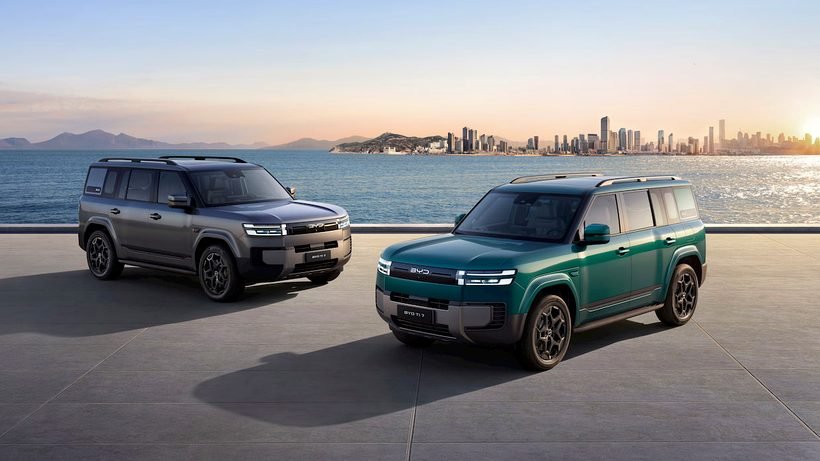
BYD opened Ti7 orders in the UK and Europe in late July 2026. It launched the SUV in the UK in July, it reaches showrooms in November, and customer deliveries begin in January 2027. It is the first UK vehicle on BYD's DM-p powertrain, and BYD said the Ti7 "vastly exceeds the closest competition," which reads like another jab at the Defender.
The Ti7 vs the Defender 110
Put the two SUVs next to each other and the problem for JLR is obvious. The Ti7 is not a cheap knock-off with a weak engine. On the numbers that matter to a buyer, it beats the Defender 110 it is accused of copying.
| BYD Ti7 | Land Rover Defender 110 (plug-in hybrid) | |
|---|---|---|
| UK price from | £47,995 | £71,840 |
| Power | 408 PS (402 hp) | 300 hp |
| 0-62 mph (Ti7) / 0-60 mph (Defender) | 4.8 seconds | 7.4 seconds |
| Seats | 7 | 5 |
| Powertrain | 1.5-litre petrol engine + electric motors, plug-in hybrid | 2.0-litre petrol plug-in hybrid (P300e) |
The gap is the story. The Ti7 costs £23,845 less than the plug-in Defender 110, has 102 more horsepower, gets to 60 mph about two and a half seconds quicker, and seats seven people where the Defender's plug-in hybrid seats five. The Defender's plug-in version only comes with five seats because the battery takes up space in the load area, according to Land Rover's own specifications. The Ti7 was designed for Europe and the UK as a seven-seater from the start.
The Ti7's 35.6 kWh battery gives up to 74 miles of electric range on the WLTP cycle, or up to 102 miles in city driving. It also sits in the UK's 7% benefit-in-kind tax band, which makes it cheaper still for company-car drivers. The Defender 110 plug-in hybrid is the SP300e, a 2.0-litre petrol plug-in hybrid with 300 hp.
None of that proves BYD copied anything. A cheaper, quicker, more practical SUV is not evidence of theft. But it explains why JLR is spending money on lawyers instead of shrugging the Ti7 off. The Ti7 is not a curiosity. It is a direct rival to JLR's best-selling model, at a price JLR cannot match.
Why the price gap is the real story
The Ti7's UK price is not an accident. It is the whole point of the car.
In China, the Ti7 launched in September 2025 starting at under $27,000. BYD added a battery-electric version in April for $29,900. In Europe, versions start at around $64,500, against about $92,000 for the comparable seven-seat Defender 110, according to InsideEVs. In the UK, the Ti7 starts at £47,995.
That is the pattern of the last five years. Five years ago, Chinese-owned brands accounted for 2.5 percent of new car sales in the UK. By September 2026, their share had risen to 23 percent of new registrations, according to Autocar India. The Ti7 is the latest front in that fight, and it lands in the Defender's home market.
JLR is not against Chinese carmakers as such. It has a longstanding manufacturing partnership with Chery, and the two companies have agreed to work together on bringing back the Freelander name for a new generation of electrified vehicles. The Ti7 case is about one car, not one country. But the timing matters. The Ti7 arrives as Chinese brands are taking nearly a quarter of the UK market, and JLR's most iconic model is the one in the firing line.
The Defender is JLR's global bestseller, and the stakes are high. In India, demand for the SUV has been strong enough that JLR recently started local assembly of the Defender 110. The Ti7 arrives in the Defender's home market at a moment when JLR is expanding the Defender's footprint, not shrinking it.
Why the Netherlands
JLR filed the case in the Netherlands, and that was a choice. The Sunday Times reported that the case is believed to have been filed there because Dutch courts have historically been more favourable to intellectual property theft claims.
The November 11 ruling is about procedure, not guilt. The court decided the seized records cannot be used: it lifted the evidence seizure, told JLR to end it and arrange for the retained data to be destroyed under set conditions, and halted the enforcement measures tied to it. That is a setback for JLR, because the records were the material it wanted to show how the Ti7 was developed. It does not decide whether BYD copied anything, and it puts no restriction on Ti7 sales.
JLR has been here before, and the record is mixed. In 2019, it won a case against Jiangling Motor Corporation in China, after a three-year dispute, when a court ruled the Landwind X7 was too close to the Range Rover Evoque and restricted sales of the vehicle. It lost the other big one. The Ineos Grenadier, which looks a lot like the original Defender, was cleared for sale in 2020. A boxy shape alone was not enough to stop it.
What happens next
The court in The Hague ruled on November 11: the seizure is lifted, JLR must end it and arrange for the seized records to be destroyed under set conditions, and the enforcement measures tied to the seizure are halted. The underlying case over whether the Ti7 copies the Defender is still open, and a full hearing would take years. But JLR now has to make that case without the seized records. (Updated November 12, 2026.)
Either way, the Ti7 is not going away in the meantime. It reaches UK showrooms in November, and customer deliveries begin in January 2027. It is already on sale in China and on its way to Europe. The lawsuit will not stop it being sold unless a court orders it to, and that is a long way off.
For American buyers, the Ti7 is a car they will not get to buy. BYD does not sell passenger cars in the United States, and the Ti7 is built for China, the UK, and Europe. The lawsuit is a European fight, but the question it asks is a global one. How much can a car look like another car before it stops being inspiration and starts being theft? The court in The Hague has had its first say, and on the evidence question it went BYD's way.
BYD's European push is moving fast, and the Ti7 is only the latest step. You can follow it on our BYD news page, and the EVThrottle homepage has the rest of the week's EV news.