The short answer
Lucid’s third quarter came in short of what Wall Street wanted, and better than feared on the one number that matters most for the company’s survival. Revenue was $350.3 million, up 4% from a year earlier, but below the roughly $396 million analysts had expected, according to S&P consensus data cited by StockStory. The adjusted loss was $2.30 per share, against an expected loss of $2.21. At the same time, Lucid cut the cash it burns each quarter by 30% from the second quarter, to $1.04 billion, and lined up $1.75 billion in extra funding from Saudi Arabia’s Public Investment Fund, its biggest shareholder. Put together, the company says its money now stretches into the fourth quarter of 2027.
Shares closed up 9.4% at $3.60 on Monday before the numbers came out. The results were released at 4:05 p.m. Eastern, after the market closed, so that gain was not a reaction to the earnings. It was the latest leg of a rally that started after the midterm elections, a run we covered here last week. What the stock does next depends on the earnings call, which started at 5:30 p.m. Eastern.
The numbers, line by line
Revenue of $350.3 million compares with $336.6 million in the same quarter last year. That 4% rise came in a US battery-electric market that shrank 41% over the same stretch, according to S&P Mobility data cited in Lucid’s own release. Lucid grew while the market around it shrank, which is the bright spot in the top line. The rest of the top line is less kind: sales are still small for a car company, and revenue fell from the $405.3 million Lucid posted in the second quarter, TickerGuard reports.
Lucid still loses money on every car it builds. The cost of bringing in $350.3 million in revenue was $608.6 million, so the gap between what a car sells for and what it costs to build is still wide. It is narrower than a year ago, when that cost was $670.2 million against $336.6 million in revenue, and Lucid says its gross profit margin improved a lot. The direction is right. The size of the loss is still the story.
Below that line, research and development cost $311.8 million, and selling, general and administrative costs were $286.2 million. The operating loss was $857.6 million, down from $942.0 million a year earlier. The net loss was $830.9 million, or $2.74 per share, against a net loss of $978.4 million, or $3.31 per share, in the third quarter of 2025. Over the first nine months of 2026, revenue reached $1.04 billion, up about 25% from $831.1 million in the same stretch last year.
Adjusted EBITDA, the version of profit that strips out interest, taxes, depreciation and stock pay, was a loss of $726.3 million, StockStory reports. That was worse than the $611 million loss analysts had penciled in, according to CNBC figures cited by TradersUnion.
Wall Street wanted more
The miss was not close. Revenue fell 11.6% short of the S&P consensus of $396.3 million, StockStory says. CNBC’s forecast was higher still, at $407 million, TradersUnion reports. Either way, Lucid landed well below the bar. The adjusted loss of $2.30 per share was 4.2% worse than the $2.21 analysts expected.
The car count missed too. Lucid delivered 3,806 cars in the quarter, down 6.7% from the 4,078 it delivered a year earlier, and below the 4,687 Wall Street had expected, Gadgets365 reports. Deliveries also slipped 3.7% from the 3,953 handed over in the second quarter. For a company that needs volume to spread its fixed costs, that is the number that hurts most. Each car carries a large share of factory, staff and development costs, so fewer deliveries mean each sale has more cost riding on it.
There is a counterpoint, and Lucid made it in the release: the US battery-electric market fell 41% in the quarter, per S&P Mobility. Growing 4% in that market means Lucid took share even as the pie shrank. That is true, and it is also a low bar. The market fell because the $7,500 federal tax credit ended last year, and buyers pulled back across the board. Our look at that full year is here. Lucid’s problem is not the market alone. It is that its own sales are still too small to cover its costs, and they are growing too slowly to close the gap soon.
The cash story is the real news
If the revenue line disappointed, the cash line is why the stock did not fall apart. Free cash flow consumption, the cash the business burns after paying for its factories and equipment, fell 30% from the second quarter to $1.04 billion. That is still a large number, and it is worse than the $955.5 million Lucid burned in the same quarter last year, StockStory notes. But the direction changed, and the direction is what investors have been waiting for.
The improvement comes from the operating reset Lucid announced with its second-quarter results. The company ended the second shift at its Arizona plant in June, cut 18% of its US workforce the same month, and started selling cars out of stock instead of building new ones, EVXL reports. Those moves sit inside a $1.4 billion cash flow improvement plan, and Lucid says it has banked $0.8 billion of savings so far this year and is on track for the full-year target.
Chief executive Silvio Napoli put it this way in the release: “Our transformation is beginning to show progress. We are acting with urgency, strengthening the fundamentals and driving greater discipline, while continuing to invest in the priorities to deliver profitable long-term growth.” Chief financial officer Alexander De Bock added: “The operating reset announced with our Q2 results includes decisive actions to align our manufacturing capacity with demand, reduce inventory and lower operating expenses. These actions are already showing through in Q3, with free cash flow consumption 30% lower sequentially.”
Then there is the money from Riyadh. Lucid said it increased its delayed draw term loan facility with the Public Investment Fund by $1.75 billion. Total liquidity ended the quarter at $2.0 billion, or $3.75 billion counting the new facility. Lucid says that level funds operations and key investments into the fourth quarter of 2027, which carries the company through the start of production of its cheaper midsize car. The fund is Lucid’s anchor shareholder, and it has now stepped in again at the moment the company needed it most. Kalkine’s rundown of the quarter has the full set of figures.
Fewer cars, on purpose
Lucid built 2,954 cars in the third quarter, down 38% from the 4,774 it built in the second quarter, and the lowest quarterly output since early 2025. It was the third straight quarter of falling production. The company dropped to a single shift at its Casa Grande, Arizona plant, known as AMP-1, and says it is matching what it builds to what buyers actually want.
That is why deliveries beat production for the first time this year, by 852 cars. Lucid sold cars it had already built, working down a pile of finished stock. Over the first nine months of 2026, it built 13,228 cars and delivered 10,852, a gap of 2,376. Drawing down stock is the right move when you have too many cars sitting around, and it is also a sign of how far the plan has changed. In February, Lucid set a 2026 production target of 25,000 to 27,000 cars. It suspended that guidance in May. Through three quarters it has built barely half the bottom of the old range.

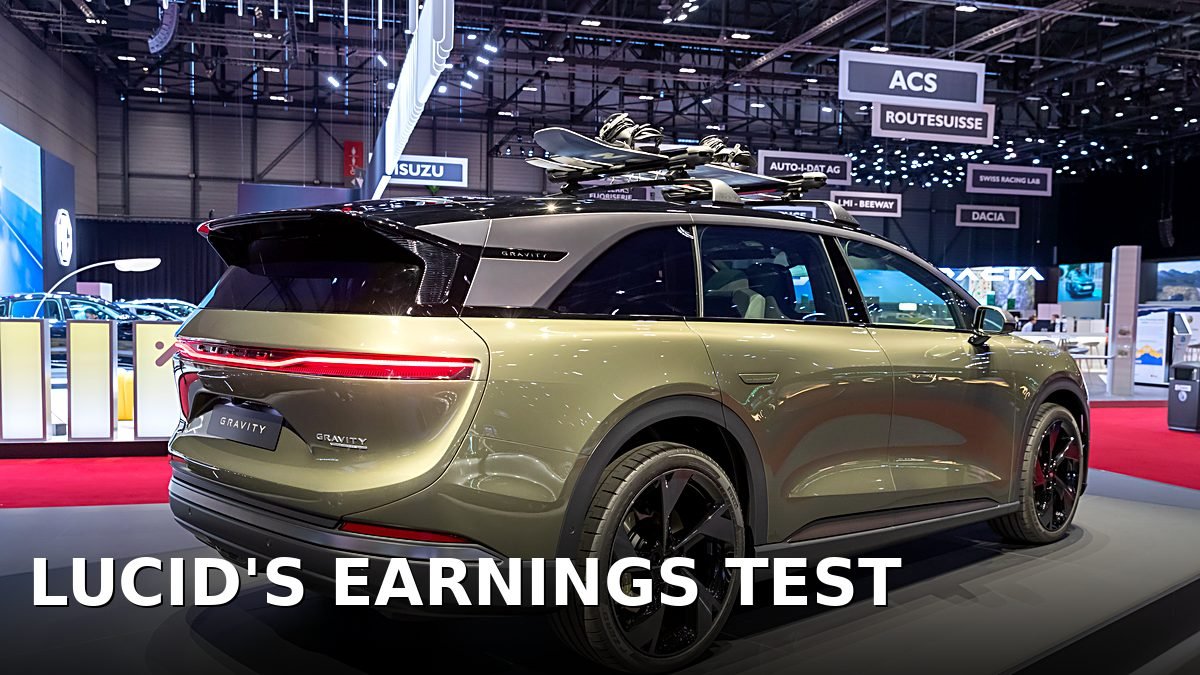
Lucid said demand for the Gravity SUV, its second model, “continued to regain momentum” in the quarter. The Gravity is the car that has to carry the company until the cheaper midsize model arrives, and the delivery count suggests it is starting to do that job. But 3,806 total deliveries in a quarter is still a small number next to rivals. Rivian sold 19,239 cars in the same quarter, and its new R2 is now its best seller. Ford’s Lightning owners are trading into R2s at strong prices, as we reported here. Lucid is not playing in that volume game yet.
Gravity is the bet now
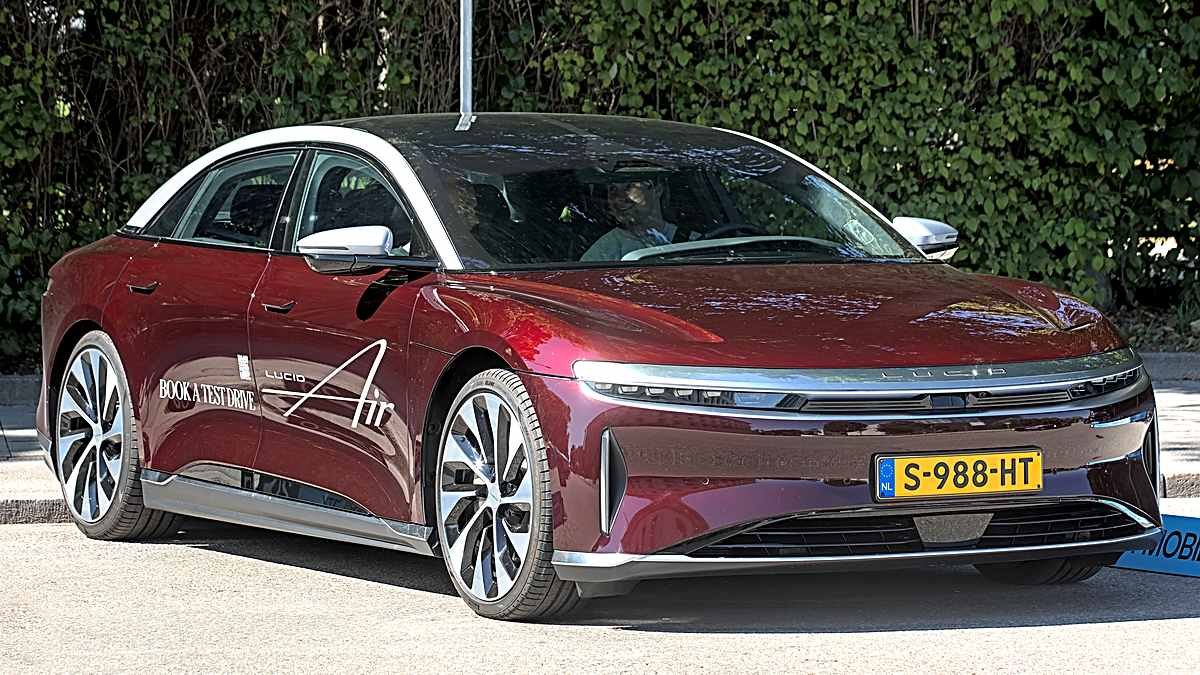
The Gravity starts at $79,900 for the Touring, with the Grand Touring at $98,900. The Air sedan starts at $70,900 for the Pure, rising to $79,900 for the Touring, $114,900 for the Grand Touring, and $249,000 for the three-motor Sapphire. Those are Autoblog’s current US list prices, and they explain both Lucid’s promise and its problem. The cars are good, the engineering is real, and the prices put them in a thin slice of the market.
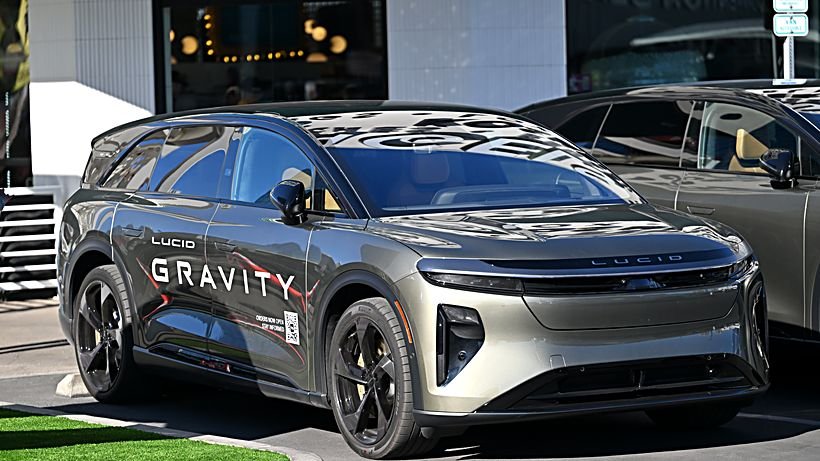
The Gravity is the more important car now. It is an SUV with up to seven seats, it is the model that can sell in family-sized numbers, and it is the one Lucid’s factory is set up to build at volume. The Air is a sedan in a market that buys SUVs. That is why the Gravity’s momentum matters more than the Air’s, and why the delivery count is watched so closely. If Gravity sales keep climbing through the fourth quarter, the revenue line has a path up. If they stall, there is not much else to lift it.
Robotaxis, Saudi Arabia, and the $50,000 car
The release also gave updates on the three bets that sit beyond the car business. On autonomy, Lucid says it hit every milestone scheduled by the end of the third quarter in its robotaxi work with Uber and Nuro, and the program grew to more than 100 vehicles on the road in August. It also signed a deal with Bolt, one of Europe’s big ride-hailing platforms, with a goal of putting at least 25,000 Lucid vehicles into service. These are early steps, and they bring in no real revenue yet, but they are the reason Uber and Bolt are in the story at all.
In Saudi Arabia, construction of Lucid’s second plant, AMP-2, is in the final stages of industrialization and commissioning, and the company expects to open it in early 2027. The plant matters because the midsize car, the one Lucid needs to reach buyers who cannot spend $70,000 or more, will be built there.
That midsize car is now the date everyone watches. Testing and final-stage prototyping continued through the quarter, pilot production is in its final phase, and production is still planned for the second half of 2027. Lucid says it will announce reveal and production dates in the first quarter of 2027, and the starting price is planned at below $50,000. It will also lay out its mid-term plan and targets early next year. Between now and then, there is not much new for buyers to wait for.
The stock moved before the news
Lucid shares closed Monday at $3.60, up 9.4% on the day, according to Finnhub market data. That move happened before the results were released at 4:05 p.m. Eastern, after the closing bell. It extends the rally that followed the midterm elections, when the stock jumped 12% to $3.37, as we reported here. The market was bidding the stock up on hope. The numbers that arrived after the bell were mixed, and the call that started at 5:30 p.m. Eastern is where investors will hear whether management thinks the reset is on track.
What happens in after-hours trading will be the first verdict. The honest read is that the quarter gives both sides something. The revenue miss and the delivery miss are real, and the cash burn, while smaller, is still over $1 billion a quarter. The funding, the falling burn, and the runway into late 2027 are also real, and they take the near-term survival question off the table.
What to watch next
Three dates matter from here. The first is the mid-term plan Lucid promised for early next year, which should say how fast it thinks it can reach positive gross margin and how much the midsize car will cost to build. The second is the fourth-quarter production and delivery count, due in early January, which will show whether Gravity demand kept building or whether the third quarter was a pause. The third is the midsize reveal date, due in the first quarter of 2027, which will show whether the car that is supposed to change Lucid’s scale is on schedule.
Watch the cash burn too. The 30% sequential drop is the best number in this report. If the fourth quarter shows another step down, the reset is working. If the burn flattens or rises, the funding buys time but not a turnaround.
What it means if you are buying a Lucid now
For buyers, the quarter changes little and answers one question. The Air Pure starts at $70,900 and the Gravity Touring at $79,900, and there is no federal tax credit to soften those prices anymore. The midsize car, at below $50,000, is still more than a year and a half from showrooms. If you want a Lucid now, you are buying a luxury car from a company that is still losing money on each one it sells, and the price is the price.
The funding does answer the question buyers ask most often about small carmakers: will the company still be here in a year to service the car? With $3.75 billion in pro forma liquidity and a stated runway into the fourth quarter of 2027, Lucid has bought itself the time to get the midsize car built. That is not a promise the car will sell. It is a promise the company will still be around to try.
For the full picture, see our latest EV news and our homepage for the day’s top stories.
Lucid Q3 questions, answered
What did Lucid report for Q3 2026?
Revenue of $350.3 million, up 4% from a year earlier, and a net loss of $830.9 million, or $2.74 per share. Free cash flow consumption fell 30% from the second quarter to $1.04 billion, and total liquidity was $2.0 billion, or $3.75 billion counting a new $1.75 billion loan facility from Saudi Arabia's Public Investment Fund.
Did Lucid beat or miss Wall Street estimates?
It missed. Revenue came in 11.6% below the S&P consensus of $396.3 million, StockStory reports, and the adjusted loss of $2.30 per share was worse than the $2.21 loss analysts expected. CNBC's revenue forecast was higher still, at $407 million.
How much cash is Lucid burning?
Free cash flow consumption was $1.04 billion in the third quarter, down 30% from the second quarter but worse than the $955.5 million burned a year earlier. Lucid says it has saved $0.8 billion this year under its $1.4 billion cash flow improvement plan.
How many cars did Lucid deliver in Q3 2026?
3,806, down 6.7% from a year earlier and below the 4,687 Wall Street expected. It built 2,954 cars, down 38% from the second quarter, as it cut production to match demand and sold cars out of stock.
When is Lucid's cheaper midsize EV coming?
Production is planned for the second half of 2027, with a starting price planned at below $50,000. Lucid says it will announce reveal and production dates in the first quarter of 2027, and its Saudi Arabia plant, AMP-2, is due to open in early 2027.
Is Lucid running out of money?
Not soon. Total liquidity was $2.0 billion at the end of the quarter, or $3.75 billion counting the expanded loan facility from its biggest shareholder, Saudi Arabia's Public Investment Fund. Lucid says that funds operations and key investments into the fourth quarter of 2027.