On this page: BYD 1.5 MW charger · How fast · Han L charging time · Station count · BYD vs Tesla · Can you buy one in the US · Europe · Hanging cables · FAQ
BYD’s 1 MW charging network can add 250 miles of range in five minutes, and a new T-shaped charger spotted in China is rated to 1,500 kW. The network already has more than 10,000 stations in China, with 3,000 planned for Europe by the end of 2027. US drivers still cannot use any of it.
This article sorts out the three power figures BYD uses, 1,000, 1,360, and 1,500 kW, and explains what each one means. It also covers the cars, the station count, and the US rules that keep this hardware out of American showrooms.
BYD 1.5 MW charger: the T-shaped unit spotted in China
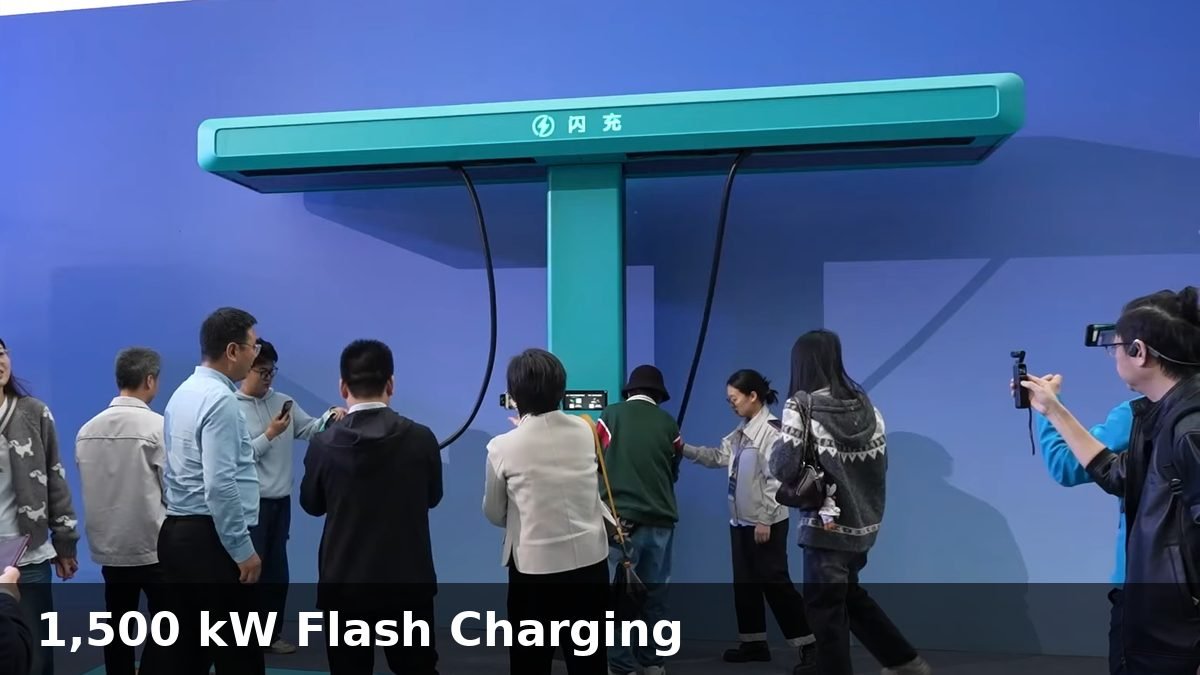
Chinese social media users spotted the new units popping up across China in early 2026. InsideEVs first reported the new units on February 28, 2026. The teal, T-shaped chargers look nothing like the Flash charging stations BYD showed in 2025.
Photos of the chargers’ information plates, taken by Chinese bloggers, show at least some of the new units can dispense 1,500 kW, or 1.5 MW. BYD had not made a separate official announcement about this new generation of hardware when InsideEVs reported it, and a company representative did not respond to questions about the new stations.
That does not mean the 1,500 kW figure is unconfirmed. BYD confirmed a charger rated up to 1,500 kW in its March 2026 second-generation Blade Battery release in Japan. The rating is official. The link between that rating and the specific T-shaped units spotted in China still rests on the blogger photos of their plates.
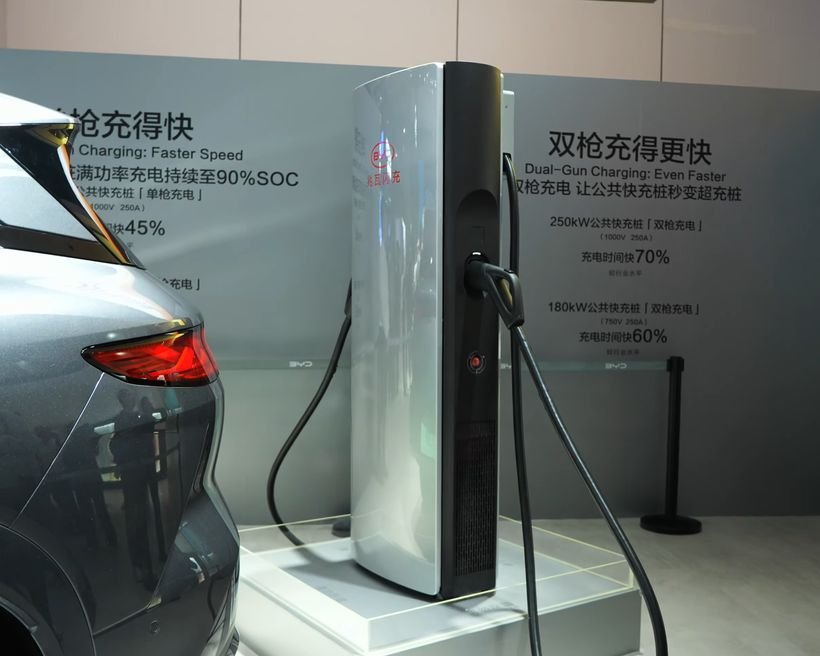
BYD megawatt flash charging how fast: 250 miles in five minutes, with catches
The math is simple. The Super e-Platform runs at 1,000 volts and 1,000 amps, and 1,000 times 1,000 is 1,000,000 watts. BYD calls the result the fastest peak charging speed for a mass-produced car: 2 km of range per second, or 400 km, about 250 miles, in five minutes.
That 400 km figure uses China’s CLTC test cycle, which leans toward city driving. Real-world range, and an EPA-equivalent figure, would be lower. Peak power is also a moment, not a session average. A charger rated at 1,500 kW does not feed a battery 1,500 kW the whole time. The charge curve, the battery temperature, and the starting charge level decide how long a stop really takes.
BYD’s second-generation system, announced March 5, 2026, states the claim as a charge window instead of a range figure: 10 to 70 percent in five minutes, and 10 to 97 percent in nine minutes. At minus 30 degrees Celsius, BYD says charging takes about three minutes longer.
| Item | 2025 Super e-Platform | 2026 second-gen |
|---|---|---|
| Voltage | 1,000 V | 1,000 V |
| Peak per car | 1,000 kW | 1,000 kW |
| Charger rating | 1,360 kW | 1,500 kW |
| Five-minute claim | 400 km of range | 10 to 70 percent |
| Near-full charge | Not stated | 10 to 97 percent in 9 min |
BYD Han L charging time 5 minutes: the two cars that launched with it
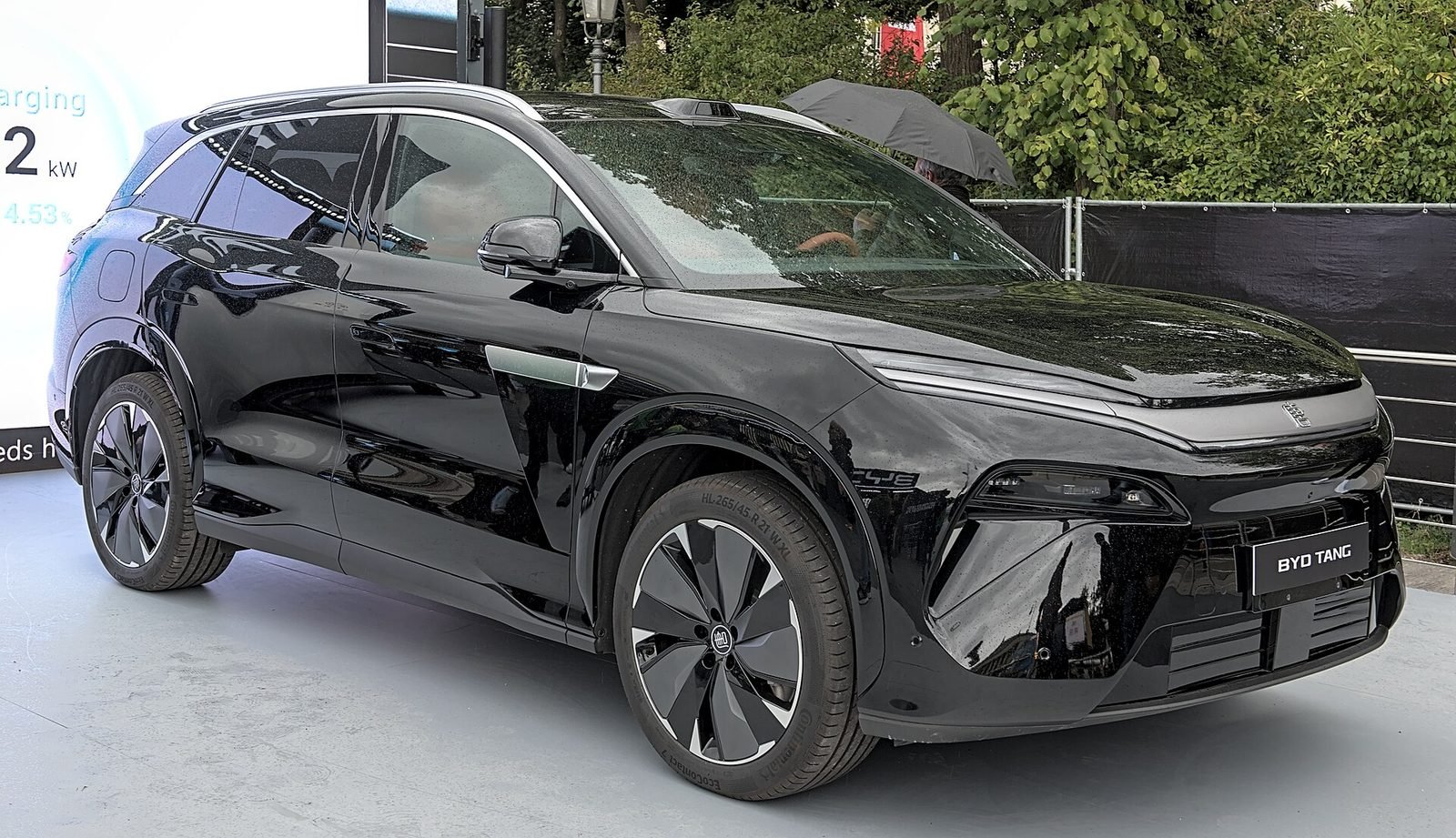
The Han L sedan and the Tang L SUV were the first cars on the Super e-Platform. BYD opened pre-sales for both in China on March 17, 2025, with launches set for April. The Han L is the car behind the 400 km in five minutes claim.
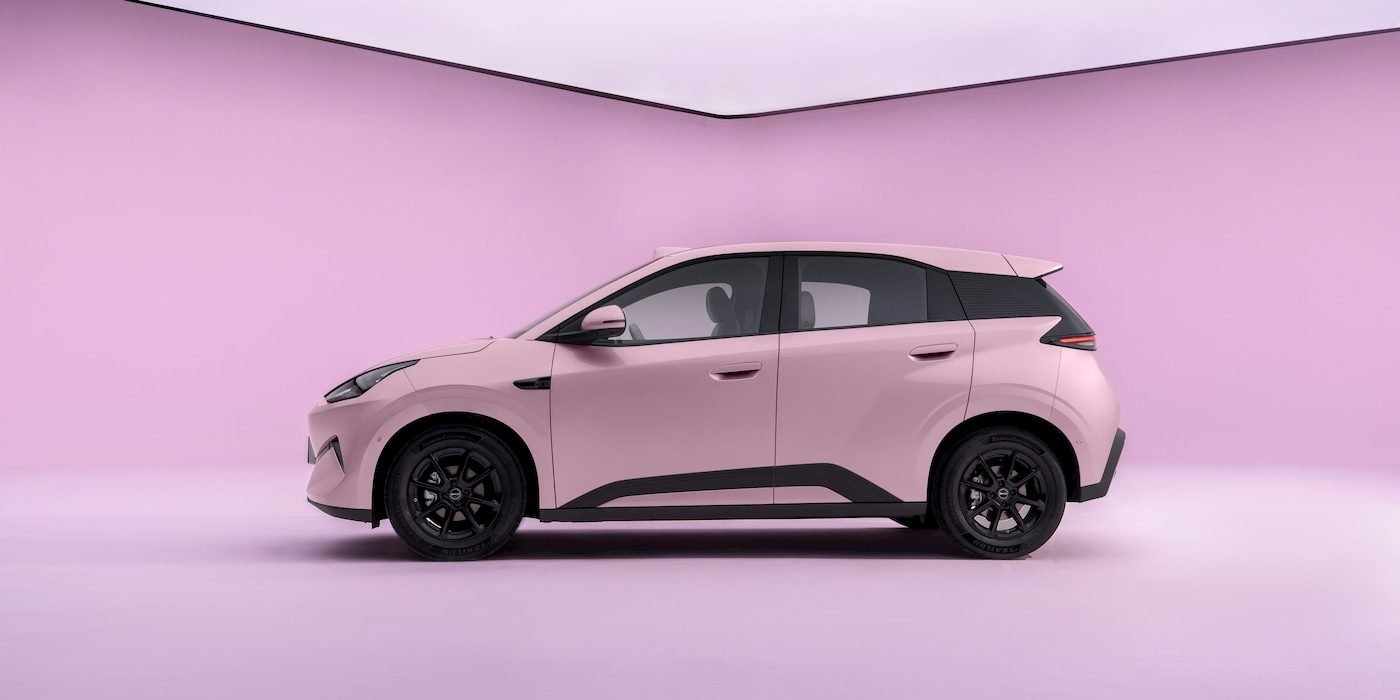
The platform itself is more than a fast charger. It uses a 30,000 rpm motor, silicon carbide power chips, and a single-motor output of 580 kW, with a top speed over 300 km/h. Both launch cars are China-market models. BYD has also put the same fast-charging tech in the Seagull, which we covered in our BYD Seagull second-generation Flash charging launch report.
| Car | Market | Flash charging |
|---|---|---|
| Han L | China | 1 MW, first car |
| Tang L | China | 1 MW, SUV twin |
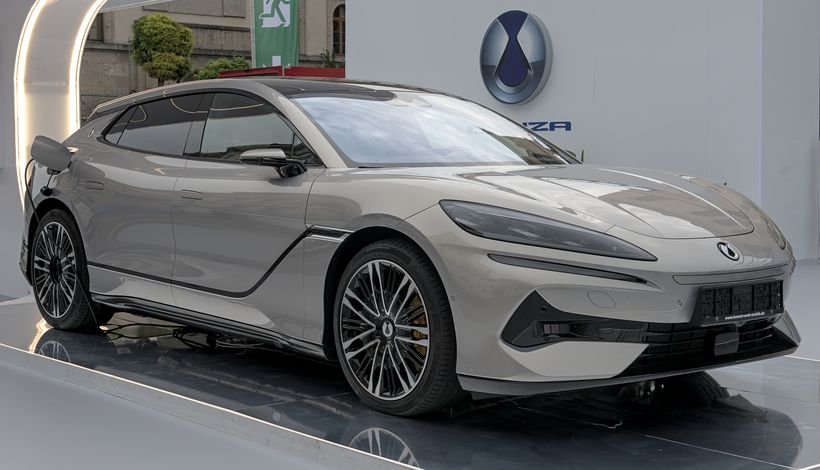
| Denza Z9 GT | Europe | Full 1,500 kW |
| Atto 8 | Europe, from Q1 2027 | 10 to 70 percent in 5 min |
BYD flash charging stations how many: from 500 to 10,000 in eight months
BYD started this network from almost nothing. The company had no strong charging network of its own, even in China, and relied on small partnerships with third-party charging providers. In March 2025 it said it would build 4,000 stations itself, with 15,000 more through partners.
By February 2026, at least 500 first-generation 1 MW stations were running in China. By October 2026, the count had passed 10,000. BYD now targets 20,000 stations in China by the end of 2026, and 6,000 overseas by the end of 2027.
Most of that build is partner work, not BYD construction crews. Later reporting puts the split at about 18,000 partner sites and 2,000 BYD-owned motorway sites out of the 20,000 target, with partners including Sinopec, PetroChina, CNOOC, Teld, and JD.com.
The stations carry their own storage. Autonext reports each charger holds 370 kWh on site in two 185 kWh batteries, and draws only 100 to 560 kW from the grid. That lets a site serve a megawatt car without a megawatt grid connection, and it lets BYD store cheap off-peak power for busy hours. The network is also open to other brands. Autonext reports about a third of Flash charging users drive rival cars.
| Date | China stations | Plan |
|---|---|---|
| Feb 2026 | 500+ first-gen | 4,000 own, 15,000 partner |
| Oct 2026 | 10,000+ | 20,000 by end of 2026 |
| End 2027 | Not stated | 6,000 overseas |
BYD 1000 kW charging vs Tesla Supercharger: the gap in the US
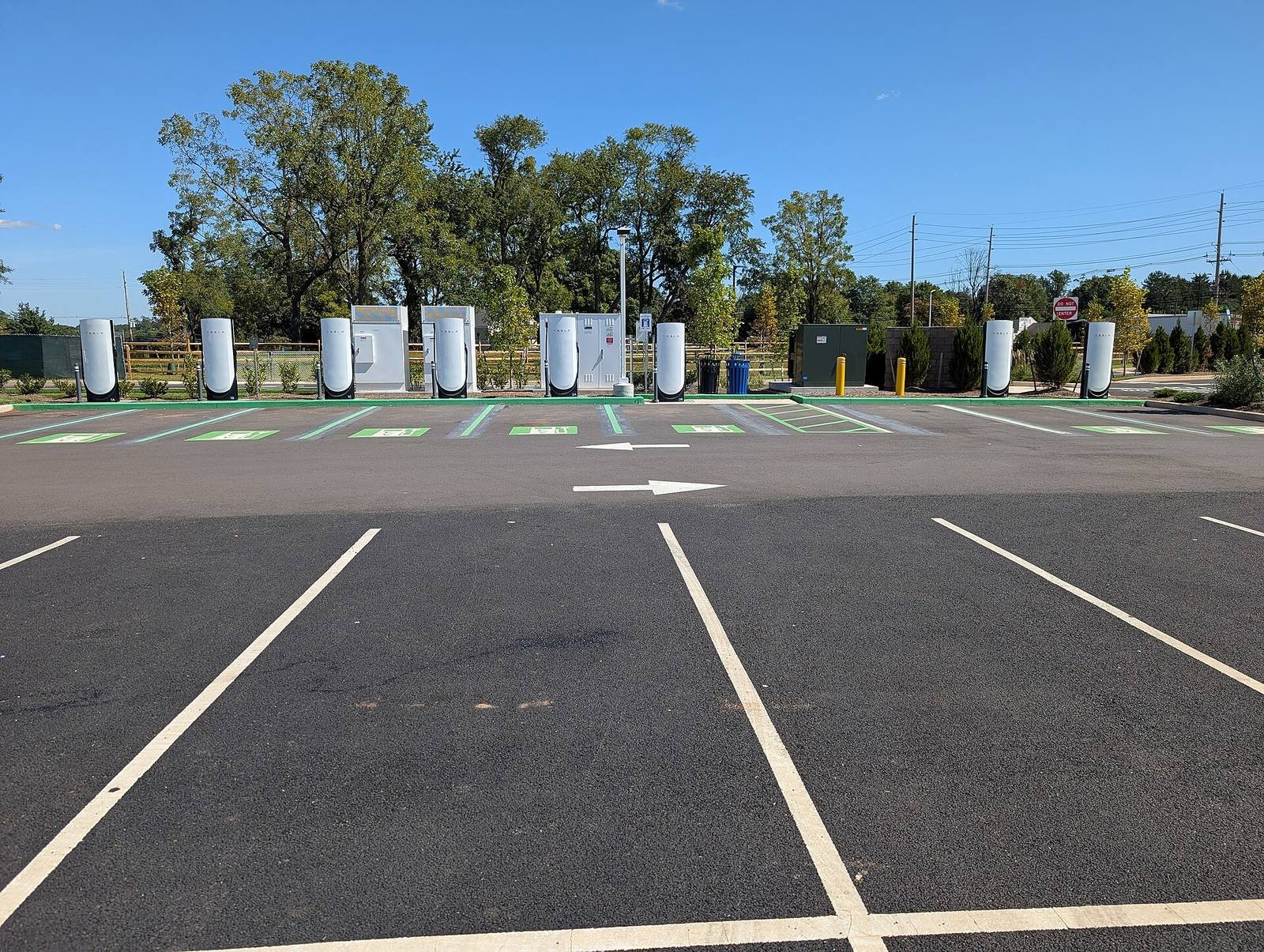
BYD’s 1 MW peak is double the highest power rating in the US, as InsideEVs put it. Most public DC fast chargers in the US top out at 350 kW. Tesla’s newest V4 hardware is rated to 500 kW per stall, and only the Cybertruck has the 800-volt architecture to use it. Even then, its charging curve falls well short of what a 1,000-volt BYD can take.
Tesla is building its own megawatt charging for the Semi, with up to 1.2 MW through the Megawatt Charging System connector. That is truck hardware, not passenger-car hardware. For cars on American roads today, a typical 10 to 80 percent fast-charge session still takes 15 to 35 minutes. BYD’s second-generation system claims 10 to 97 percent in nine minutes, on its own chargers, with its own cars. Our report on how US public charging grew in 2026 shows how far behind that pace the US network sits.
| Charger | Peak power | What it means |
|---|---|---|
| BYD Flash, China | 1,000 to 1,500 kW | 10 to 70 percent in 5 min, claimed |
| Tesla V4 cabinet | 500 kW | Cybertruck only, peak is brief |
| Typical US public DC fast | 350 kW | 15 to 35 min for most EVs |
Can you buy a BYD EV in the US: no, and here is why
No. BYD does not sell passenger cars to US buyers, and no US launch is on the horizon. Two separate US actions block it. The US Trade Representative raised the tariff on Chinese-made EVs to 100 percent, effective September 27, 2024. The Commerce Department then announced a connected-vehicle rule on January 14, 2025, which bars companies with a sufficient link to China from selling new connected vehicles in the US starting with model year 2027, even if the car is built here.
BYD does have a US presence. It builds electric buses in Lancaster, California, and sells energy storage here. It does not sell cars through US dealers. In January 2026, several BYD US units sued the federal government over duties imposed under emergency-powers law, and the Supreme Court ruled in February 2026 that the emergency-powers law does not authorize tariffs. That ruling does not touch the 100 percent rate, which sits under Section 301, a different law. We track the politics in our BYD vs Tesla US tariff debate coverage.
BYD flash charging Europe 3000 stations: what is actually coming
Europe is next. The first 1,500 kW Flash station on European soil went live in Germany in June 2026. CarNewsChina reported the Europe plan from the Paris show: 100 stations in Europe by the end of 2026, and 3,000 by the end of 2027. The UK gets 300 of them.
Only one car in Europe can use the full speed today. The Denza Z9 GT, listed from 105,000 pounds in the UK, is the only BYD-made car in Europe with Flash charging. The Atto 8, a seven-seat SUV shown at the Paris show, arrives in the first quarter of 2027 as the first BYD-badged model in Europe with the tech. We covered that debut in our BYD Atto 8 Europe debut report. Every Flash charger takes a standard CCS2 plug, so other EVs can use them at lower power.
BYD T-shaped charger hanging cables: a clever fix with one real drawback
The T-shape solves a weight problem. Liquid-cooled cables that carry 1,000 amps are heavy, and a driver has to lift one every session. BYD hangs both cables from an overhead bar on a spring-loaded retractor, so the bar carries the weight. The guns stay at chest height, off the ground, and the cable is long enough to reach a charge port wherever the carmaker put it. Both guns can work in parallel.
The same design has one real drawback, and it showed up in public. On October 2, 2026, two children used the hanging cables at a station in Nanning as playground swings, with their feet off the ground. BYD customer service confirmed on October 4 that playing on charging equipment is strictly prohibited, sent maintenance staff to inspect the site, and said it would tighten station checks.
The electrical risk in that moment was low. Under China’s charging standards, the station’s main contactors stay open and de-energized while the gun is docked, and high voltage only engages after the connector locks to a car and passes its checks. The mechanical risk is the bigger issue. The gun weighs 3.0 to 5.0 kg, and repeated swinging loads the retractor, the cable seals, and the connector joints in ways the lab tests do not cover. Internal damage to coolant lines or wiring would not always show on the outside, and it would matter most at the high currents megawatt charging uses.
BYD 1 MW charging questions, answered
How fast is BYD megawatt charging?
BYD claims 250 miles of range in five minutes on the 2025 Super e-Platform, and 10 to 70 percent in five minutes on the second-generation system. Both figures need a compatible car and a Flash charging station.
How many BYD flash charging stations are there?
BYD passed 10,000 Flash charging stations in China by October 2026, up from about 500 in February 2026. The company targets 20,000 in China by the end of 2026 and 3,000 in Europe by the end of 2027.
Can you buy a BYD EV in the US?
No. BYD does not sell passenger cars in the US, and a 100 percent tariff on Chinese-made EVs plus a connected-vehicle rule block sales. BYD does sell electric buses and energy storage in the US.
Will BYD flash charging come to Europe?
Yes. The first 1,500 kW Flash station opened in Germany in June 2026, and BYD plans 100 stations in Europe by the end of 2026 and 3,000 by the end of 2027. Only the Denza Z9 GT can use the full speed in Europe today.
Bottom line
BYD built the fastest charging system a passenger car can use today, and it is scaling it faster than any rival network. The 1,000, 1,360, and 1,500 kW figures describe three different things, a car peak, a first-generation terminal, and a second-generation charger, and the T-shaped units are the newest step. None of it reaches the US, and nothing in the current rules points to that changing soon. If you drive an EV in the US today, the practical move is to check which 350 kW chargers sit on your regular routes, since that is the fastest hardware you can actually use. Start with our EV charging station near me guide.