In the Abu Dhabi desert, BYD showed a charging station where the BYD robotic charging arm plugs in your EV by itself. The station runs on solar power and stored battery energy, and in a demo it took a test car from 10% to 70% in five minutes and 17 seconds. It is a prototype, not a product you can buy, and it shared the stage with a 312.65 mph production-car record.
That pairing is the story. The record got the headlines, and clips from BYD’s desert event have spread widely on social media. The charging hub is the part that could change how EVs get filled up. A robot does the plugging, the sun and a battery bank supply the power, and the driver never touches a cable. Here is what BYD actually showed, what the record really is, and what is still unproven.
What BYD showed in Abu Dhabi
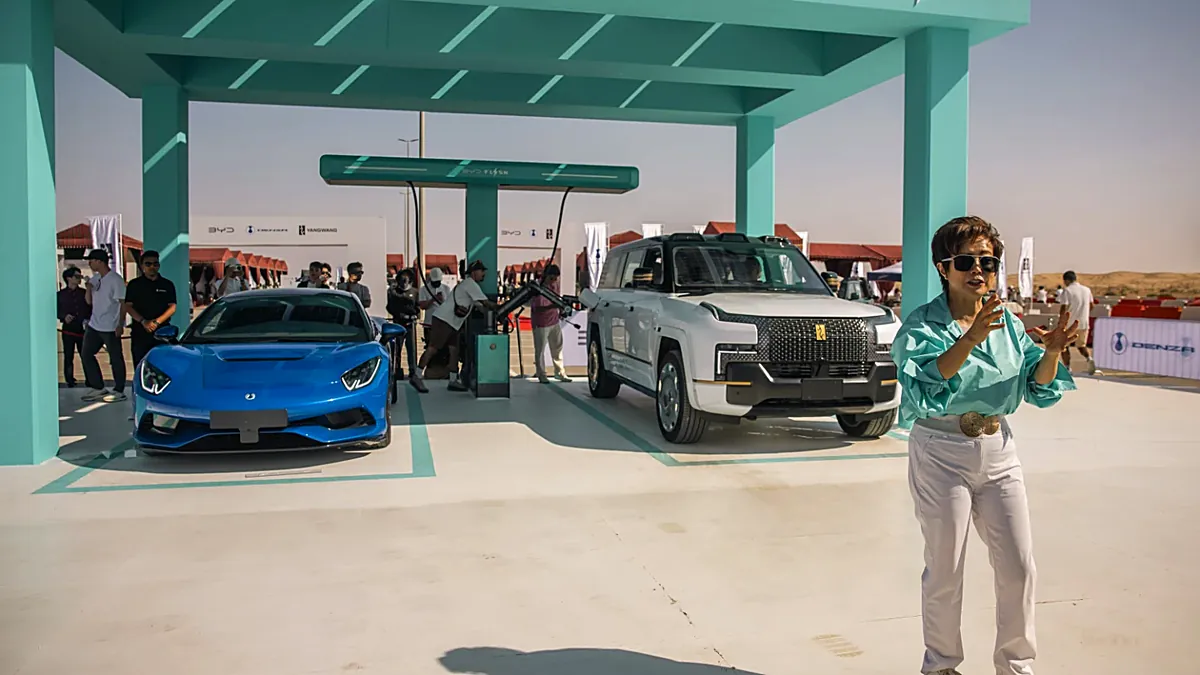
BYD calls its new installation the world’s first integrated solar-storage-charging and robotic refueling hub. It sits in the Abu Dhabi desert, under a solar canopy, and it brings four pieces together in one place: solar panels that make power, stationary batteries that store it, ultra-fast Flash Charging hardware, and a robotic arm that handles the plug.
BYD executive vice president Stella Li presented the system on stage in Abu Dhabi. She said BYD is bringing its integrated Solar-Storage-FLASH Charging technology to the world stage, with what she called “clean energy generation, energy storage and ultra-fast charging together.” The company has spent 20 years building toward this point. It started life making rechargeable batteries, and its solar arm now operates in more than 100 countries. In 2006, chairman Wang Chuanfu laid out a plan he called the “Three Green Dreams”: solar power, stored energy, and electric transport, run as one business.
The desert setting is part of the pitch. The UAE gets intense sun, high heat, and little rain, so a solar canopy there harvests plenty of energy. The same conditions also test the hardware. Sand, heat, and dust are hard on moving parts, and a robot arm working outside all day has to cope with all three.
The 312.65 mph record, and the one catch
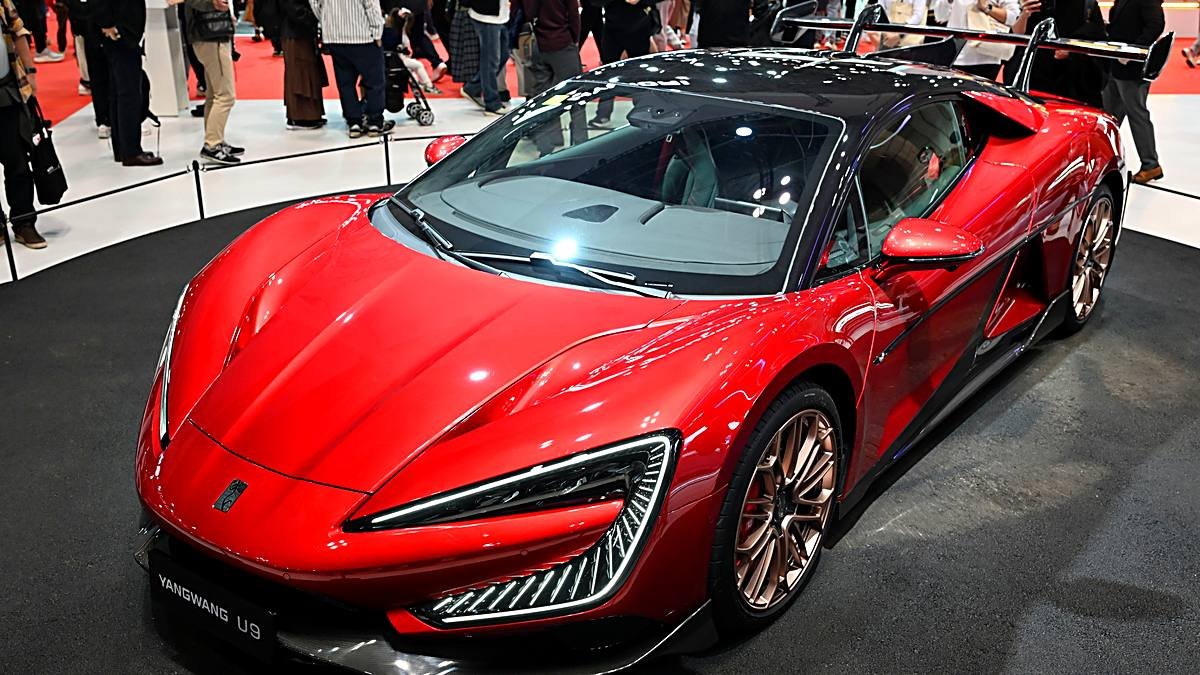
The record came first. On November 1, 2026, the Yangwang U9 Xtreme hit 503.17 km/h, about 312.65 mph, on Sheikh Khalifa Bin Zayed International Road, the E11, in Abu Dhabi’s Al Dhafra region. German racing driver Marc Basseng was behind the wheel. It beat the car’s own previous mark of 496.22 km/h, set at the ATP Papenburg proving ground in Germany in September 2025.
Two Guinness World Records came with it: fastest production car in a single-direction run, and fastest electric production car in a single-direction run. The FIA, motorsport’s world governing body, also recognized the speed. We covered the full record run here.
The record has one honest catch, and it sits in the headline of the Backfire News report: one direction only. Guinness certified the speed as a single-direction run. That is what the two Guinness titles say, and it is the asterisk on the record. The run is real, and so is the asterisk. Both belong in the same sentence.
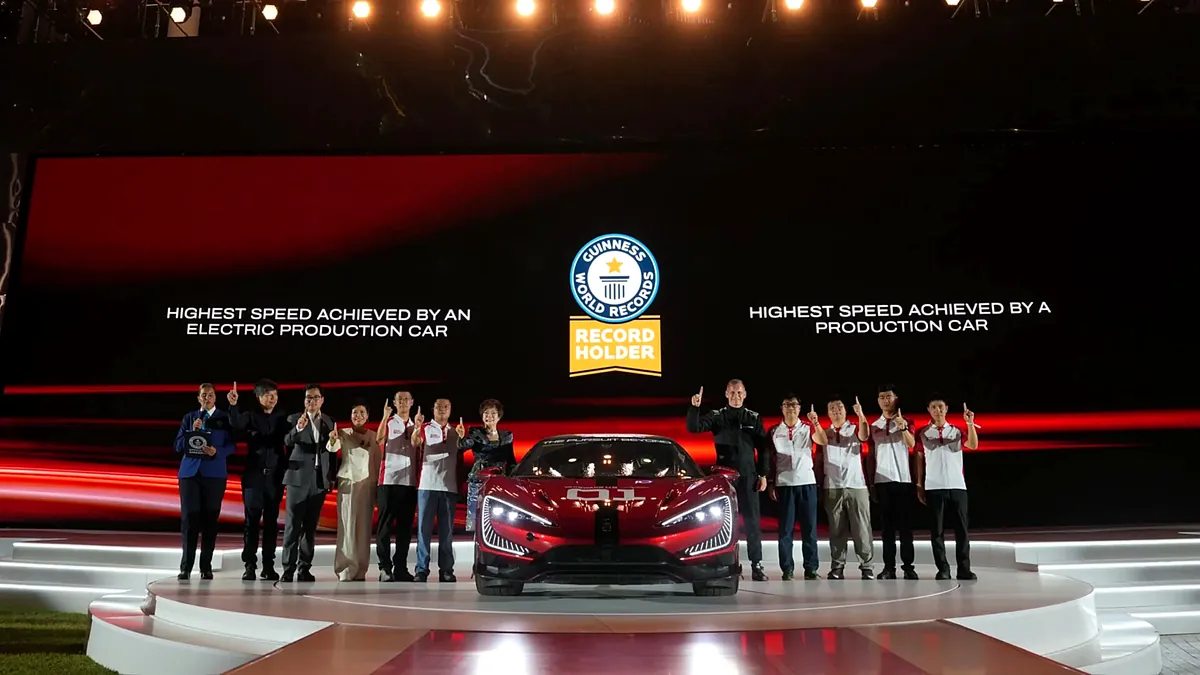
BYD marked the record in Dubai with a light and projection show on the Burj Khalifa, in front of about 3,000 international media and VIP guests. The same week, Stella Li picked up a World Branding Awards trophy after BYD was named Brand of the Year in Automobiles at the awards’ Global Tier, following a ceremony at Hampton Court Palace in London on November 3. Then on November 7, a 110-vehicle parade of Yangwang, Denza, and BYD models rolled from West Park to Emirates Palace in Abu Dhabi, with the U9 Xtreme leading the convoy.
| September 2025 | November 1, 2026 | |
|---|---|---|
| Top speed | 496.22 km/h (308.33 mph) | 503.17 km/h (312.65 mph) |
| Place | ATP Papenburg, Germany | E11, Al Dhafra, Abu Dhabi |
| Car | Yangwang U9 Xtreme | Yangwang U9 Xtreme |
The U9 Xtreme’s two record runs. Sources: Tarmac Life; margin calculated by EVThrottle.
The new mark beats the old one by 6.95 km/h, about 4.32 mph. That is a gain of 1.4%. Small numbers, but they crossed a line no production car had crossed before: 500 km/h.
How the robotic charging arm works
The charging hub works in four steps, and the driver is only involved in the first one.
First, the driver pulls up to the station, steps out, locks the doors, and walks to an air-conditioned lounge. BYD’s Automated Valet Parking software then steers the car into an open bay on its own. Second, a multi-axis robotic arm uses optical cameras and feedback sensors to find the charging flap, pop it open, and seat a heavy liquid-cooled connector into the port. Third, the car charges. Fourth, when the session ends, the arm disconnects, stows the cable, and leaves the car ready to roll.
The point of the robot is the cable itself. A megawatt-class connector is thick, heavy, and hot to handle, and wrestling it in triple-digit desert heat is nobody’s idea of a good stop. The arm takes that job away. It also takes away the wait at the plug: the car parks itself, the arm connects it, and the driver is already inside in the cool.
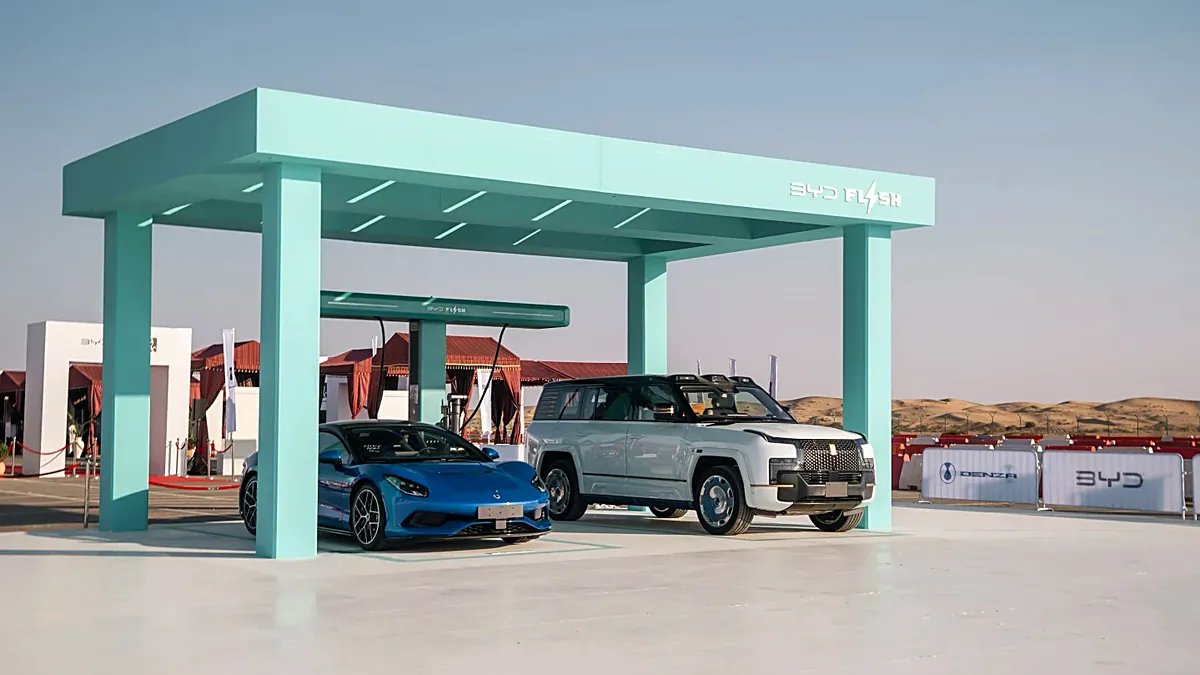
Under the canopy, the power side is just as deliberate. Overhead solar arrays harvest sunlight all day and trickle-charge stationary lithium-iron-phosphate battery packs. When a car pulls in, those batteries discharge at high rates, so the station can push a megawatt into a car without pulling the same load from the local grid at once. BYD says the setup can support operation independent of the electricity grid. Whether the Abu Dhabi installation itself runs fully off-grid is unconfirmed: New Atlas asked BYD, and the company had not confirmed it.
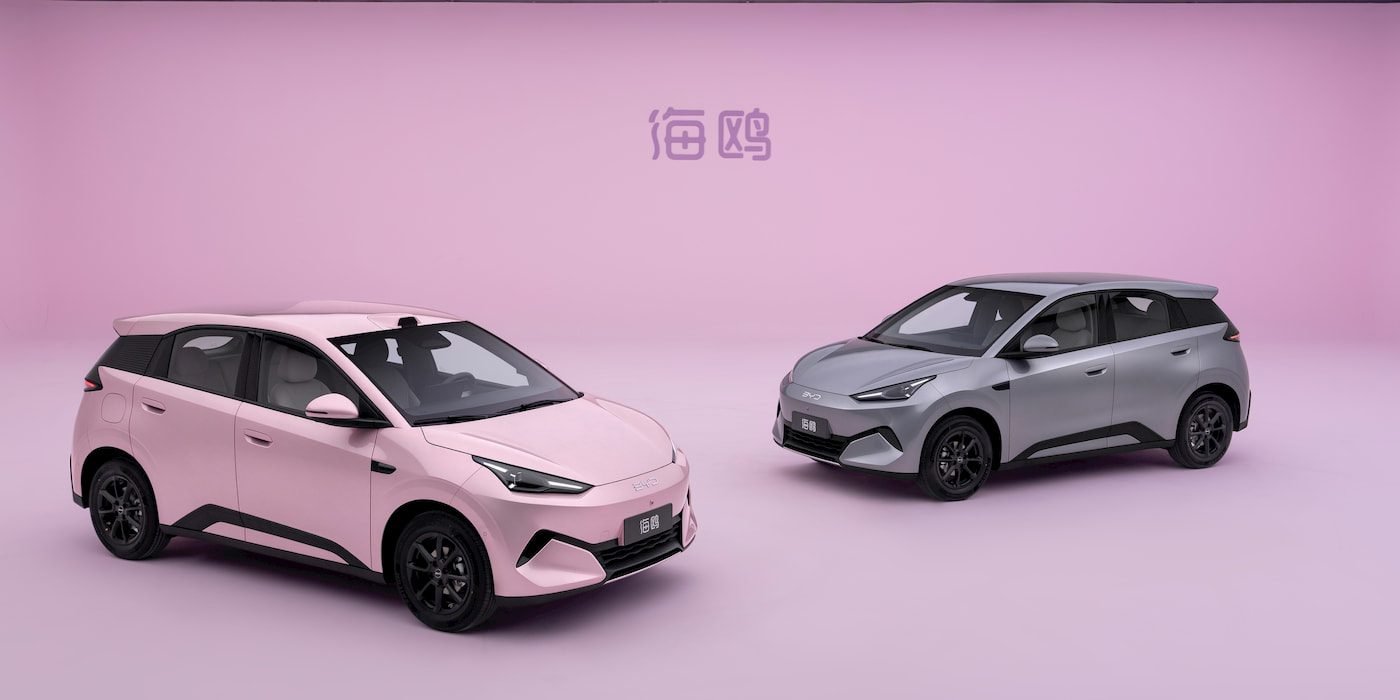
The charging numbers are strong, with a limit that matters. In the press demo, reporters watched the system push a megawatt into a test vehicle, taking its pack from 10% to 70% in five minutes and 17 seconds, and to 97% in eight minutes and 57 seconds. BYD says the system adds roughly 249 miles, about 400 km, of range in around five minutes. Its Flash Dispensers can now peak at 1,500 kilowatts through a single charge point. But those five-minute fills only work on cars built with 1,000-volt architectures and second-generation Blade packs. Plug an older EV into a Flash Charger and it will charge at that car’s own pace, not the station’s. BYD’s second-generation Seagull, which charges in five minutes and costs under $10,000, is built on the same Flash Charging tech.
What our numbers show: the charge slows after 70%
EVThrottle calculation. The demo figures BYD shared tell a second story that none of the coverage spelled out: the charge slows down a lot after 70%.
Here is the math, straight from the demo numbers New Atlas reported. The first 60% of the charge, from 10% to 70%, took 5 minutes and 17 seconds, or 317 seconds. That is 60 divided by 5.28 minutes, or 11.36% of charge per minute. The last 27%, from 70% to 97%, took 3 minutes and 40 seconds, or 220 seconds. That is 27 divided by 3.67 minutes, or 7.36% per minute.
So the charging rate falls by about 35% once the battery passes 70%: 11.36 minus 7.36, divided by 11.36, is 0.352. The five-minute claim covers the fast part of the curve. The last stretch to nearly full takes almost four more minutes for less than half as much charge. That is normal for lithium batteries, which taper as they fill, but it is worth knowing before you plan a stop around the five-minute number. The same demo figures give a second useful number: about 249 miles in around five minutes works out to roughly 50 miles of range per minute of charging, while the pack is in its fast zone.
Why the charging hub matters more than the speed record
The record is a headline. The charging hub is the product idea underneath it, and it is the more important of the two.
A 312.65 mph car is a halo: BYD will build 30 U9 Xtremes, and almost nobody reading this will ever drive one. A charging station that makes its own power, stores it, and plugs the car in by itself is a different kind of news. It attacks the two problems that slow EV adoption down: charging takes too long, and the grid cannot always deliver megawatt power where drivers need it.
BYD’s answer to both is to stop treating the charger as an extension cord plugged into the utility. The station makes power from the sun, banks it in batteries, and spends it in short, hard bursts. In theory, that lets a fast charger sit anywhere with sun and space, even where the local grid is weak. It also removes the last manual step. Valet parking already moves the car; the arm finishes the job by connecting it.
The catch is that none of this is a product yet. BYD admitted in Abu Dhabi that the robotic arm remains a prototype with no commercial launch date. Outdoor robotics face heavy maintenance questions. New Atlas flags the same worry: complex robots exposed to blowing desert sand, or Midwestern sleet and road salt, would need a lot of upkeep, and charging networks already struggle to keep basic card readers online. A demo in the desert proves the idea works once. It does not prove it works every day, in every climate, for years.
What this means for US drivers
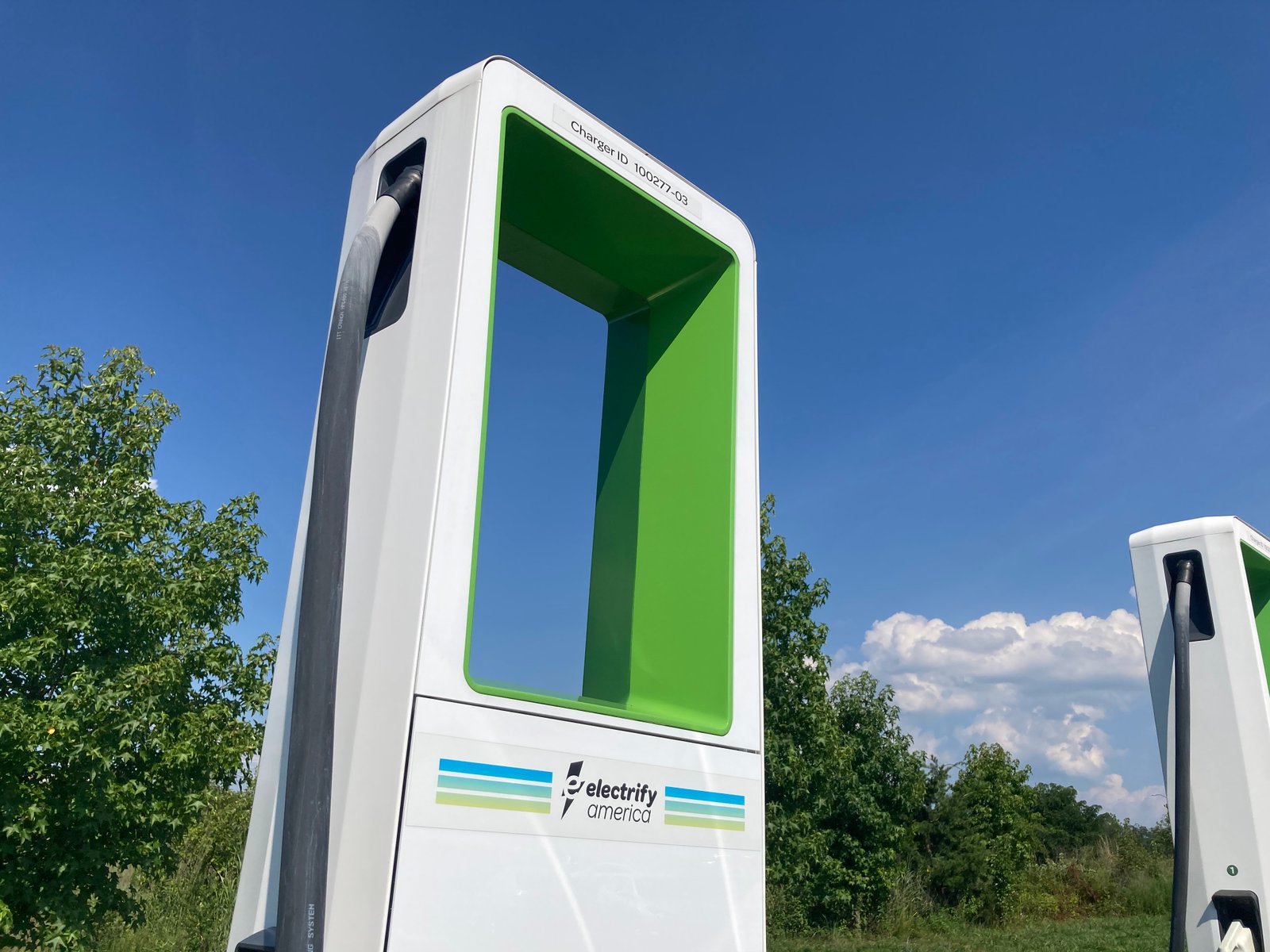
For now, not much directly, and BYD is not pretending otherwise. Steep tariffs keep BYD passenger cars out of American showrooms, so no US driver will pull into a BYD robot station on their way home. US drivers rely on Tesla’s 500-kilowatt Superchargers or 350-kilowatt CCS stalls from Electrify America and Ionna, and those are the fastest public options in the country today. BYD’s 1,500-kilowatt peak is three times Tesla’s top figure and more than four times the fastest CCS stalls.
That gap is the part worth watching. BYD plans 6,000 Flash Charging stations globally by the end of next year, including 3,000 across Europe, and it has named no US plans at all. But charging tech travels. The five-minute fill, the solar-plus-storage station, and the robot plug all set a bar that US networks and automakers now have to answer. America’s public charging network is growing fast, and it just passed 262,000 public chargers, but speed and reliability are still the weak spots. If you want to know where the US network stands, our charging station guide covers what to expect at a public charger today.
Why Abu Dhabi, then? Because it is the one place where both halves of BYD’s week worked at once. The desert gave the solar station its best case, with sun all day and open land. The E11 gave the record car a long, straight, closed public road. And the UAE gave BYD a stage: the Burj Khalifa show, the parade, and the branding award all happened in the space of two weeks, in front of thousands of guests. It was a launch week, not a single event.
What we still don’t know
Three questions from this week have no answer yet, and each one decides how much of the demo becomes real.
First, is the Abu Dhabi station actually off-grid? BYD says the system can support operation independent of the grid, but it left the key detail out of its press material for this installation. New Atlas asked the company for confirmation and was still waiting. Until BYD answers, the off-grid claim is a design feature, not a proven fact about this site.
Second, when can anyone use the robot? BYD has given no commercial launch date, no price for the equipment, and no list of which stations will get an arm. The 6,000-station target covers Flash Charging stations in general, not robot-equipped ones.
Third, does the arm hold up outside a demo? A station that works for reporters on a press day is not the same as one that works in sandstorms, salt, and sleet for years. BYD has not shared reliability data, and the arm has no track record in daily service yet. Those answers will come from the next installations, not this one.
Timeline: BYD’s week in the UAE
| Date | What happened |
|---|---|
| September 2025 | U9 Xtreme sets 496.22 km/h at ATP Papenburg, Germany |
| November 1, 2026 | U9 Xtreme hits 503.17 km/h on the E11, Al Dhafra, Abu Dhabi |
| November 3, 2026 | BYD named Brand of the Year in Automobiles at the World Branding Awards, London |
| November 7, 2026 | 110-vehicle parade from West Park to Emirates Palace, Abu Dhabi |
| November 13, 2026 | New Atlas reports the Abu Dhabi solar-storage Flash charging hub and robotic arm |
| End of next year | BYD’s target: 6,000 Flash Charging stations worldwide, 3,000 of them in Europe |
BYD’s record week, in order. Sources: Tarmac Life, New Atlas.
What happens next
Watch three things. First, whether BYD confirms the Abu Dhabi station runs fully off-grid, and whether it says so on the record. Second, whether the robotic arm shows up at a second station, ideally one open to the public, which would turn a demo into a product. Third, where the 6,000 Flash Charging stations actually land: 3,000 are slated for Europe, and the rest of the map is still blank.
The record is settled. The charging hub is not. The arm works, the demo numbers are real, and the idea is sound. What is missing is a date, a price, and proof that it survives daily use. Until those arrive, the robot that plugs in your EV is a glimpse of where charging is headed, not a charger you can drive to.
More from BYD is on our BYD News page, and the rest of today’s car news is on the EVThrottle homepage.
BYD robotic charging arm questions, answered
How does BYD’s robotic charging arm work?
The car parks itself in a bay using Automated Valet Parking. A multi-axis robotic arm then finds the charging flap with optical cameras and feedback sensors, opens it, and seats a liquid-cooled connector. When charging ends, the arm disconnects and stows the cable.
Is the 312 mph record official?
Yes, with an asterisk. Guinness World Records certified two single-direction records, and the FIA recognized the speed. The record is for a single-direction run, not a two-way average.
When will BYD’s robot charger be available?
BYD has not said. The company admitted in Abu Dhabi that the arm is a prototype with no commercial launch date.
Will the BYD robot charger come to the US?
BYD has announced no US plans for it. Its rollout target names Europe, and steep tariffs keep BYD passenger cars out of American showrooms.