Here is what we know for sure, and it fits in one sentence: Tesla has agreed to become a foundry customer for Intel's upcoming 14A manufacturing process, and neither Intel nor Tesla has said what chip Intel will actually build. That is the whole announcement. Everything after that sentence — the guesses, the timelines, the dollar figures from other deals — is context, and this article keeps the two apart on purpose, because the internet has already started treating guesses as announcements.
The news broke alongside a broader Intel update, with Intel also sharing progress on output from its 18A node and announcing a $20 billion equity raise to fund new factories for its foundry expansion, according to Not a Tesla App. For Intel, Tesla is a big get: a high-profile outside client willing to bet on its leading-edge roadmap at a moment when Intel needs exactly that kind of proof to compete with TSMC and Samsung on cutting-edge chips. For Tesla, it is one more supplier in a chip strategy that is already spread across Samsung, TSMC, and now Intel — plus its own giant fab project in Texas. The mystery chip sits at the center of all of it, and the most useful question is not just "what is it?" but "when could it possibly be ready, and what does that rule out?"
Intel and Tesla: the quick answers
| Question | What is confirmed |
|---|---|
| What did Intel and Tesla announce? | Tesla will become an Intel foundry customer for the 14A process. Intel joined the TeraFab project in April 2026. |
| What chip will Intel build? | Not named by either company. No dollar figures and no timelines have been shared for this specific chip. |
| When did Musk commit to 14A? | On Tesla's Q1 2026 earnings call, Musk said Tesla plans to use Intel's 14A process, calling it "state-of-the-art and in fact not yet totally complete." |
| Where will Intel make it? | The 14A deal appears separate from TeraFab's own production, with Intel making chips in its own fabs. |
| When is 14A ready? | Intel markets 14A as a rival to TSMC's 1.4nm-class A14, landing around 2028. Risk production is targeted for the second half of 2027, with volume production in 2028. |
| Leading suspect | AI6, based on timing — but Samsung already holds a $16.5 billion AI6 contract through the end of 2033. |
| Almost certainly not | AI4+ / AI4.5, the upgrade computer for HW3 owners, which is needed well before 14A is ready. |
| Long shot | A custom infotainment chip (a possible MCU4), since Tesla has historically bought off-the-shelf processors for its Media Control Unit. |
What Intel and Tesla actually announced — and what they did not
The core facts come from two places that agree with each other. Data Center Dynamics reports Musk's words from Tesla's Q1 2026 earnings call: "We plan to use Intel's 14A process, which is state-of-the-art and in fact not yet totally complete. By the time TeraFab scales up, 14A will be probably fairly mature or ready for prime time. 14A seems like the right move, and we have a great relationship with Intel, a lot of respect for the CEO, the CTO, and the new team there." That quote matters for two reasons. First, Musk is not claiming 14A is ready today — he is saying it will be ready by the time TeraFab scales up. Second, he frames the choice as a relationship bet as much as a technical one, which is worth remembering when the timeline slips, as chip timelines usually do.
Intel's own entry into the project came two weeks before that call, in April 2026, when the company posted on X that it had joined TeraFab, writing that its ability to design, fabricate, and package ultra-high-performance chips at scale would help speed up TeraFab's aim to produce 1 TW of compute a year to power future advances in AI and robotics, according to Data Center Dynamics. Manufacturing Digital adds the same April 2026 date for Intel joining the venture, alongside Tesla, SpaceX, and xAI, "to help refactor silicon fab technology."
What neither side has done is just as telling. Neither Intel nor Tesla has named the chip, shared dollar figures, or given a timeline for this Intel-made chip, as Not a Tesla App notes. If you see a post claiming Intel will build a specific Tesla chip for a specific price on a specific date, that post is guessing. The honest version of this story is a process commitment with a blank where the product name should be, and the rest of this article is an attempt to fill that blank with the best-supported guesses — labeled as guesses.
Why AI6 is the leading suspect — and why Samsung makes it complicated
Start with timing, because timing is the strongest clue in this whole story. Intel markets 14A as a rival to TSMC's 1.4nm-class A14 process, landing around 2028. Tesla's AI5 is built on Samsung's 2nm and TSMC's 3nm nodes. Whatever Intel builds on 14A will likely be more advanced than AI5, simply because 14A is a later, smaller-class process. That points forward, not backward — to the chip after AI5, which is AI6. Not a Tesla App calls AI6 "a strong suspect" on exactly this logic, and adds that it could also be a chip Tesla has not announced yet. Both of those readings are still on the table.
Then comes the complication, and it is a big one. Samsung already holds the AI6 contract. Musk announced on X in July 2025 that Samsung will produce Tesla's AI6 chip under a deal worth $16.5 billion — about 7.6 percent of Samsung's 2024 sales, and the chip division's largest single-client contract — according to The Investor. Production of AI6 chips is planned for 2027-2028 and will run through the end of 2033. Not a Tesla App cites the same deal at $16 billion. The small difference in the reported figure ($16 billion versus $16.5 billion) is a rounding and reporting difference, not a second deal — the contract itself is the same one.
So if Intel is also building AI6, it cannot be a straight replacement for Samsung. The only readings that fit both facts are a second source or a different variant. Tesla already runs a dual-foundry strategy on AI5, with Samsung and TSMC both making the same chip, precisely so it is not stuck if one fab has a problem. Doing the same thing on AI6 — Samsung as the main source, Intel as a second source on a newer process — would fit Tesla's stated goal of oversupply, and it would fit Intel's need for a marquee customer. What it would not fit is a clean story where Intel "wins" AI6 away from Samsung. If you read that version anywhere, it is wrong, because Samsung's contract runs through 2033 and its production window overlaps the 14A window.
There is one more wrinkle worth naming. One source in the reporting around this story says TSMC will manufacture AI6.5, a follow-on chip. That claim is attributed, not confirmed, and this article does not present it as fact. But it shows the shape of Tesla's roadmap: AI5 now, AI6 next, and a follow-on after that, with room for more than one foundry at each step. An Intel chip that is not AI6 could be that follow-on, or a chip Tesla has not announced yet at all. The TeraFab site itself lists AI5 and AI6 for Tesla vehicles and Optimus robots, and D3 for SpaceX's space-computing plans, according to EverydayNext — which means the announced roadmap does not have a spare, unnamed Tesla chip sitting in it. If Intel's chip is not AI6, it is either a variant of AI6 or something new that has not been put on that list yet.
The other candidates, ranked from most to least likely
It helps to lay out every candidate in one place, with the case for and against each, instead of letting one theory dominate the conversation.
| Candidate | Case for it | Case against it | Verdict |
|---|---|---|---|
| AI6 (second source / variant) | Timing fits 14A around 2028; AI6 is the next chip after AI5 | Samsung already holds a $16.5B AI6 contract through 2033 | Leading suspect, as a second source — not a replacement |
| Extra AI5 capacity | Tesla wants an oversupply of AI5; a backup supplier makes sense | AI5 is on Samsung 2nm / TSMC 3nm; 14A is a later process, so it would be an odd fit for the same chip | Plausible as capacity insurance, weaker on process fit |
| Unannounced chip / AI6 follow-on | Neither side named the chip; roadmaps always have a next step | No public evidence for a specific new chip yet | Possible, but currently just a placeholder |
| D3 (SpaceX space chip) | D3 is on the TeraFab list, and Intel joined TeraFab | D3 is a SpaceX chip, and the Intel deal is described as a Tesla foundry deal | Unlikely for this announcement |
| Custom infotainment chip (MCU4) | Tesla's MCU2 once used an Intel Atom processor | Tesla buys off-the-shelf processors for the Media Control Unit; MCU1 was Nvidia Tegra, MCU3 is AMD Ryzen | Long shot |
| AI4+ / AI4.5 upgrade computer | HW3 owners are waiting for an upgrade path to unsupervised autonomy | Those owners need it well before 14A is ready around 2028 | Almost certainly not |
The extra-AI5-capacity theory deserves a little more time, because it sounds sensible until you check the process nodes. Tesla does want a lot of AI5 chips — Musk's stated goal is an oversupply, with surplus chips going into cars, robots, and Tesla's data centers, according to The Investor. A backup supplier would help. But AI5 is already being made on Samsung's 2nm process in Texas and TSMC's 3nm process, and moving that same chip design to Intel's 1.4nm-class 14A would be a redesign, not a simple copy. Foundries do not swap like that. So if Intel is building AI5 capacity, it would more likely be a 14A version of an AI5-class chip than the same AI5 silicon — and at that point, you are basically describing a next-generation chip again.
What AI5 looks like right now, so the next chip makes sense
To judge AI6, you need to know where AI5 stands. The picture is unusually clear for a Tesla chip, because Musk has talked about it on earnings calls. AI5 had previously been expected to be produced solely by TSMC, but on Tesla's third-quarter earnings call, Musk revealed it will be manufactured by Samsung in Texas and TSMC in Arizona, according to The Investor. Samsung has recently started trial production of AI5 at its Texas fab, with mass production expected in 2027, while volume production is set for 2026 in the broader reporting, according to Not a Tesla App — the difference there is trial versus mass production, and both can be true at once. The Investor also reports AI5 is set for mass production in 2026. The safest way to read it: AI5 is in the production ramp now, with full mass production expected in 2027.
One AI5 chip offers five times the compute of two current-generation AI4 chips combined, according to Not a Tesla App. Tesla plans to put AI5 in Optimus robots and AI training clusters before it eventually reaches vehicles. That order matters: it tells you Tesla's bottleneck is no longer just cars. Robots and training clusters eat chips at a rate that makes car volumes look small, which is exactly why Musk keeps talking about oversupply. If AI5 demand is that large, the case for a second or third foundry on the next chip writes itself.
AI5 also sets the bar for what "more advanced" means. AI5 is on 2nm (Samsung) and 3nm (TSMC). Intel 14A is a 1.4nm-class process. In the chip world, those node names no longer describe one physical measurement, but they do describe generations: 14A is a step past the nodes AI5 uses. That is why the Intel chip, whatever it is, will likely be more advanced than AI5 — and why AI6, as the next named chip in line, keeps coming back as the answer.
Inside TeraFab: the giant fab this deal sits next to
It is easy to mix up two different things that share a name, so here is the split. TeraFab is Tesla, SpaceX, and xAI's own chip factory project. The Intel 14A deal is a foundry deal with Intel making chips in Intel's own fabs. They are related — Intel joined TeraFab in April 2026, and Musk says TeraFab plans to use the 14A process once it matures — but they are not the same production line. Confusing them is how you end up thinking Intel is building TeraFab, or that TeraFab is already making 14A chips. Neither is true yet.
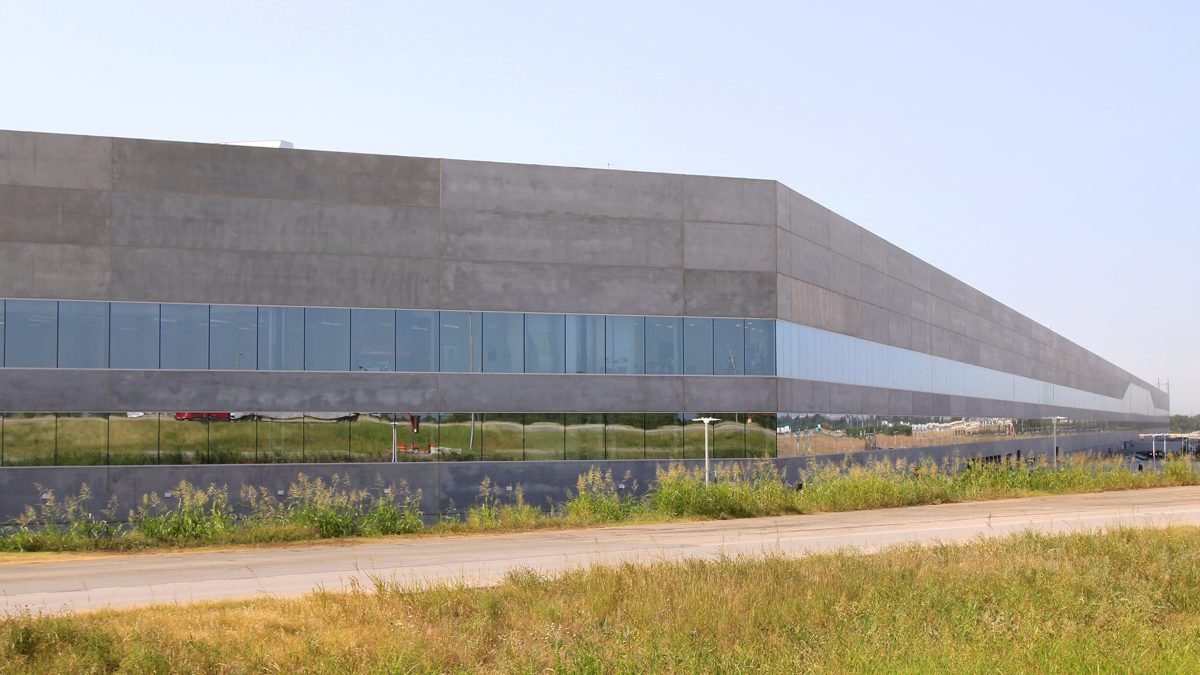
TeraFab itself was launched on March 21, 2026, in Austin, as a joint project of Tesla, SpaceX, and xAI, according to Musk Industries. The first phase is budgeted at about $16.8 billion, and the goal is more than 1 terawatt of compute a year — a figure Musk has compared with roughly 20 gigawatts a year of current global AI chip output, or about 2 percent of what his companies expect to need. His line at launch was blunt: "We either build the Terafab or we don't have the chips."
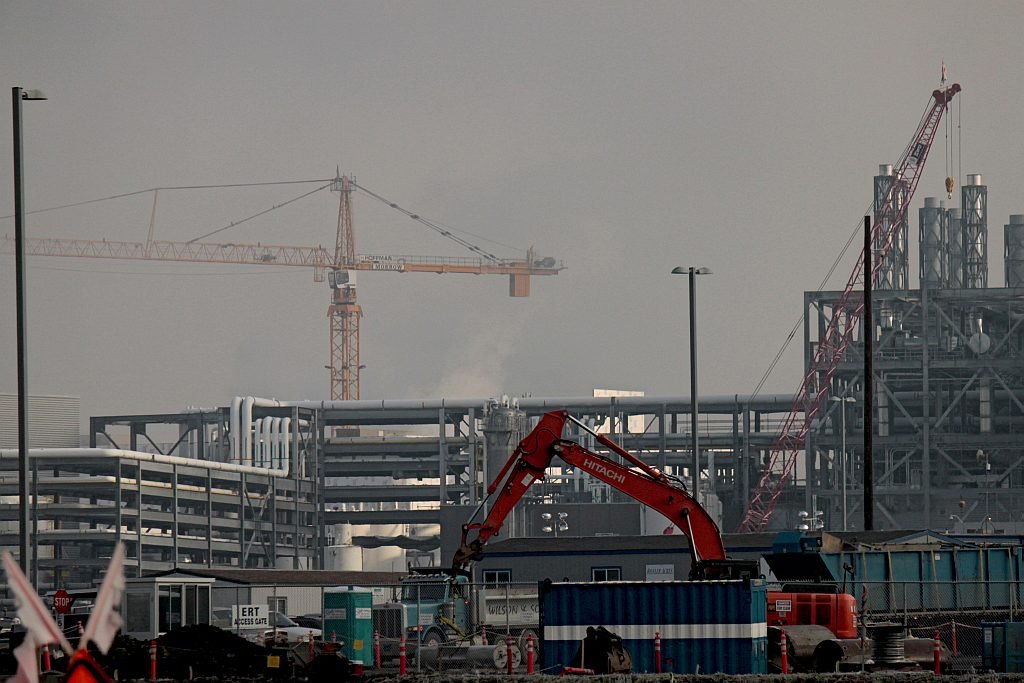
The project has two parts, and the split of labor is public. In the near term, Tesla will build a $3 billion research fab on the Gigafactory Texas campus in Austin, aimed at a few thousand wafers a month, to test ideas and prove out processes, according to Data Center Dynamics. Tesla broke ground on that research fab in April 2026, and its Q2 2026 update said construction and equipment buying were under way but still in the early stages, according to Musk Industries. Long term, SpaceX will take responsibility for high-volume manufacturing. On August 6, 2026, SpaceX named Grimes County, Texas — about an hour northwest of Houston — as the big site, with a plan for more than 100 million square feet of factory, about ten times Gigafactory Texas, and at least 3,000 jobs, according to Musk Industries.
The timeline Musk has put on that big fab is, by his own word, aggressive. Manufacturing Digital reports SRAM test chips are intended for around May or June 2027, with volume production targeted for the third quarter of 2028, and Musk himself called those "insanely fast times for chip production." The same report notes a real constraint: advanced chip production needs extreme ultraviolet lithography machines, ASML is the only supplier of that technology, and Reuters reported in October 2026 that ASML had forecast short supplies of its chipmaking equipment for 2027 and 2028 — right across TeraFab's proposed timeline. Equipment, not ambition, may set the pace here.
Musk has also set a design goal that explains why he wants his own fab at all. One significant chip design usually takes about two years from start to volume production, he said in October 2026, and the aim is closer to 10 designs a year, knowing a bunch of them will not work out, according to Musk Industries. That goal is also the source of a separate report that Musk wants Tesla and SpaceX to test 10 chip designs a year at TeraFab, as covered by Asianet Newsable. And on the question of who runs the place, Musk drew a hard line on October 7, 2026, in an X post quoted by Musk Industries: "No, we will build and run the fab. Let there be ZERO doubt about that. Maybe TSMC subleases part of the Terafab if they want, but nothing more than that." So TSMC, at most, rents space. Tesla and SpaceX run the fab. No TSMC agreement has been announced.
Intel 14A, explained without the hype
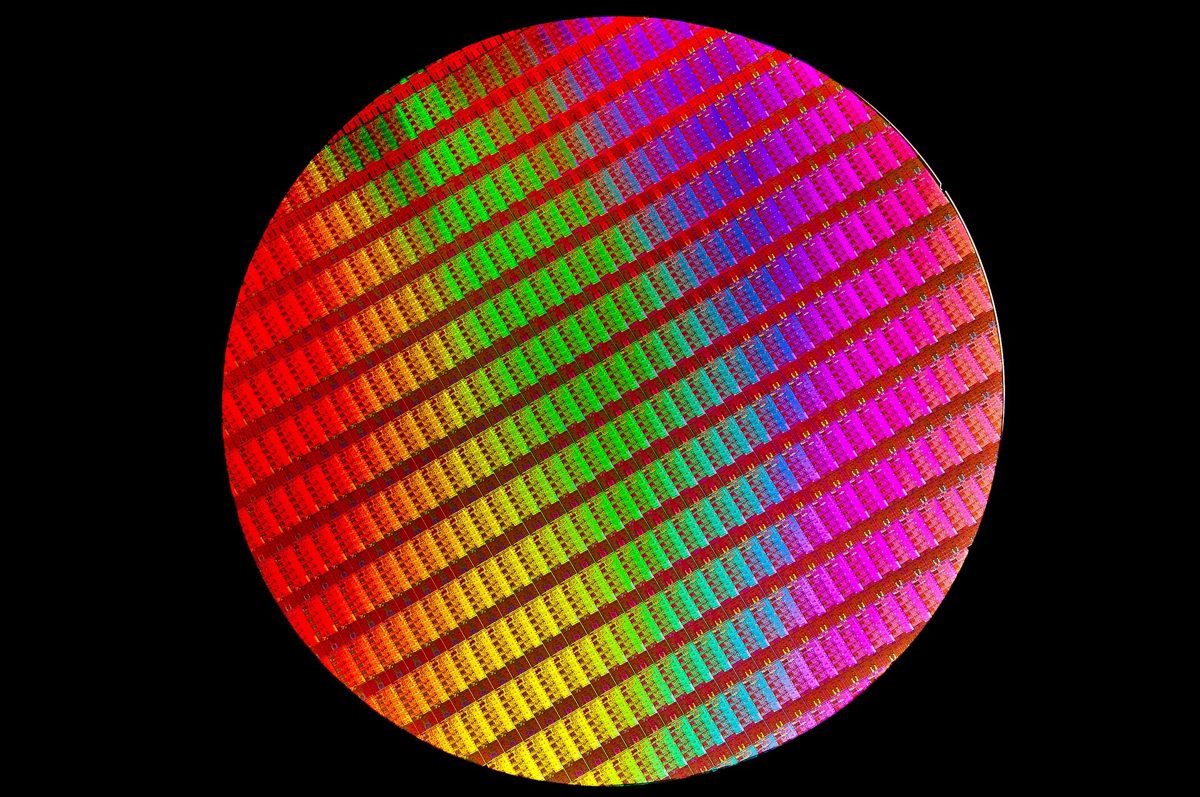
Intel 14A is the company's process generation positioned at roughly the 14-angstrom class — about 1.4 nanometers in the old naming convention, though modern node names describe a technology generation rather than a literal transistor measurement, according to Tech Insider. It sits one full generation beyond Intel's current leading process, 18A, which entered high-volume manufacturing in late 2025 across fabs in Oregon and Arizona. Panther Lake laptop chips and Clearwater Forest server chips are built on 18A, not 14A — a mix-up that shows up a lot in social posts, and one worth correcting every time, because 18A shipping today is the best evidence customers have for judging whether Intel can be trusted with 14A.
The 14A timeline, as reported by Tech Insider, puts risk production for internal products in the second half of 2027, with high-volume manufacturing targeted for 2028, and a September 2026 report sharpening that to risk production in the second quarter of 2027 and volume production in the first quarter of 2028. Intel has already released 14A process design kit 0.5 to early partners, and is on track to ship PDK 0.9 to external customers in October 2026 — the point where a design team finally has enough detail to commit a specific chip to the node rather than just run test structures. Intel also reported a 14A defect density of 0.5 defects per square centimeter as of June 2026, with an internal target of 0.1 to 0.2 by the first quarter of 2027. If either the PDK cadence or that defect curve slips, the 2028 volume target slips with it.
On performance, Intel's own targets for 14A, relative to 18A, are 15 to 20 percent higher performance at the same power draw, or 25 to 35 percent lower power use at matched frequency and transistor count, plus up to 30 percent higher chip density, according to Tech Insider. Those are Intel's internal projections, not third-party lab results, and they should be read as targets until independent silicon ships. Against TSMC, Intel Foundry chief Naga Chandrasekaran said 14A is expected to land within 5 percent of TSMC's A14 process on performance, according to Tech Insider. Note what that claim is not: Intel is not publicly claiming to beat TSMC on 14A. It is claiming to be competitive with it, which is itself a shift from years when Intel trailed TSMC by a full node generation.
That competitive claim sits next to a hard financial reality. Intel CEO Lip-Bu Tan said after Q2 2025 earnings that Intel would only move forward with 14A if it found a meaningful external customer to drive acceptable returns on its deployed capital, according to Data Center Dynamics. "I do not subscribe to the belief that if you build it, they will come," Tan said. Tesla is now, in effect, the customer Tan was waiting for. How much that is worth in dollars is still unknown: Intel's external-foundry business brought in just $293 million in revenue in the second quarter of 2026, according to Tech Insider, against billions already sunk into fabs. A Tesla commitment helps the story, but it does not by itself fill a fab.
One more distinction from Tech Insider is worth carrying into any conversation about this deal: evaluating is not buying. A September 2026 report based on a Piper Sandler note said Amazon, Apple, AMD, Google, Tesla, Microsoft, Nvidia, and Qualcomm are all reportedly evaluating 14A. Evaluating typically means a company has early technical documentation, possibly a process design kit, and may be running test structures. It does not mean a production design has been committed, a manufacturing agreement signed, or capacity reserved. Tesla, at that point, was the only publicly confirmed external 14A customer, tied to TeraFab. Everyone else on that list remains in the "reportedly evaluating" category. Intel's Tesla deal is real in a way the rest of that list is not yet.
What this means if you drive a Tesla, or are thinking about buying one
Short term, nothing changes. No car you can buy today, and no car Tesla will ship in the next year or two, will have an Intel 14A chip in it, because 14A volume production is targeted for 2028 and the chip itself has not even been named. If you are an HW3 owner waiting for the AI4+ upgrade computer, this announcement is not your answer — that upgrade is needed well before 14A is ready, which is why it is almost certainly a different chip on a different timeline. If you are shopping for a Model Y or Cybercab today, the chip story that matters is AI5's ramp, not Intel's 14A.
Medium term, the story is supply, not speed. Tesla's whole chip strategy right now is about never being short of compute again — dual foundries on AI5, a Samsung AI6 contract through 2033, an Intel 14A commitment on top, and its own TeraFab aiming for 1 TW a year. That is a company that has decided chip shortages, not chip performance, are the risk to its robot and robotaxi plans. For buyers, that shows up as steadier production and, in theory, steadier prices — not as a faster car next year. For investors and watchers, the milestones to track are concrete: 14A PDK 0.9 landing in October 2026, defect density falling toward 0.1 to 0.2 by early 2027, SRAM test chips around May or June 2027, and volume production in the third quarter of 2028. Misses on those dates will tell you more than any new rumor about the chip's name.
There is also a US manufacturing angle that is easy to overstate and easy to miss at the same time. Intel is one of the only US-headquartered companies able to design and fabricate leading-edge logic chips at home, and its fabs in Oregon and Arizona are already running 18A at volume. A Tesla chip made on Intel 14A in the US, alongside Samsung's Texas production of AI5 and AI6 and TSMC's Arizona production of AI5, would make Tesla's AI compute about as American-made as advanced chips get in 2026. That does not make the chip faster, and it does not make it cheaper on its own — but in a year when supply chains and tariffs dominate car pricing, it is not a footnote either.
Quick answers
What chip will Intel make for Tesla? Neither company has named it. AI6 is the leading suspect based on timing, as a second source alongside Samsung — not a replacement for Samsung's $16.5 billion AI6 contract, which runs through 2033.
When will the Intel chip be ready? Intel targets volume production of 14A in 2028, with risk production in the second half of 2027. No timeline has been given for the specific Tesla chip on 14A.
Is Intel building TeraFab? No. Intel joined the TeraFab project in April 2026, and TeraFab plans to use the 14A process once it matures, but the 14A foundry deal appears separate, with Intel making chips in its own fabs. Tesla and SpaceX plan to build and run TeraFab themselves.
What is AI5, and who makes it? AI5 is Tesla's current-generation AI chip, with one chip offering five times the compute of two AI4 chips combined. It is made by Samsung in Texas and TSMC in Arizona, with mass production expected in 2027. It goes to Optimus robots and training clusters before vehicles.
Is this chip the HW3 upgrade? Almost certainly not. HW3 owners need the AI4+ upgrade well before 14A is ready around 2028.
Could it be an infotainment chip? That is a long shot. Tesla has used off-the-shelf processors for its Media Control Unit — Nvidia Tegra for MCU1, Intel Atom for MCU2, and AMD Ryzen for MCU3 — and a custom Intel MCU4 is possible but unlikely as the answer here.
Are Apple, Nvidia, and the others also buying 14A? Not that anyone has confirmed. They are reportedly evaluating 14A, which is not the same as a production commitment. Tesla is the only publicly confirmed external 14A customer in the reporting so far.
The bottom line
EVThrottle take: AI6 as a second source is the bet that fits the facts — everything else is a stretch. The timing fits, the process generation fits, and Tesla's dual-foundry habit fits. What does not fit is any version where Intel takes AI6 away from Samsung, or where this chip is the HW3 upgrade, or where a named chip, price, and date are already settled. None of those are supported by what Intel or Tesla has actually said.
That leaves a story that is less exciting than a product launch and more important than a rumor: the world's most chip-hungry car company is now spread across Samsung, TSMC, Intel, and its own fab, all at once, because it has decided that running out of compute is a bigger risk than paying for too much of it. If 14A hits its 2028 volume target and the defect curve keeps falling, Tesla will have a third leading-edge supplier in the US. If it slips, Tesla still has Samsung and TSMC. Either way, the mystery chip is less about one product and more about a supply chain that is being built to never say no to a robot, a robotaxi, or a training cluster. Watch the PDK dates and the test chips, not the headlines — the name will come when the silicon is real.