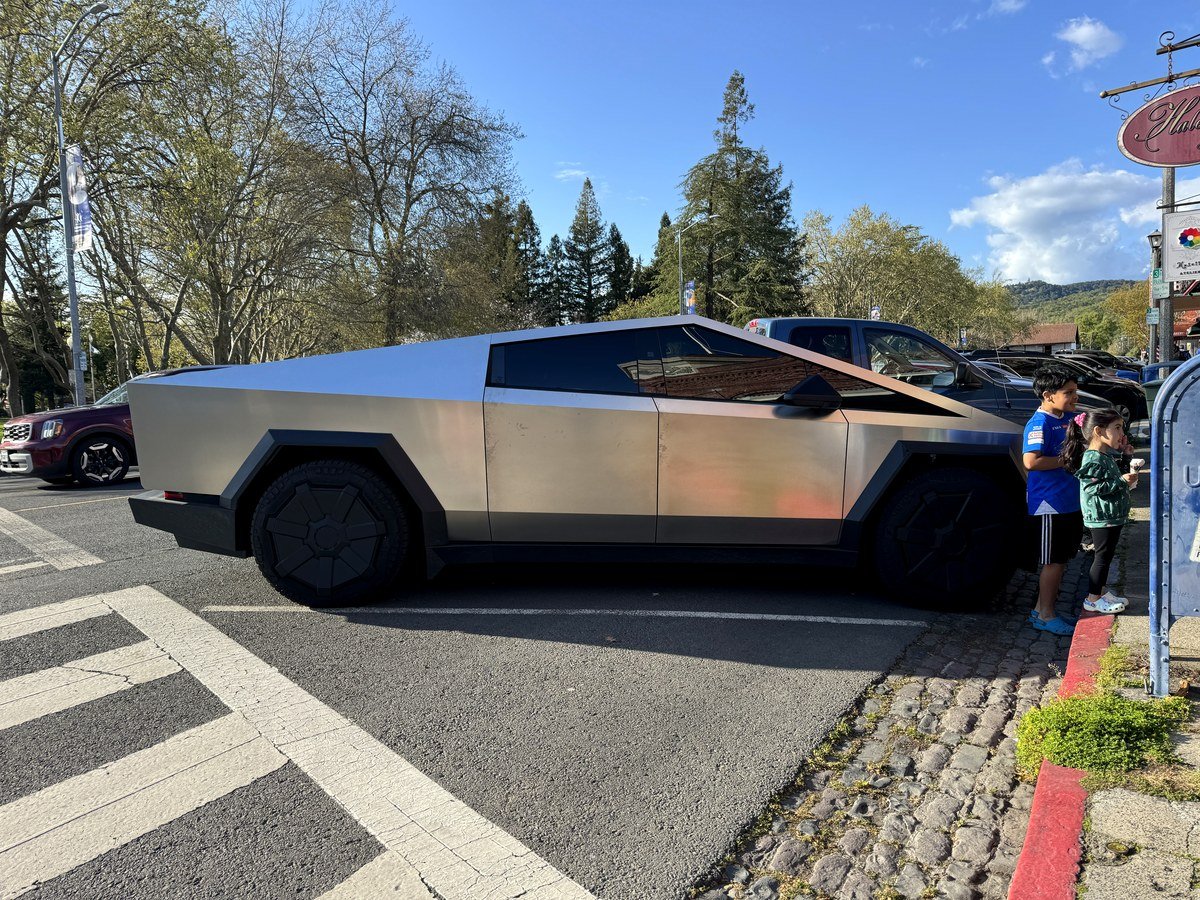
Tesla is pushing software update 2026.38.5.13 to thousands more cars today, and the headline feature inside it is Automatic Collision Evasion — a system that can take over your car and steer it out of a crash while you are still driving manually. The rollout is accelerating: tracker Teslascope logged a third wave on November 15, with about 17,380 additional vehicles receiving the update in five minutes. The first cars got it on November 13, when the build was spotted on a Cybertruck all-wheel drive in Florida.
Here is the part most coverage skips: Automatic Collision Evasion is not a brand-new feature. Tesla added it to the owner's manual and shipped it in update 2026.27.6 in September 2026, with FSD v14.3.9. What is new is the scale. The Tesla 2026.38.5.13 update is the build carrying the feature to the wider fleet. The 2026.38.5 branch has been widening the rollout since October, and 2026.38.5.13 is the build taking it to the bulk of eligible cars. This article explains what the feature does, which cars get it, and why it matters — three days after an independent AAA test showed why braking alone is not enough.
If you own a Tesla with HW4 hardware and an active Full Self-Driving subscription, the update should reach you in the current wave. If you drive an HW3 car, you get a different build — FSD v14.3 Lite — and no Collision Evasion. The details are below.
What's in update 2026.38.5.13
| What's inside | What it does | Who gets it |
|---|---|---|
| Automatic Collision Evasion | Activates FSD (Supervised) to steer around a crash, or re-engage FSD if you stop paying attention | HW4 cars with an active FSD purchase or subscription |
| FSD (Supervised) v14.3.13 | Upgraded reinforcement-learning stage of FSD training, improving a wide range of driving scenarios | HW4 cars |
| FSD (Supervised) v14.3 Lite | A lighter FSD build for older hardware | HW3 cars (no Collision Evasion) |
What is Tesla Automatic Collision Evasion?
Tesla Automatic Collision Evasion is a safety feature that activates Full Self-Driving (Supervised) to try to keep your car safe — and then keeps driving. It works while you are driving manually, not while FSD is already running. When it engages, the car can steer and maneuver, not just brake. That is the whole point: in some situations, braking alone will not avoid the crash, so the car takes a different action.
Tesla's release notes describe it in one paragraph: “Automatic Collision Evasion activates Full Self-Driving (Supervised) to try to keep your vehicle safe and then continue driving.” The feature engages in two situations.
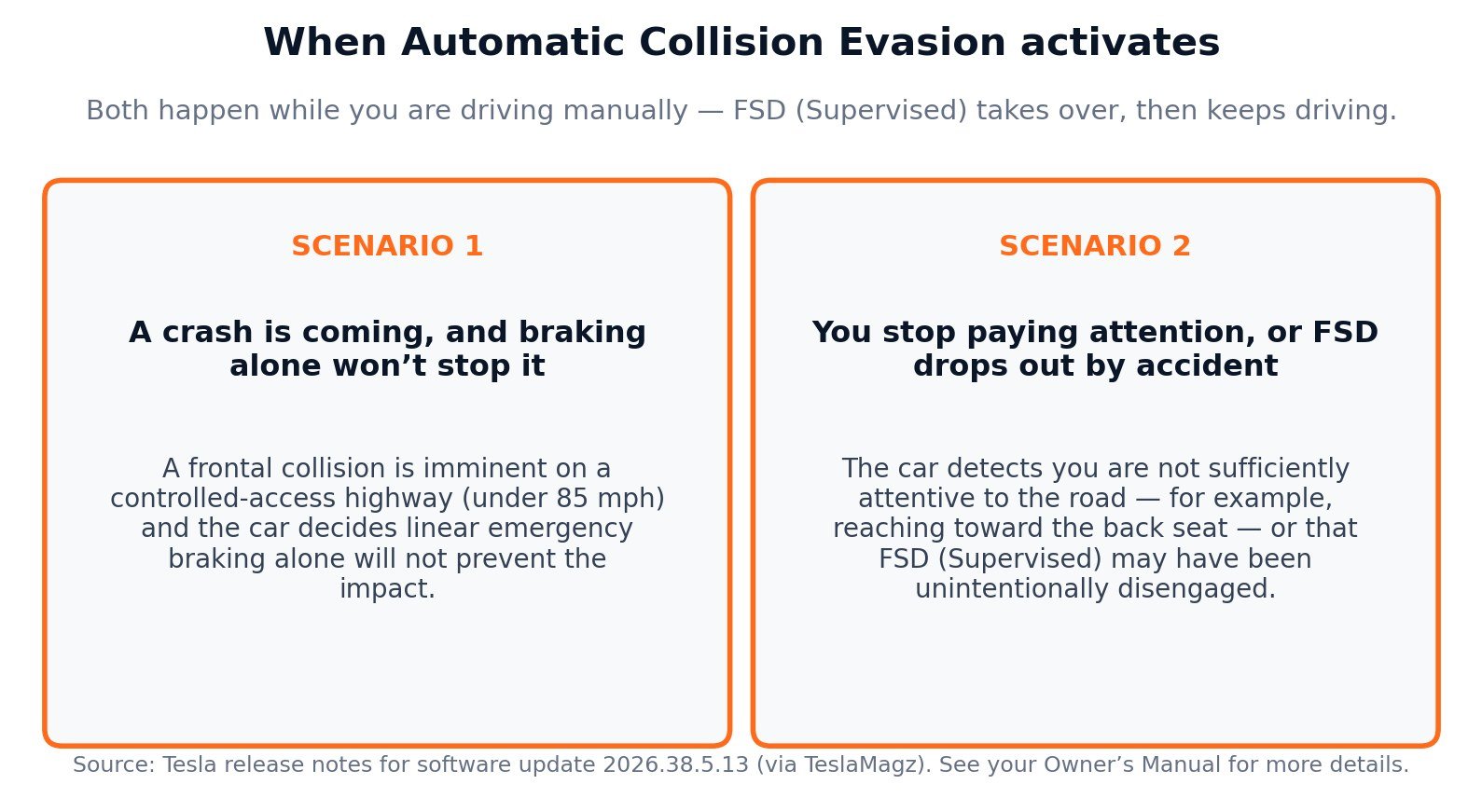
Scenario 1: a frontal collision is imminent and braking alone may not avoid it. This is the scenario the owner's manual spells out in detail: an imminent frontal collision on a controlled-access highway at speeds under 85 mph, where the car decides linear emergency braking alone will not prevent the impact. In that case, FSD (Supervised) engages and the car can steer around the hazard.
Scenario 2: you stop paying attention, or FSD drops out by accident. The car detects that you are not sufficiently attentive to the road — Tesla's notes give reaching toward the back seat as an example — and that FSD (Supervised) may have been unintentionally disengaged. The system re-engages FSD to keep the car safe. A Reddit video from September 2026 showed this in action: FSD re-engaged and took the wheel while the driver was in full manual control.
A few things it is not. It is not self-driving — FSD (Supervised) is still a Level 2 driver-assistance system, and the driver stays responsible. It is not a replacement for Automatic Emergency Braking, which still works alongside it. And it is not a guarantee: the release notes say the system “tries” to keep the vehicle safe. No independent test has yet measured how often it succeeds in the real world.
Which Teslas get Automatic Collision Evasion?
Automatic Collision Evasion HW4 is the rule: only cars with the HW4 (AI4) computer get the feature. It also needs an active Full Self-Driving purchase or subscription, with both Automatic Emergency Braking and FSD (Supervised) enabled. If any of those is missing, the feature does not activate.
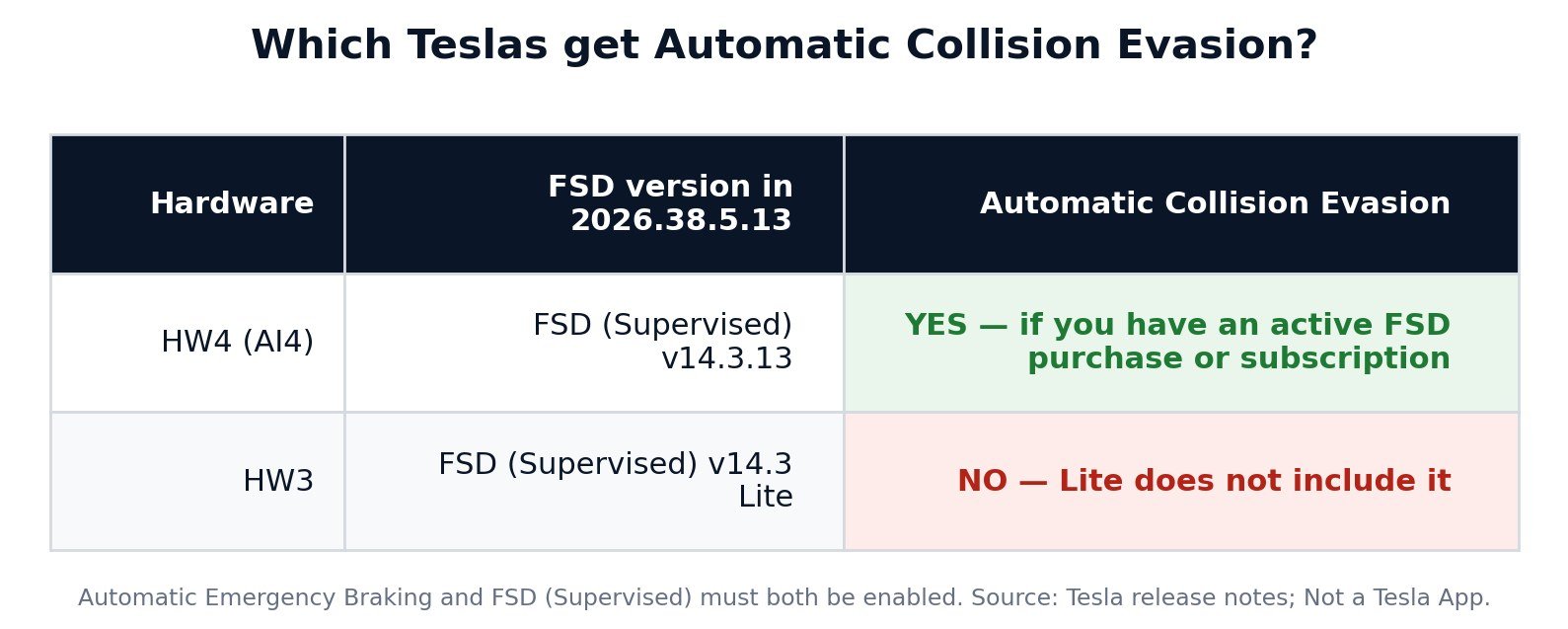
HW3 cars are not left without an update — they get the same 2026.38.5.13 build, but with FSD (Supervised) v14.3 Lite instead of the full v14.3.13. Lite is the cut-down FSD build for the older computer, and Tesla has not said HW3 will ever get Collision Evasion. If you are unsure which computer your car has, the short version is: cars built roughly from early 2023 onward have HW4, while older cars have HW3. Your car's software screen lists the hardware under the vehicle information.
The rollout itself is staged, as Tesla updates always are. The build first appeared on November 13 on a Cybertruck in Florida, then spread through a second wave, and a third wave on November 15 added about 17,380 vehicles in five minutes, according to tracker Teslascope. Owners have been posting release-notes screenshots and download progress in Tesla owner groups since November 14. If you have not received it yet, that is normal for a staged rollout — it does not mean your car is excluded.
How is Automatic Collision Evasion different from Automatic Emergency Braking?
If you are weighing Tesla collision evasion vs automatic emergency braking, the difference is simple: AEB brakes, Collision Evasion steers. Automatic Emergency Braking is the system most new cars have — it detects a collision ahead and brakes hard, or brakes for you, to avoid it or soften it. It only controls the brakes. Collision Evasion goes further: it activates the full FSD (Supervised) system, which can steer the car around the hazard and then keep driving.
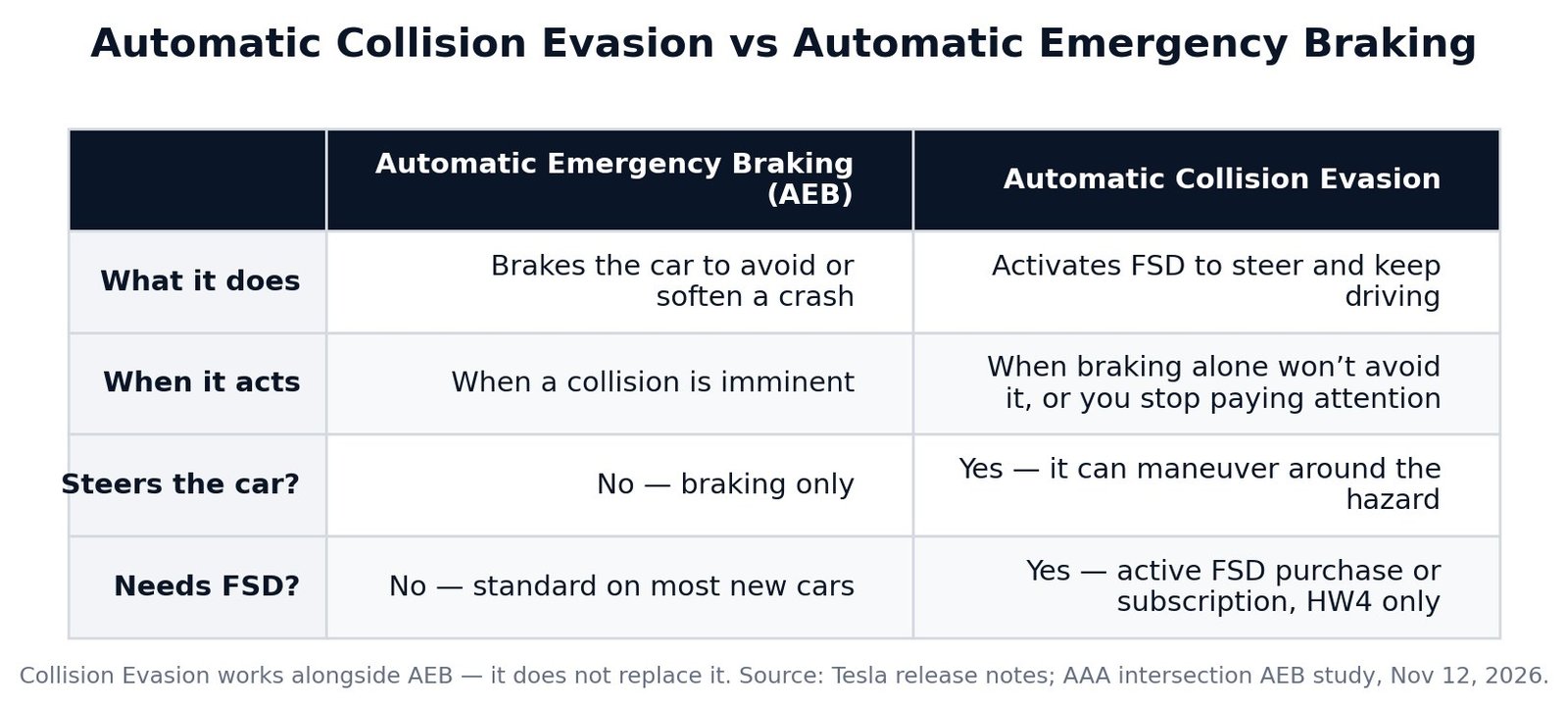
The two systems also differ in what they need. AEB is standard on most new Teslas and works on its own. Collision Evasion needs the HW4 computer and an active FSD purchase or subscription, plus AEB and FSD (Supervised) both enabled. And they differ in when they act: AEB fires when a collision is imminent; Collision Evasion fires when braking alone will not avoid it, or when you stop paying attention. Think of AEB as the last line of defense and Collision Evasion as the car taking a different way out when braking is not enough.
One more distinction matters for this article: AAA's November 12 test measured AEB, not Collision Evasion. The test is relevant because it shows the exact gap Collision Evasion is built to fill — but nobody has yet tested Collision Evasion itself the same way. That is the next section.
What did AAA's test find about intersection AEB?
On November 12, 2026, AAA published an intersection test of automatic emergency braking, run with the Automobile Club of Southern California's Automotive Research Center. Four 2026 vehicles with intersection AEB as standard took part: the Chevrolet Equinox, Ford Explorer, Hyundai Tucson, and Tesla Model Y. The test ran 74 closed-course runs in controlled daytime conditions, using a robotic soft-vehicle target.
The headline result is in the turn-into-path scenario: the test car travels straight at 30 mph while the soft target turns right into its path from a perpendicular road at 5 mph. Only the Model Y avoided contact — in all five of its runs. The other three struck the target in every valid run. The Model Y warned and braked in all five runs, with a mean peak deceleration of 0.99 g.
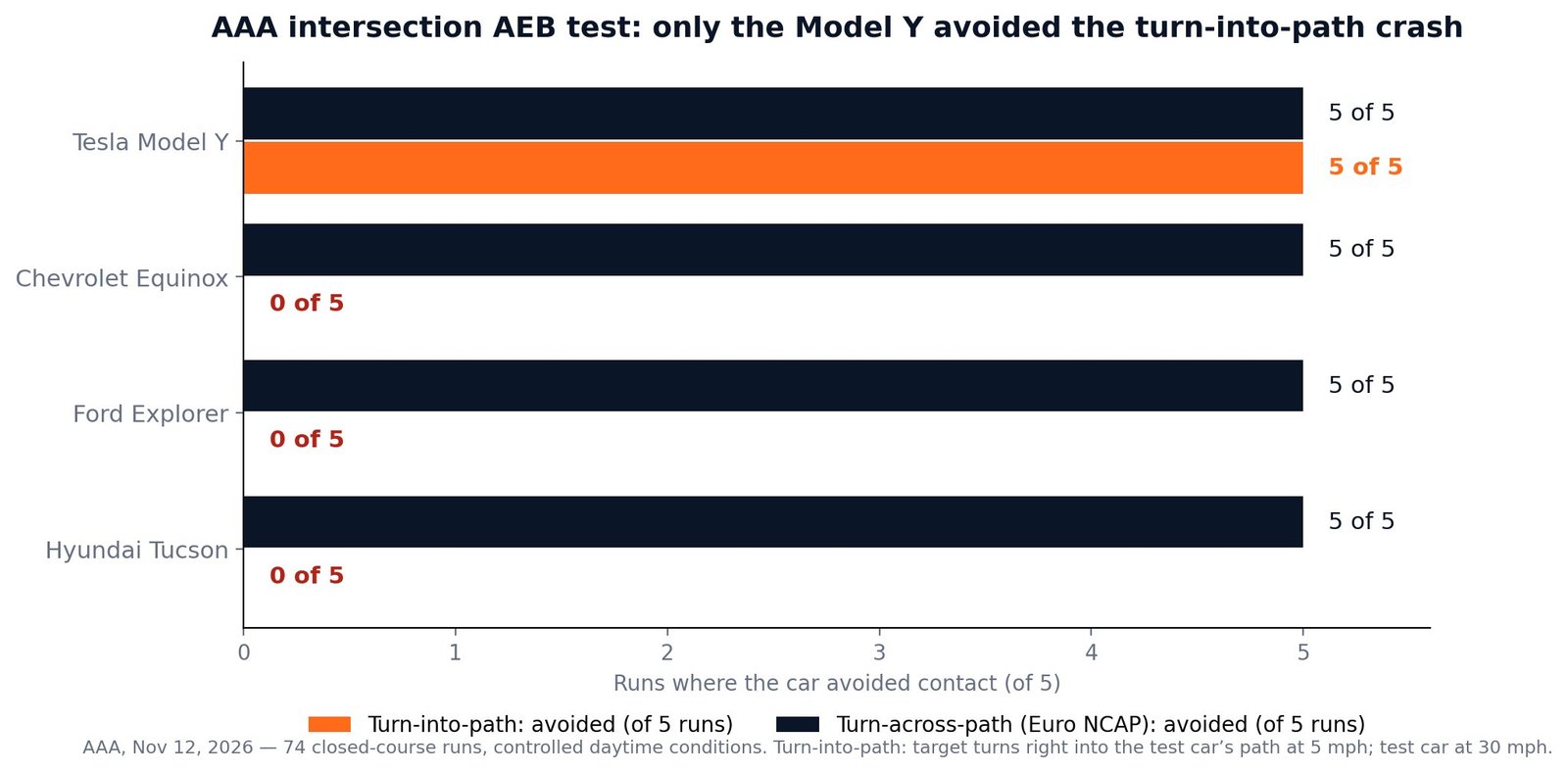
- Chevrolet Equinox: forward collision warning in 4 of 5 runs, but AEB applied in only 1 — it struck the target in every run.
- Ford Explorer: no forward collision warning in any of its runs. Testing stopped after 3 runs; it struck the target at about 20 mph on average.
- Hyundai Tucson: struck the target in the turn-into-path runs. In the turn-across-path test without a turn signal, it gave neither a warning nor braking and struck the target in all 3 valid runs.
The turn-across-path test tells a different story. There, the test car turns left at 15 km/h (9.3 mph) across a target travelling at 30 km/h (18.6 mph), with the turn signal on and a steering robot. All four cars avoided contact in every run. With manual steering and the signal on, all four avoided contact too. So AEB works well in the scenario it is tested for — and fails in the one it is not.
AAA's own summary is blunt. Marie Dodds, AAA Oregon/Idaho public affairs director, said the systems “don't work in all scenarios… No current technologies can replace an attentive and alert driver.” Greg Brannon, AAA director of automotive engineering and research, said: “AEB is making progress in the limited intersection scenarios it is tested to handle. Unfortunately, performance outside those scenarios is spotty.”
Why the AAA test is the reason this feature matters
Here is the connection between the two stories — and it is our analysis, not something AAA or Tesla has stated. AAA proved on November 12 that braking alone fails the turn-into-path scenario in three of four cars. Tesla's Collision Evasion, rolling out fleet-wide three days later, is the feature designed to go beyond braking by activating FSD to steer and maneuver. No top-10 page connects the two stories. The test shows the gap; the feature is built for exactly that gap.
That does not mean Collision Evasion would have passed AAA's test. The test measured AEB, and Collision Evasion is a different system with different inputs — it needs the FSD cameras, the HW4 computer, and an active subscription. Whether it would have avoided the turn-into-path crash is untested, and no one should claim otherwise. What the test does prove is that the problem Collision Evasion addresses is real and current: in one of the most common intersection crash types, braking alone is not enough for most cars.
There is a second reason the timing matters. The Model Y was the only car in AAA's test to avoid the turn-into-path crash — and it is also the car that, as of May 2026, is the first vehicle model to pass NHTSA's new NCAP advanced driver-assistance benchmark, covering pedestrian AEB, lane keeping assistance, blind spot warning, blind spot intervention, forward collision warning, crash imminent braking, dynamic brake support, and lane departure warning. Tesla's safety story is consistent across both tests. Collision Evasion is the next step in that story — a system that acts when the braking-based tests reach their limit.
What is FSD v14.3.13?
The Tesla FSD v14.3.13 build inside update 2026.38.5.13 is the latest version of Full Self-Driving (Supervised) for HW4 cars. Its release note is short: Tesla “upgraded the Reinforcement Learning (RL) stage of training the FSD neural network, resulting in improvements in a wide variety of driving scenarios.” In plain terms, the system was retrained with a newer method, and Tesla says it drives better across many situations — not one specific maneuver.
The version history helps to place it. FSD v14.3 arrived with update 2026.38.5 on October 10, 2026. A point release, 2026.38.5.10, followed on October 20 and reached about 2.8% of the TeslaFi tracked fleet. Another, 2026.38.5.11, arrived on October 27 and reached about 21.8% of that fleet. The 2026.38.5.13 build is the latest point release in that branch, and it is the one going wide now. HW3 cars get FSD v14.3 Lite, the lighter build for the older computer.
One number from the last earnings report puts the FSD audience in context: FSD subscriptions reached 1.74 million in the third quarter of 2026, up 67% from 1.04 million a year earlier, and the FSD (Supervised) attach rate is over 75% of new vehicle deliveries in North America. That is the pool of owners who can get Collision Evasion — if their car has HW4.
How do I get the 2026.38.5.13 update?
You do not need to do anything special. Tesla pushes software updates in waves, and the car downloads the update when it is parked, connected to Wi-Fi, and in range. Check the Tesla app, not the car, for the prompt — the app shows the update is ready before the car does. Tap to install, or schedule it for later. The car needs to be parked and, for most updates, plugged in or with enough charge.
If the update has not reached you yet, wait. Staged rollouts take days, and Tesla can pause a wave if it spots a problem. There is no way to force the update, and no official early-access list for regular owners. If your car is HW3, you will get the same build number but with FSD v14.3 Lite, and Collision Evasion will not appear in your release notes — that is expected, not a fault.
Before installing, check two things: that your FSD subscription is active (Collision Evasion needs it) and that Automatic Emergency Braking and FSD (Supervised) are both enabled in the Autopilot settings. The feature will not activate if either is off.
What NHTSA is watching
The same system is under an open federal investigation, and any honest article has to say so. NHTSA's Office of Defects Investigation upgraded its FSD reduced-visibility probe from a preliminary evaluation (PE24031) to an Engineering Analysis, EA26002, on March 18, 2026, covering an estimated 3,203,754 FSD-equipped vehicles. The question: whether FSD's degradation detection fails to warn drivers when cameras are blinded by glare, fog, or airborne dust — and whether it warns them with enough time to respond.
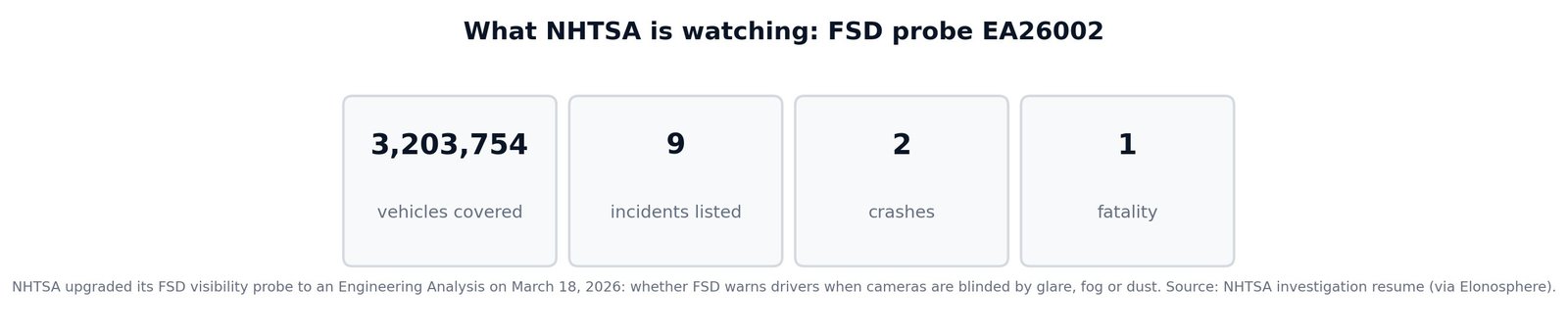
The failure summary in the NHTSA resume lists 9 incidents, 2 crashes, 2 injury incidents with 1 injury, and 1 fatality tied to FSD performance in reduced visibility. In the crashes NHTSA reviewed, the system did not detect the conditions impairing camera visibility and did not present alerts until immediately before the crash. A follow-up information request, EA26002-01, dated July 2, 2026, asks Tesla for clarification on the adequacy of its driver alerts in glare, fog, and airborne dust. An Engineering Analysis is not a finding of a defect — it is the stage that typically precedes a recall determination, and NHTSA has not scheduled a public deadline for Tesla's response.
There is also a separate, newer thread: on September 23, 2026, a petition alleged that Model Year 2026 Tesla robotaxis — the Model Y and the two-seat Cybercab — exceed posted speed limits in active school zones while their Automated Driving System is engaged. NHTSA opened a preliminary evaluation covering roughly 1,000 vehicles. A preliminary evaluation does not imply any finding of a defect. And in October 2026, NHTSA opened an investigation into a California crash in which the driver was reported to have fallen asleep. These are the counterweights to the rollout story, and they are why the “what this does not decide” section below exists.
How the week played out
| Date | What happened |
|---|---|
| September 2026 | Automatic Collision Evasion debuts in update 2026.27.6 (FSD v14.3.9); Tesla adds it to the owner's manual |
| October 10, 2026 | Update 2026.38.5 ships with FSD v14.3.12 |
| October 20, 2026 | Update 2026.38.5.10 reaches about 2.8% of the TeslaFi tracked fleet |
| October 27, 2026 | Update 2026.38.5.11 reaches about 21.8% of the TeslaFi tracked fleet |
| November 12, 2026 | AAA publishes its intersection AEB test: only the Model Y avoids the turn-into-path crash |
| November 13, 2026 | Update 2026.38.5.13 first spotted on a Cybertruck AWD in Florida |
| November 15, 2026 | Third wave: about 17,380 additional vehicles receive the update in five minutes (Teslascope) |
| Next | Wider rollout continues; NHTSA EA26002 probe ongoing with no public deadline |
What this does not decide
A rollout is not a verdict. Here is what this update does not settle.
- Whether Collision Evasion prevents crashes in the real world. No independent test has measured it yet. AAA tested AEB, not this feature, and Tesla's own release notes say the system “tries” to keep the vehicle safe.
- Whether HW3 cars will ever get it. Tesla has said nothing, and the hardware gap — the HW4 computer runs the full v14.3.13 build, HW3 runs Lite — is the reason it is HW4-only. Do not expect it on HW3.
- Whether the 348-mile-style numbers hold up. This is not a range story, but the same caution applies: Tesla's configurator and release notes are the source, and independent verification takes time.
- Whether NHTSA's EA26002 probe changes anything. An Engineering Analysis is not a finding of a defect, and the probe covers FSD's behavior in reduced visibility — a different question from Collision Evasion's crash-avoidance role. But the same cameras and the same system are involved, so the probe is relevant context, not a footnote.
- Whether the feature is worth paying for FSD. Collision Evasion needs an active FSD purchase or subscription. If you do not already pay for FSD, this feature alone is unlikely to justify the cost — it activates rarely, by design.
What happens next
The rollout continues in waves over the coming days, and the Tesla FSD v14.3.13 build should reach the bulk of eligible HW4 cars within a week or two if Tesla follows its usual pattern. Watch for owner reports in Tesla groups — the first real-world accounts of the feature activating will come from there, not from Tesla. If a credible video of Collision Evasion steering around a crash surfaces, that becomes the next story.
Two things to watch beyond the rollout. First, the NHTSA EA26002 probe, which has no public deadline — any finding there would matter more than any single software update. Second, the next FSD build: Tesla is already working toward FSD v15, and the release notes for the next branch will show whether Collision Evasion expands to more scenarios or stays as it is.
For now, the practical takeaway is simple. If you have an HW4 Tesla and an active FSD subscription, check the app for the update. If you have an HW3 car, you will get the same build number with FSD Lite and no Collision Evasion. And whatever you drive, the AAA test is the reminder that matters most: no current system replaces an attentive driver.
Mix-ups, corrected
- Mix-up: “Automatic Collision Evasion is a brand-new feature.” Correction: it debuted in update 2026.27.6 in September 2026, with FSD v14.3.9. The news is the wide rollout in 2026.38.5.13, not the debut.
- Mix-up: “It makes the car self-driving.” Correction: FSD (Supervised) is a Level 2 driver-assistance system. The driver stays responsible, and the feature only engages while you are driving manually.
- Mix-up: “Every Tesla gets it.” Correction: only HW4 cars with an active FSD purchase or subscription. HW3 cars get FSD v14.3 Lite instead, with no Collision Evasion.
- Mix-up: “It replaces Automatic Emergency Braking.” Correction: it works alongside AEB. AEB brakes; Collision Evasion steers. Both need to be enabled for the feature to work.
- Mix-up: “AAA tested Collision Evasion.” Correction: AAA tested automatic emergency braking. The connection between the test and the feature is our analysis — the test shows the gap the feature is built to fill, but the feature itself has not been tested that way.
Quick answers
What is Tesla Automatic Collision Evasion?
A safety feature that activates Full Self-Driving (Supervised) to steer your car out of a crash — or to take over again if you stop paying attention — while you are driving manually. It arrived in update 2026.27.6 in September 2026 and is now rolling out widely in update 2026.38.5.13.
Which Teslas get Automatic Collision Evasion?
Only HW4 (AI4) cars with an active Full Self-Driving purchase or subscription, with both Automatic Emergency Braking and FSD (Supervised) enabled. HW3 cars get FSD v14.3 Lite instead, which does not include the feature.
Do I need FSD to get Automatic Collision Evasion?
Yes. The feature needs an active FSD purchase or subscription. Without it, the feature does not activate, even on an HW4 car with the update installed.
How is Automatic Collision Evasion different from Automatic Emergency Braking?
AEB only controls the brakes — it brakes hard to avoid or soften a crash. Collision Evasion activates the full FSD (Supervised) system, which can steer the car around the hazard and then keep driving. It also needs HW4 hardware and an active FSD subscription; AEB does not.
How do I get update 2026.38.5.13?
Tesla pushes it in waves. Park the car, connect to Wi-Fi, and check the Tesla app for the prompt. There is no way to force the update. HW3 cars get the same build number with FSD v14.3 Lite.
What did AAA's test find about intersection AEB?
In the turn-into-path test, only the Tesla Model Y avoided contact — in all five runs. The Chevrolet Equinox, Ford Explorer, and Hyundai Tucson struck the target in every valid run. In the turn-across-path test, all four cars avoided contact in every run.
Is Automatic Collision Evasion the same as Full Self-Driving?
No. It activates FSD (Supervised) in an emergency, but FSD (Supervised) is a Level 2 driver-assistance system, not self-driving. The driver stays responsible at all times.
Does Automatic Collision Evasion work on HW3 cars?
No. HW3 cars get FSD v14.3 Lite in the same update, and Lite does not include Collision Evasion. Tesla has not said HW3 will ever get it.
Sources
- News: TeslaMagz — Tesla software update 2026.38.5.13 release notes (Automatic Collision Evasion, FSD v14.3.13, HW4-only)
- News: Basenor — Tesla update 2026.38.5.13 rollout tracker (third wave, ~17,380 vehicles in 5 minutes)
- Study: AAA Oregon/Idaho — AAA: How Well does Automatic Emergency Braking Work in Intersections? (Nov 12, 2026)
- Official: NHTSA — Tesla Model Y first vehicle to pass NHTSA's new ADAS tests (press release)
- News: Not a Tesla App — Watch Tesla's FSD's new Automatic Collision Evasion feature in action (Sept 26, 2026)
- News: Elonosphere — Tesla pushes FSD v14.3 rollout as NHTSA's visibility probe reaches 3.2 million vehicles (EA26002)
- News: Reuters — Tesla Model Y is first vehicle to pass new US driver-assistance system tests (May 7, 2026)
What people are saying
- Total Tesla — Craig (Facebook, Nov 15): a photo of the 2026.38.5.13 release-notes screen showing Automatic Collision Evasion and its two scenarios. See the post on Facebook
- Steven Knox (Facebook, Nov 14): a plain-English explainer of the rollout — first spotted on a Cybertruck in Florida; FSD v14.3.13 for HW4. See the post on Facebook
- Sonny Rattan (Facebook, Nov 15): “Downloading 2026.38.5.13 (67%)” — a screenshot of the update in progress. See the post on Facebook
No Reddit thread or X post could be opened from our research environment, so none is linked here. The Reddit video of the feature in action (r/TeslaFSD, September 2026) is documented through the Not a Tesla App article in the sources above.