| Question | Short answer |
|---|---|
| Why did Tesla stock rise on October 26? | Barclays upgraded Tesla to Overweight and raised its target to $450, after a weekend of Robotaxi records. |
| What did Barclays change? | Rating to Overweight from Equal Weight; target to $450 from $370 — about 21% above Friday's $372.22 close. |
| What does the $450 target depend on? | Four legs: a SpaceX deal premium, a car-business recovery, sold-out energy storage, and a Robotaxi inflection. Each has a break point. |
| Is a Tesla–SpaceX merger done? | No. Committees formed, but filings say no assurance a deal happens; any vote comes later. |
| How big is Houston's Robotaxi zone, really? | Tesla gave no new size. A tracker estimates about 254 square miles served by about 34 driverless Model Ys. |
| Is this investment advice? | No. Targets are reported, never endorsed. |
Tesla stock rose about 6% intraday on Monday, October 26, 2026, after Barclays analyst Dan Levy upgraded the company to Overweight from Equal Weight and raised his price target to $450 from $370. The move capped a weekend in which driverless Cybercabs swarmed the Formula 1 race in Austin, Houston's Robotaxi zone grew into a new shape, Berlin set a production record, and Latvia became the tenth European country to approve Tesla's supervised driving software.
That is the news. The more useful question is what the $450 target actually rests on, because a target is an opinion about the future, not a measurement of the present. Levy's case, as reported from his note, rests on four legs: a takeover premium if Tesla combines with SpaceX, a car business returning to growth, energy storage nearly sold out for 2027, and a Robotaxi business whose miles are inflecting upward. Each leg is real, and each one has a way to break. This article takes them one at a time, separates what is verified from what is merely expected, and keeps the counterarguments in the same frame. This is not investment advice.
The market reaction, in order
Monday's tape, in order, tells a cleaner story than any single snapshot. In pre-market trading the stock was up about 2.0 to 2.3%, to roughly $380. It opened at $383.83. By 12:29 p.m. Eastern it was at $395.06, up $22.84 or 6.13%, according to the Motley Fool's midday market report. In the afternoon session it was up 6.1%, according to StockStory. The EV publication's press-time figure was $394.64, up $22.42 or 6.02% from Friday's $372.22 close. Finnhub's later intraday snapshot showed $396.11, up $23.89 or 6.42%, with a day range of $383.73 to $396.96. Every figure in this section is intraday. No Monday closing price exists in any source checked for this article, and none is stated here.
For context, Tesla rose 7.3% in October and led the big-technology group for the month, while ranking as its worst performer for the year, according to Stocktwits. SpaceX shares were up about 1.5% intraday Monday, to $149.70, in the same coverage. Year-to-date figures for Tesla itself are deliberately left out of this article: snapshots published the same day disagree by wide margins, and mixing them would mislead more than inform.
What Barclays actually changed
The change itself is simple. Barclays moved Tesla from Equal Weight, its neutral stance, to Overweight, its positive stance, and lifted the 12-month price target by $80, from $370 to $450. The new target sits about 21% above Friday's $372.22 close, according to Finbold's arithmetic, and the raise itself is a 21.6% increase on the old target. Mizuho rates Tesla Outperform with a $460 target, according to Tradingpedia's October 26 coverage; this article states that rating and target without characterizing whether Mizuho raised or maintained it, because the day's coverage describes it both ways.
Levy's reasoning, as reported from his note, starts with the deal. "The recent dialogue around Tesla has skewed heavily to a potential combination with SPCX," he wrote, using SpaceX's ticker. "With a combination heavily expected, and with expectation for some premium to TSLA stock, we believe this should drive upside for the stock." The rest of the case does not rest on a deal alone. Levy wrote that the auto business is on track to grow this year after two years of declines, with self-driving demand and rising exports from Giga Shanghai supporting further gains in 2027, and that energy storage is nearly sold out for 2027 on data-center demand, which could support shipment growth above 50%. On Robotaxi, he wrote: "In recent weeks we've seen a sharp inflection in Robotaxi miles driven, boosting hope that TSLA can compete more directly with Waymo in autonomous ridehailing."
For consensus, this article uses one snapshot only, to avoid mixing surveys taken at different times. Price Target counts 18 analysts setting a Tesla target in the past three months, with targets from $24.86 to $500 and a median of $446. That range alone should warn any reader against treating $450 as a consensus or a destination. It is one firm's view, sitting near the middle of a very wide spread.
Leg one: the SpaceX premium
The first leg is also the most fragile, because it prices in a transaction that does not exist yet. Musk disclosed on the Oct 20 call that both boards had formed special committees; the filings describe exploring a deeper relationship that could include a combination, with no assurance a deal happens. That hedged wording is deliberate. One source describes the committees as appearing only in Musk's call words, so this article does not claim the filings confirm the committees. Musk himself said a merger should not be assumed to be a certainty, adding: "because I'm a conflicted party, I can't actually be in the discussions of the special committees" — an "odd kabuki dance." On Tesla's call a day later he said he had said everything that should be said, and investor-relations head Travis Axelrod declined merger questions. Full background is in our earlier merger piece.
What would have to happen for this leg to pay off is a high bar. A Tesla deal needs a majority of all outstanding shares, not just votes cast. Musk holds 19.8% of Tesla as of September 30 and more than half of SpaceX's voting power, which makes approval far easier on the SpaceX side than on Tesla's. The December 3, 2026 annual-meeting proxy contains no merger proposal, so any vote comes later; Wall Street's working expectation is a deal before the end of 2027. Dan Ives of Yorkville Ives, who carries a $500 Tesla target, put the odds at 90% on CNBC on October 22, with a $500 to $550 deal price, and his October 26 note put it at 80 to 90% by the end of 2027, splitting $500 into $165 for vehicles and $335 for autonomy and Optimus. Gene Munster has gone to 95% within two years, possibly next year. Those are opinions, not a done deal, and the gap between 80% and certainty is where a premium can evaporate.
The financial ties are already large, which is part of why the market prices in a deal at all. SpaceX bought $151 million of Megapack batteries in the third quarter, $480 million in the first nine months of 2026. Tesla recognized $221 million of Megapack revenue from SpaceX in the quarter, $626 million in nine months, with $729 million in receivables at September 30. Tesla's roughly $2 billion March 2026 investment in SpaceX stock was worth $2.865 billion at September 30. On the joint Terafab semiconductor plant in Texas, keep two numbers apart: a reported initial build-out of about $3 billion for a research facility, rising to $16.8 billion full-scale in Grimes County, versus Musk's long-term framing of "tens of billions" through early 2028, with "who pays for what" unresolved. What breaks this leg: no agreement, a failed shareholder vote, or a deal at no premium. Any of those would remove the very thing Barclays is paying for.
Leg two: the car business turns
The second leg is the core business, and here the evidence is mixed in a way that actually supports Levy's caution as much as his optimism. Tesla delivered 486,532 vehicles in the third quarter, above the FactSet analyst consensus of about 461,000 by roughly 5.5%, including 478,237 Model 3 and Model Y vehicles and 8,295 other models. Total deliveries still fell 2.1% from 497,099 in the third quarter of 2025, and production was 464,391. A beat against lowered expectations is not the same as growth, and Levy's claim is specifically that autos return to growth this year after two years of declines — a claim the fourth quarter still has to prove.
Berlin gave the auto story its own record last week: 7,000 Model Ys in one week, per Tesla Manufacturing on X on October 23 — "Ramp-up is in full swing" — with the plant running around the clock five days a week. The number still falls about 500 a week short of the 7,500 target. The ladder is 4,000 a week in February 2023, 5,000 in March 2023, 6,000 in early 2024, and 7,000 now, a run rate of roughly 364,000 a year against a third-quarter deck figure above 375,000 annualized. September needed three extra shifts plus mandatory special shifts on September 18, 19, and 25, yet output stayed below 6,500 a week. For context, 2025 produced about 202,000 vehicles at 54% of capacity. Demand backs the ramp: Model Y was Europe's best-selling EV in January through July 2026, with 115,957 registrations, up 55% year over year, according to Dataforce, and Germany's September registrations tripled to 12,552. Berlin ships to more than 30 markets, including Canada from Halifax since September 2025, which avoids the 25% counter-tariff on US-made cars. Tesla also plans to seek approval in December for a second production hall of about 536,000 square meters, and Musk said on the earnings call that demand is exceeding production "by a significant margin," with battery availability constraining output and the largest passenger-vehicle backlog in four years. What breaks this leg: a fourth quarter that fails to deliver growth, or a ramp that stalls below 7,500.
One car story closed for good this month, and it belongs in the same section because it shows the limits of the lineup. Tesla told Australian and New Zealand reservation holders that "after careful consideration, plans to produce Cybertruck for Australia and New Zealand have been discontinued." Reservations were cancelled with full refunds within 30 days of confirming refund details, and the truck left the Australian and New Zealand websites. Tesla gave no reason beyond the statement. Deposits were $150 from the November 2019 unveiling, and the order page vanished in May 2022. Consolation is a complimentary one-year supervised self-driving subscription with a new Model 3 or Model Y order — about $1,788 at Australia's $149-a-month price, though an order-by-year-end condition reported by EVStraya and Merritt rests on unseen footnotes. The truck was never built in right-hand drive, and US sales fell about 50% in 2025.
Leg three: energy, nearly sold out
The third leg is the quietest and, on the numbers, the most contradictory. Levy's view is that energy storage is nearly sold out for 2027 on data-center demand, which could support shipment growth above 50%. The third quarter itself does not flatter that view: energy generation and storage revenue was $2.881 billion, down 16% from a year earlier, even as the company reported record demand and backlog, with deployments of 13.7 gigawatt-hours. Sold-out order books and falling reported revenue can both be true at once — orders convert to revenue later — but the gap is exactly what a skeptical reader should watch. What breaks this leg: orders that fail to convert, or a 2027 shipment number that lands well below 50% growth. The SpaceX Megapack purchases described above sit inside this leg too: they are real revenue, but they are also related-party revenue, which deserves the label.
Leg four: Robotaxi inflection — and its limits
The fourth leg is where Monday's news was loudest, and where the gap between activity and commercial proof is widest. Tesla's safety report for January 22 to October 18 counted 3,112,541 autonomous miles: 2,118,015 in Austin, 608,130 in Dallas, and 225,964 in Houston. Tesla's own Texas police-data estimate puts human drivers at roughly 9.1 injury collisions per 2.95 million miles, with the company's own caveats: a first-contact-only metric, monitored miles excluded, Texas only. Miles are evidence of operation, not of profit. Tesla discloses no Robotaxi revenue, no ride counts, and no per-ride economics, so no reader can yet verify that the inflection Levy cites is a business rather than a demonstration.
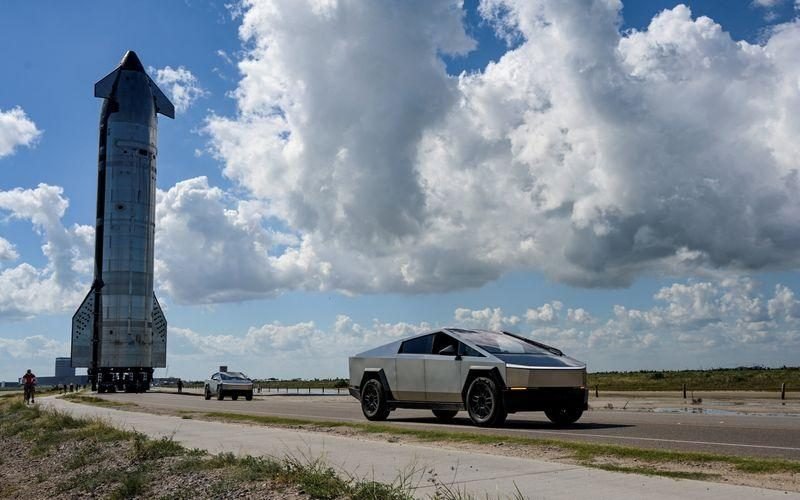
Austin was the demonstration. Tesla put its driverless Cybercabs out in force around the Formula 1 United States Grand Prix at the Circuit of the Americas. Sawyer Merritt counted more than 50 Cybercabs dropping off passengers by midday Sunday, and Tesla AI chief Ashok Elluswamy wrote: "Robotaxis as far as the eye can see!" Community tracker Cybercab Spotter logged a record 1,250 Cybercab sightings in Austin on Saturday, with 1,159 — 93% — showing nobody in the driver's seat, and Robotaxi Radar put the previous total high at 1,072 on October 16. Sightings are not vehicles: the same car counted twice counts twice, and these are community counts, not Tesla fleet numbers. Texas registrations listed 970 vehicles — 463 Cybercabs and 507 Model Ys — though registrations do not say how many actively operate. Tesla set the weekend up in advance: the Austin boundary expanded to the circuit on October 22, with "Last call is 1am" late at night, and hours had stretched from 11 p.m. in early October to 1 a.m. for race weekend. Tesla has not disclosed how many rides it gave to and from the circuit. Tesla says more than 300 Cybercabs served Austin by October 10, and Musk said the fleet grew tenfold since launch about a month ago. Targets are around-the-clock service and first customer Cybercab deliveries before year end, with most Cybercabs expected to remain Tesla-owned. Dallas Cybercab rides are due next month, per the third-quarter call — not yet live.
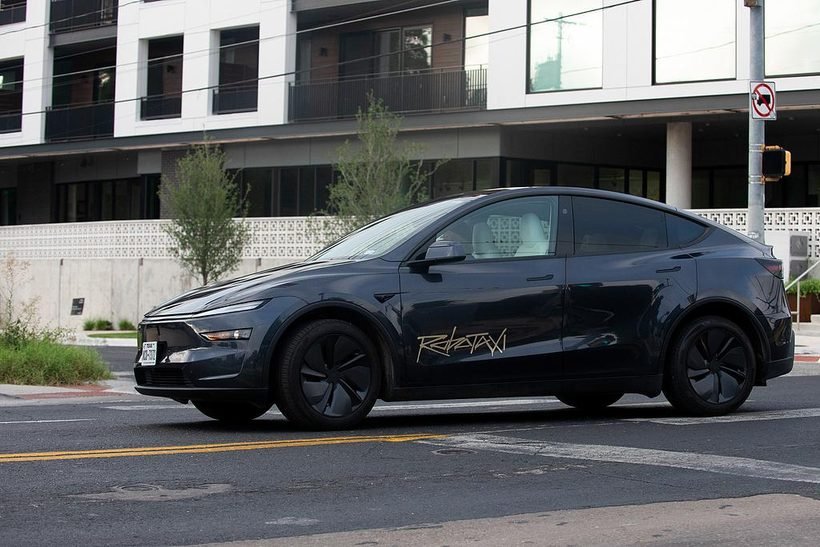
Houston was the quieter expansion, and the more revealing one. Tesla's Robotaxi account posted at 6:38 a.m. Pacific on Monday: "Houston, we have liftoff" and "Bigger service area now live," with a map overlay. Musk quote-posted it about seven minutes later: "I swear it's just a coincidence." The old zone — roughly 25 square miles — covered Jersey Village, Harvest Bend, and the Willowbrook corridor in northwest Houston, barely changed since its April 18, 2026 launch, the same day as Dallas. The new zone keeps that old patch as the nose and stretches southeast through central Houston and downtown toward Bellaire, with TeslaNorth adding the edge of Pasadena. Tesla gave no new size and did not say whether hours changed, so neither is stated here. But a third-party tracker fills in the missing piece with an attribution the reader can weigh: Robotaxi Tracker estimates the new zone at about 254 square miles, roughly ten times the launch zone, served by only 34 unsupervised Model Ys, up from 22 three months ago, and no Cybercabs yet — about one car for every 7.5 square miles. For comparison, the same tracker counts 397 driverless vehicles in Austin, more than half of them Cybercabs, and Waymo has run fully driverless rides in Houston since February, roughly doubling its zone there to nearly 50 square miles in May. Electrek's verdict on the Houston map is blunt: a geofence drawn for a joke is not the same as an operating network, and Tesla still limits itself to lower-speed roads and avoids more complex environments, with even train crossings an issue. Public Houston rides use Model Ys with nobody in the front seats, booked through the Tesla Robotaxi app, open to the public inside the geofence from day one, while public Cybercab rides remain Austin-only. TeslaNorth reports service until 2 a.m. soon, around the clock by year end. What breaks this leg: a fleet that stays tiny while the map grows, a safety incident that freezes expansion, or a year that ends with miles but no money.
Latvia took the European approval count to ten on Monday, recognizing the Dutch regulator's approval for supervised self-driving. Tesla's Europe and Middle East account posted on X: "Now approved in Latvia," adding "Rollout begins soon." The basis is a provisional EU type approval from the Dutch RDW, granted in April 2026. The ten countries are the Netherlands, Lithuania, Estonia, Denmark, Belgium, Slovenia, Czechia, Croatia, Slovakia, and Latvia; Slovakia approved earlier in October as the ninth. Latvia's path took six months: filed April 13, testing that found three problems — traffic lights, wrong lane, speed-limit adaptation — and a Ministry of Economics proposal in September. Changes include a lower speed-limit-exceed threshold, auto-reset of the manual speed offset, and stronger driver monitoring. In Europe the system is called Tesla Assisted Driving, rolling out over the air at 99 euros a month in Latvia, and a wider EU vote ahead could pave the way for a broader rollout, according to Reuters. Slovakia counsels measure: a Reuters test drive there found smooth congested-highway handling and merges, but a brake slam for a closed barrier and a takeover when the car failed to steer into an open Supercharger bay. "You really have to be awake there," the reporter wrote. In the US, supervised self-driving is subscription-only at $99 a month since February 14, 2026, with 1.74 million active subscriptions at the end of September and an attachment rate above 75% of new North American deliveries.
Washington opens a door for the Cybercab
Monday also brought a federal proposal easing one Cybercab hurdle, and it is worth stating precisely what it is. The National Highway Traffic Safety Administration filed a notice of proposed rulemaking on October 23 — "Modernization of FMVSS No. 108 to Accommodate ADS-Equipped Vehicles," docket NHTSA-2026-1519, RIN 2127-AM70 — published in the Federal Register on October 26, with a 30-day comment period and a deadline around November 25. Signed by Administrator Jonathan Morrison, it expects no added costs and seeks immediate effect once final. That "once final" matters: this is a proposal, not a law, and finalization still has to happen.
The five changes are: headlamps tested at manufacturer-specified voltage rather than a fixed 12.8 volts unchanged since 1967; no more low-beam-above-high-beam rule in vertical layouts; manual-control and telltale rules for turn signals, hazards, and beams applying only to vehicles with manual driving controls, with "driver" dropped from the hazard-switch definition; and an optional cyan marker lamp for automated-driving systems, with full specifications. The reasoning, in the agency's words, is that an automated system "cannot forget that the turn signals are active," so a self-cancel rule built around a steering wheel serves no safety purpose in a software-steered car. The filing does not name Tesla or the Cybercab. This follows a 2026 deregulation sequence — a January commitment, then March, April, June, and July moves — with Morrison saying "absolutely" in July about eliminating steering-wheel and manual-control requirements.
The investigation is a different file
Do not mix the proposal with a separate, open investigation. Audit Query 26002, opened September 3, examines Tesla's Cybercab self-certification, with 21 requests. Tesla asked for eight weeks, to November 20, and got 30 days, putting the response deadline at October 30, 2026. The core question is why Tesla skipped an exemption petition — the usual route, allowing 2,500 vehicles a year, which Zoox took. A proposal that helps a future Cybercab and an investigation into how the current one was certified are two different files, and only one of them has a deadline this week.
Roadster steps out in Los Angeles
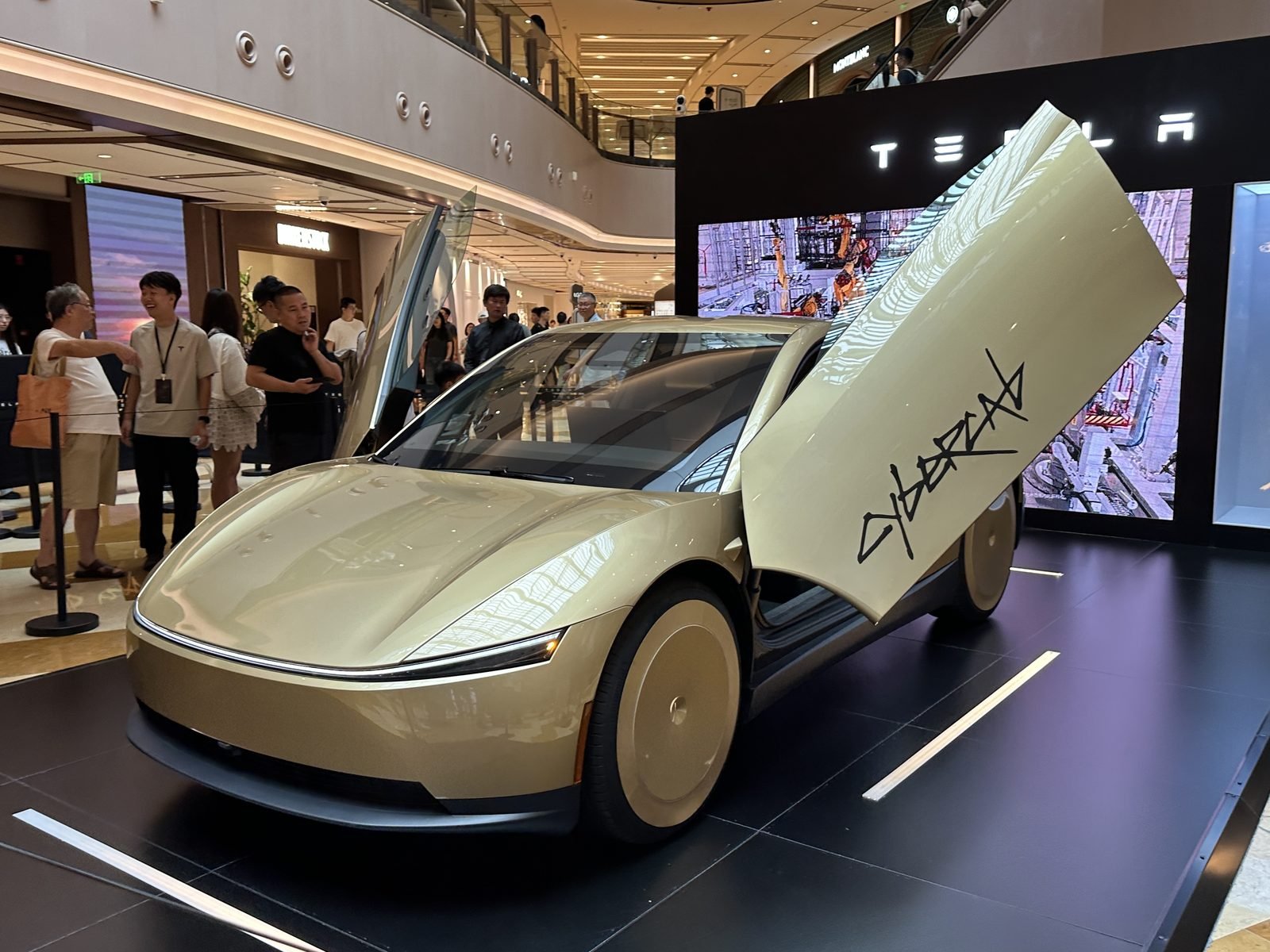
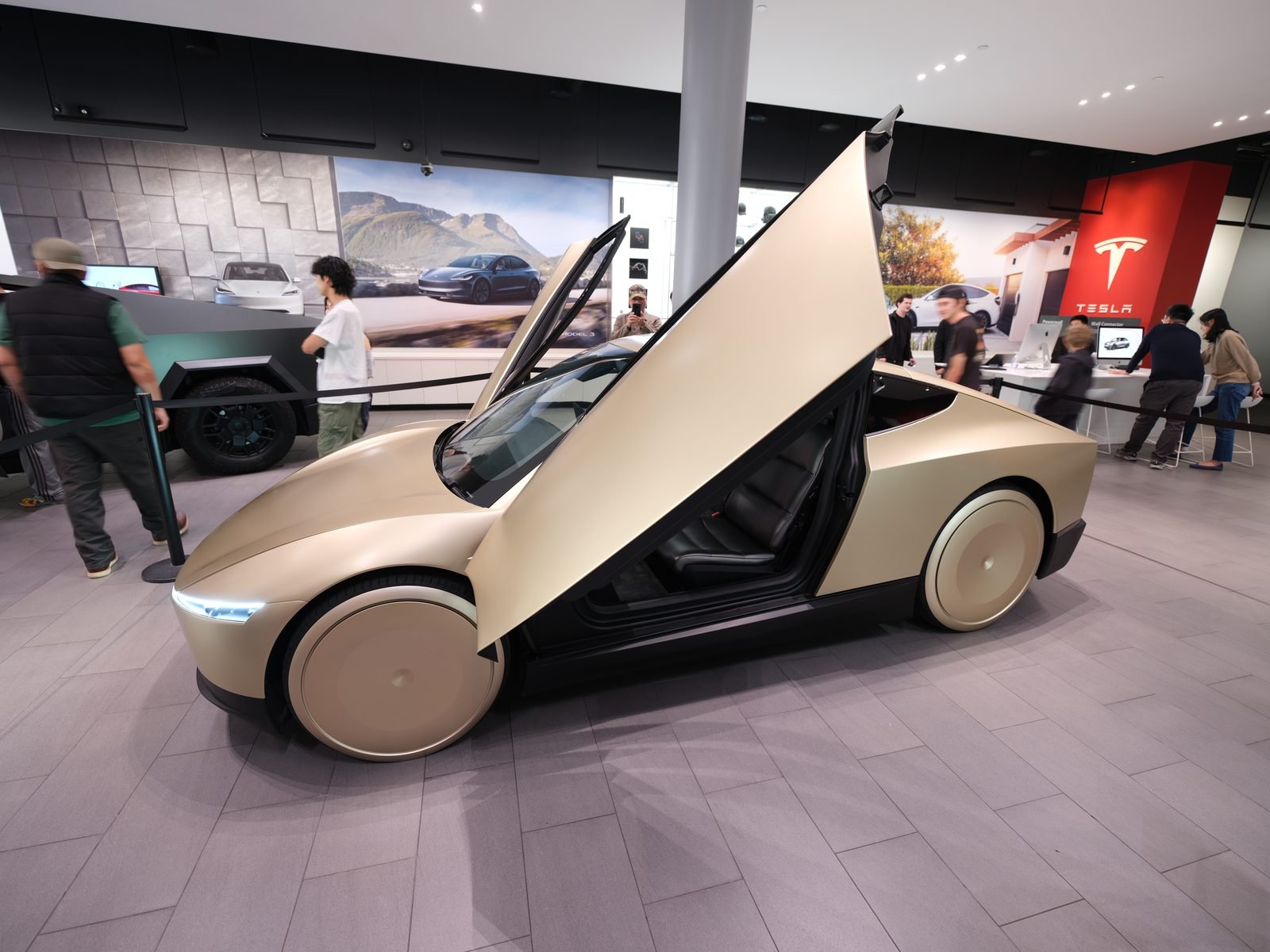
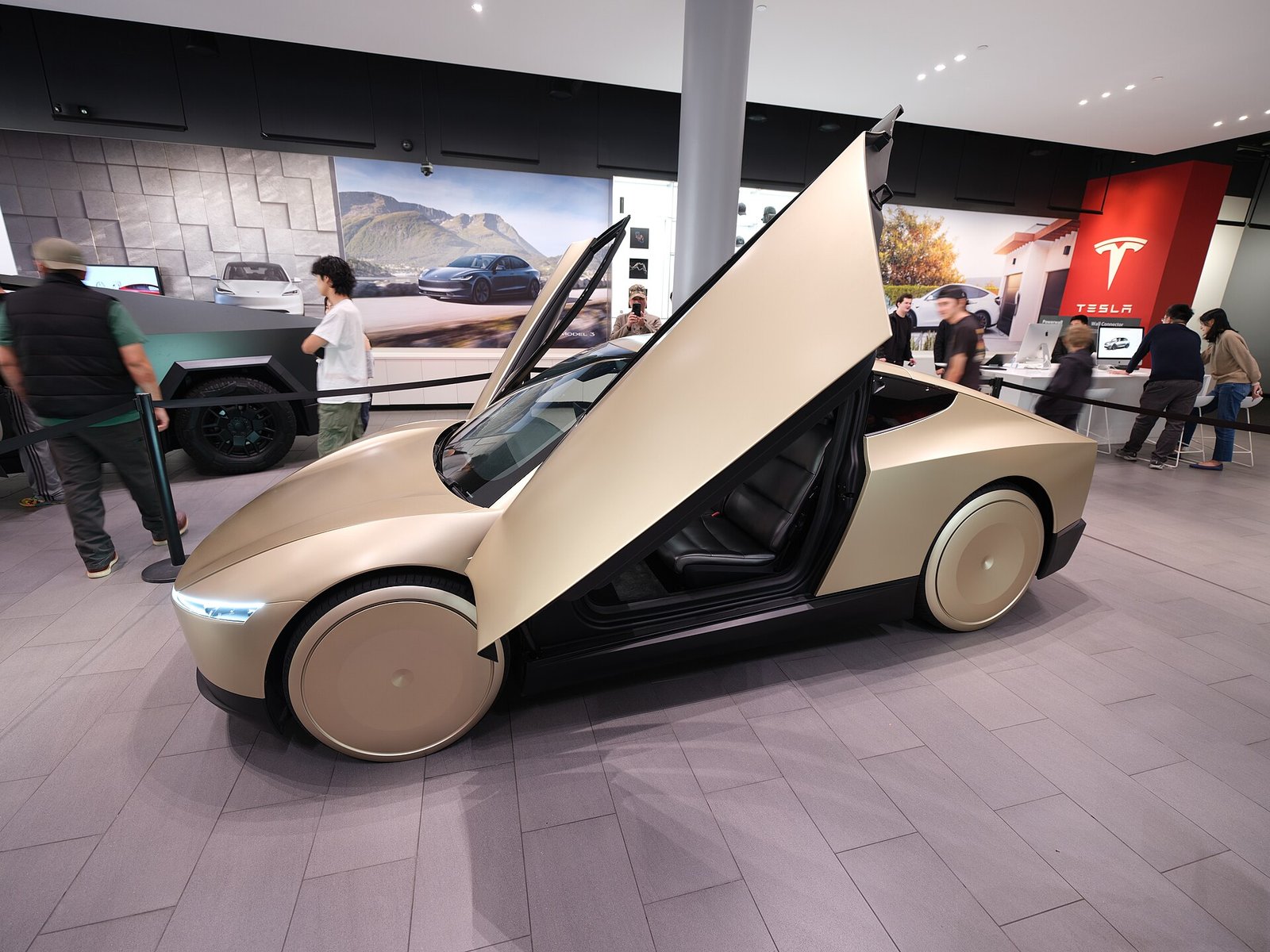
The Roadster stepped into the light for four days, October 24 to 27, in the main lobby of the Petersen Automotive Museum in Los Angeles — the same car unveiled in McGregor, Texas, in mid-October, in its first public up-close viewing. Roped off, look but don't touch, with no side mirrors on the prototype; US production cars will have them. The museum calls it the "last best driver's car." Three trims — Performance, Thrust, Rocket — run 0 to 60 in under 1.6, 0.9, and 0.59 seconds, with range above 300 miles. The Rocket's cold-gas thrusters "let it fly," and the museum puts Thrust at 0.81 seconds. Design chief Franz von Holzhausen arrived at the Petersen dinner on October 26 driving it, and the car shows dihedral doors and a visible rear pressure vessel. Production is set for 2028, with refundable deposits of $50,000 for Performance and $250,000 for Thrust, and the Rocket invite-only, according to press materials circulating the same weekend. One messaging line matters: the base version has no thrusters and is not to be described as having butterfly doors. A static display is not a production car, and nothing in this section should be read as a delivery date.
Turo, in one paragraph
One more piece landed Monday that belongs mostly elsewhere: Tesla and Turo announced US bookings for supervised self-driving test-drive rentals open October 28, verified through a Tesla integration, with a free one-month host trial. The full story is in our Turo piece.
The bear case, in one place
Fairness requires the other side in one place, not scattered as caveats. Phillip Securities raised its Tesla target to $230 from $220 on Friday but kept a Sell rating, implying about 38% downside from current levels, on the view that higher spending is offsetting margin improvements. Operating expenses rose 39% year over year, while operating margin fell to 2.6% from 5.8%. The third quarter itself is mixed underneath the upgrade: revenue of $28.046 billion was essentially flat against $28.095 billion a year earlier, and operating income fell 56%, even as adjusted earnings of $0.48 a share beat the $0.45 consensus. Against that, third-quarter free cash flow of $1.531 billion beat expectations of negative $4.92 billion, versus negative $1.092 billion in the second quarter, with operating cash flow of $6.263 billion, capital spending of $4.732 billion, cash of $45.447 billion, up $1.9 billion in the quarter, and $30 billion of undrawn facilities signed September 29. Capital-spending guidance for 2026 was cut to $20 billion from $25 billion. Retail sentiment on Stocktwits flipped to bearish from bullish over the past week, on high message volume. ARK's $5,000-by-2031 case is covered in our Cathie Wood valuation piece — one line, because that article owns the argument, and its optimism should be read against Phillip's Sell rating, not instead of it.
What to watch
The dates that will test this article's thesis, in order: October 30, when Tesla's response in the Cybercab certification investigation is due; around November 25, when comments close on the lighting proposal; next month, when Dallas Cybercab rides are due; before year end, when around-the-clock Robotaxi service and first customer Cybercab deliveries are targeted, and when Tesla plans to seek approval for Berlin's second hall; December 3, when the annual-meeting proxy arrives without a merger proposal; and before the end of 2027, when Wall Street expects a merger decision. If those dates break Tesla's way, $450 will look cautious. If they break the other way, Monday will look like a good day that ran ahead of itself.
Questions readers are asking
Is Barclays' $450 target a prediction or a guarantee?
It is a 12-month analyst target: one firm's opinion about where the stock could trade, not a promise. The same day's consensus snapshot spans $24.86 to $500, and another firm rates the stock Sell with a $230 target. Treat $450 as a thesis to test, not a destination.
Is the Tesla–SpaceX merger done?
No. Both boards formed special committees, and the filings describe exploring a deeper relationship that could include a combination, with no assurance a deal happens. A Tesla deal would need a majority of all outstanding shares, and the December 3 proxy contains no merger proposal.
How big is Houston's Robotaxi zone now?
Tesla has not given a new size. A third-party tracker estimates about 254 square miles, roughly ten times the launch zone, served by about 34 unsupervised Model Ys. The zone grew much faster than the fleet, which is the key fact for judging the expansion.
Do 1,250 Cybercab sightings mean 1,250 Cybercabs?
No. Sightings count observations by community trackers, and the same car can be counted more than once. Texas registrations listed 970 Tesla robotaxis in total, 463 of them Cybercabs, and registrations do not say how many actively operate.
Does the NHTSA proposal let the Cybercab drive without a steering wheel today?
No. It is a proposed rule with a comment period ending around November 25, and it still has to be finalized. Separately, Tesla's response in the open certification investigation is due October 30.
Bottom line
Monday's move is easy to explain and hard to dismiss: a major bank raised its target by a fifth, Robotaxi miles inflected, Houston's zone finally grew, Austin's Cybercabs set a record at the Grand Prix, Washington opened a door for the Cybercab, Berlin set a production record, and Latvia took the European approval count to ten. That is a lot of concrete news for one day. But the honest version keeps the caveats attached to the news: every price here is intraday, the merger is unagreed, the lighting rule is a proposal with a comment deadline, the investigation answers October 30, the Houston fleet is small next to its map, and the quarter underneath is mixed. The $450 target is best read as four bets placed at once — on a deal premium, a car recovery, sold-out energy storage, and a Robotaxi business that has miles but not yet money. This is not investment advice. It is a record of a day when Tesla's story caught up with its stock price, and a list of the dates that will show whether the story holds.